The Attention Recession: Why Every Sales Channel Is Getting Worse at the Same

Try Valley
Make LinkedIn your Greatest Revenue Channel ↓

Saniya
Published:
Updated:
The Attention Recession: Why Every Sales Channel Is Getting Worse at the Same Time
Published May 4, 2026 · Updated August 31, 2026
"Our outbound is off."
"Our LinkedIn numbers are down."
"Inbound's gotten weird."
"Ad performance is cratering."
"Even referrals feel slower."
If you've been hearing this from your team or saying it yourself you're probably treating each one as a separate problem. A subject line issue here. A targeting problem there. A new hire, a rebuilt sequence, a channel pivot.
That's the wrong frame. These aren't five different problems. They're one problem wearing five different costumes.
Every channel is getting worse at the same time and it's all because of attention. Or rather, a lack of it.
We are in an Attention Recession.
My favorite finds of the week:
Favorite template to get deals unstuck when leads ghost you (link)\
Discovery call red flags checklist (link)
Don’t sell through users to get buyers (link)
Prompting in json or xml format increases LLM output by 10x (link)
The traditional outbound playbook is dead (link)
What Is the Attention Recession?
Here's the shape of the problem without the jargon:
Every sales channel: cold email, LinkedIn, paid ads, SEO, webinars, events, cold calls relies on the same underlying currency: attention.
The supply of attention from a given buyer is roughly fixed. There are only so many hours a VP of Sales is going to spend evaluating vendors in a given quarter.
The demand on that attention, however, is exploding. Thanks to AI, every outbound team can now send 10x the messages, generate 10x the content, and run 10x the ad variants they could two years ago. And every buyer is feeling it.
When demand for a fixed resource goes up, the price of that resource goes up. In attention terms, that means: it costs more touches, more money, more creativity, and more time to earn the same mindshare you used to earn casually.
That's a recession. Things still work. They just cost more and return less.

What the Attention Recession Looks Like, Channel by Channel
Cold Email
Reply rates have been compressing for a decade, but AI-generated outbound has poured lighter fluid on the trend. When a CRO gets 120 "personalized" emails a day, all of which mention their recent LinkedIn post the marginal cost of getting noticed becomes astronomical.
The median cold email campaign in 2026 returns less than the median campaign did in 2022, across every benchmark available.
Same dynamic, different stage. LinkedIn used to be the cheat code. Acceptance rates were 40%+. Reply rates were 10%+. Now it's an arms race of AI-generated comments, AI-written messages, and AI-assisted content. LinkedIn responded by tightening detection and narrowing the API surface. Every play costs more to run.
Paid Ads
CPMs on LinkedIn and Meta have been climbing year over year across most B2B categories. You're paying more to reach the same person, who is now seeing more ads from more competitors, and clicking on fewer of them. The net result: CAC up, conversion down.
Events
Trade shows cost what they always cost, but a buyer's willingness to take 30 one-on-ones at a conference has dropped. The floor at most industry events is quieter than it was in 2019. The attention budget just isn't there.
Inbound
Even the good stuff is getting worse. Form fills on product pages are down. Demo-show rates are falling because buyers are doing more research silently through AI before ever identifying themselves. By the time someone fills out a form, they're already close to a decision. Your "top of funnel" is largely invisible now.
Every one of these is a real, measurable compression. And they're all happening at once.
(Insert image: channel-by-channel table or visual comparing 2022 vs 2026 performance benchmarks reply rates, CPMs, form fill rates)
💡 LinkedIn Tip of the Week
Posting and then immediately leaving LinkedIn hurts your reach. Stay active for 30 - 60 minutes after you publish. Engagement in that window signals to the algorithm that your content is worth distributing.

Why Pushing Harder Makes It Worse
The instinct, when a channel softens, is to push harder. More emails. More LinkedIn activity. More ad spend. More SDRs.
In an attention recession, this is exactly wrong.
More volume from you raises the noise floor for everyone including you. You're paying to saturate the very channel you need to cut through. You're contributing to the problem you're trying to solve.
The Three Moves That Are Actually Working
Here's what the best founders and sales leaders are doing right now:
1. Channel Concentration
Instead of being medium-good on six channels, pick one and be the best in your space. One channel, one motion, executed at a quality level that looks almost unreasonable from the outside.
Most of Valley's best customers are running one primary channel with one clear hypothesis not five channels with five mediocre hypotheses.
2. Relationship Compounding
Every touch with a prospect should accrue. With most outbound, each message is a cold start. The teams winning right now are building systems where the second message knows what the first said, the demo references the LinkedIn comment, the follow-up references the event.
It's not about any single interaction. It's about making the sum larger than the parts.
3. Asymmetric Payoff Bets
Dinners. Intimate roundtables. Physical mail. Handwritten notes. Things that are expensive in time, cheap in money, and completely outside the AI-generated attention vortex.
The ROI on a ten-person founder dinner right now is significant because nobody's measuring it that way, and nobody's competing for it at scale.
🎁 Gift Resource:
2026 Guide to LinkedIn Outreach: includes the latest InMail changes and a safety checklist.
What This Means for the Rest of 2026
Don't benchmark yourself against the version of outbound that worked in 2023. The channel that returned 15% reply rates two years ago is not the same channel today.
Your job as a founder or sales leader in 2026 is to figure out what kind of attention your ICP actually has left - and how to earn it in a way your competitors are structurally unable to copy.
That almost always means: do fewer things, at a quality level nobody else can match.
How Valley Fits Into an Attention-Scarce World
Valley is built for exactly this environment. Instead of blasting cold lists and hoping something lands, Valley focuses on warm outbound - reaching people who have already shown a signal of interest.
Profile viewers. Post engagers. Website visitors. Competitor signals. People who have already allocated a small slice of their attention to you. Valley captures those signals, qualifies them against your ICP, and sends personalized LinkedIn messages that convert at 3x the rate of standard outreach.
In an attention recession, warm outbound isn't just a better tactic. It's the only approach that makes economic sense.
Frequently Asked Questions
What is the Attention Recession in B2B sales?
The Attention Recession describes the phenomenon where every outbound sales channel, email, LinkedIn, ads, events, inbound is declining in effectiveness simultaneously. The cause: AI has dramatically increased the volume of outreach buyers receive, while the supply of buyer attention remains fixed. Higher demand for a fixed resource raises the "price" of getting noticed across every channel.
Why is cold email performance declining in 2026? AI tools have enabled every sales team to send 10x more "personalized" emails. When a single buyer receives 120 personalized emails per day, the perceived value of each one collapses. The result is declining reply rates and rising unsubscribe rates across the board.
Is LinkedIn outreach still worth doing in 2026?
Yes but the approach matters more than it used to. Cold, high-volume LinkedIn automation is facing the same headwinds as cold email. Warm outbound (reaching people who have already engaged with your profile, content, or website) still performs significantly better because it works with the buyer's existing attention rather than competing for a slice of it.
What is warm outbound and why does it work in an attention recession? Warm outbound means reaching prospects who have already shown a signal of interest: a profile view, a post engagement, a website visit. Because the prospect has already allocated some attention to you, your outreach starts with context rather than from zero. This is why warm outbound consistently outperforms cold outreach in an environment where buyer attention is scarce.
What are the best sales strategies for an attention recession?
The three approaches working best right now are: (1) channel concentration picking one channel and executing it at an exceptional quality level, (2) relationship compounding making every touchpoint aware of previous interactions, and (3) asymmetric bets investing in high-effort, low-scale tactics like dinners and physical mail that operate outside the AI-generated noise.
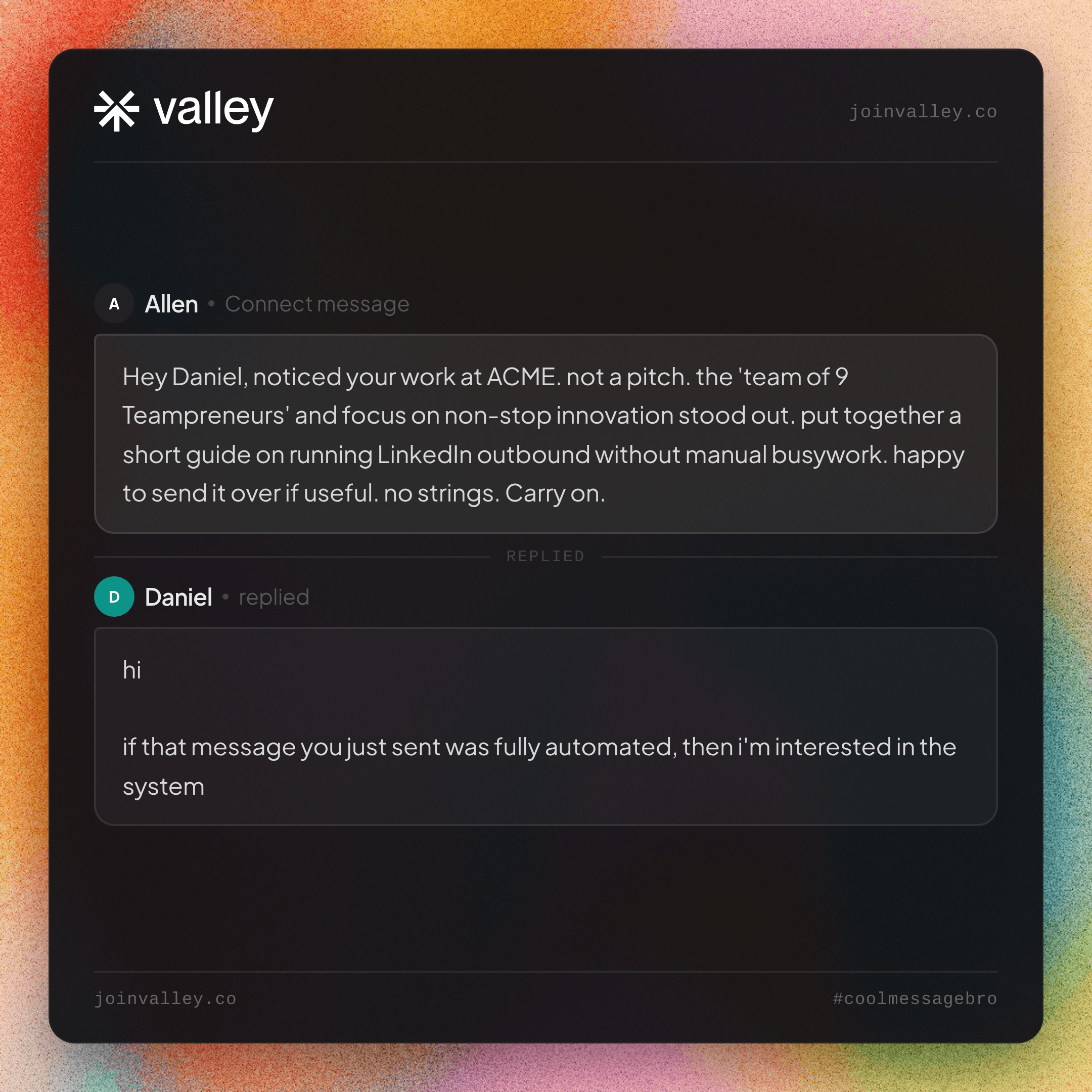
See more of Valley's outreach messaging examples: coolmessagebro.com
Generate more demos using LinkedIn: Book here
Become a Valley partner and earn 20% recurring commission: Join the affiliate program
► From insight to booked calls: Valley is free for 7 days. No sales call needed to find out.

Related Blogs

FEATURED READ
5 min
ZoomInfo Pricing Explained (2026): What It Actually Costs
Read
Read

FEATURED READ
5 min
Apollo Pricing and Credits Explained (2026): What You Actually Pay
Read
Read

FEATURED READ
5 min
Clay Pricing and Credits Explained (2026): The Post-March Math
Read
Read

FEATURED READ
5 min
LinkedIn Sales Navigator Cost Explained (2026): Every Tier, Real Numbers
Read
Read
Which channels does Valley support?
Valley supports LinkedIn outreach, including connection requests and InMails. Valley users safely send 1000-1200 messages per seat every month.
How safe is it and does Valley risk my LinkedIn account?
Do I have to commit to an Annual Plan like other AI SDRs?
How does Valley personalize messages?
Is Valley available in my country?

VALLEY MAGIC