
Try Valley
Put your outbound workflow to work.

Saniya Sood
Published:
Updated:
Published May 6, 2026 · Updated August 31, 2026
The automation is working. The leads are not. That is a signal that the automation is pointed at the wrong target.
Effective B2B lead generation automation for GTM agencies starts with intent signals, not contact lists.
The difference between automating a list and automating a signal is the difference between interrupting someone who has never heard of your client and continuing a conversation with someone who was already paying attention. Valley’s signal-based warm outbound on LinkedIn is built for the second model and it produces 3 - 5x higher reply rates because of it.
► Book a demo (teams of 5+)and explore how Valley can support your use case
The Lead Generation Automation Model That Plateaus
The standard GTM agency lead generation automation stack looks like this: LinkedIn Sales Navigator for list building, an automation tool for sequencing and sending, basic AI personalization on top, and CRM integration for tracking.
It works at low volumes. At scale, three problems compound.
Contact quality degrades. Sales Nav lists get recycled. The same 500 decision-makers in a target segment receive connection requests from three different agencies in the same month. They start ignoring all of them.
Message quality does not improve. Automation tools optimize for deliverability, not reply rates. Templates get marginally better but the fundamental problem messaging people who have no reason to care remains.
Client expectations outpace results. The client was promised 20 meetings per month. The automation is producing 6.
The gap between promise and delivery is the gap between churn and renewal.
The fix is not better templates. It is a different starting point.

B2B lead generation automation that starts from intent signals changes every downstream metric.
When a prospect has already viewed a client's LinkedIn profile, engaged with their content, or visited their website, they are not cold. They are warm. A message that arrives at that moment with context that references their behavior does not read like cold outreach.
It reads like a timely, relevant follow-up to something they were already thinking about.
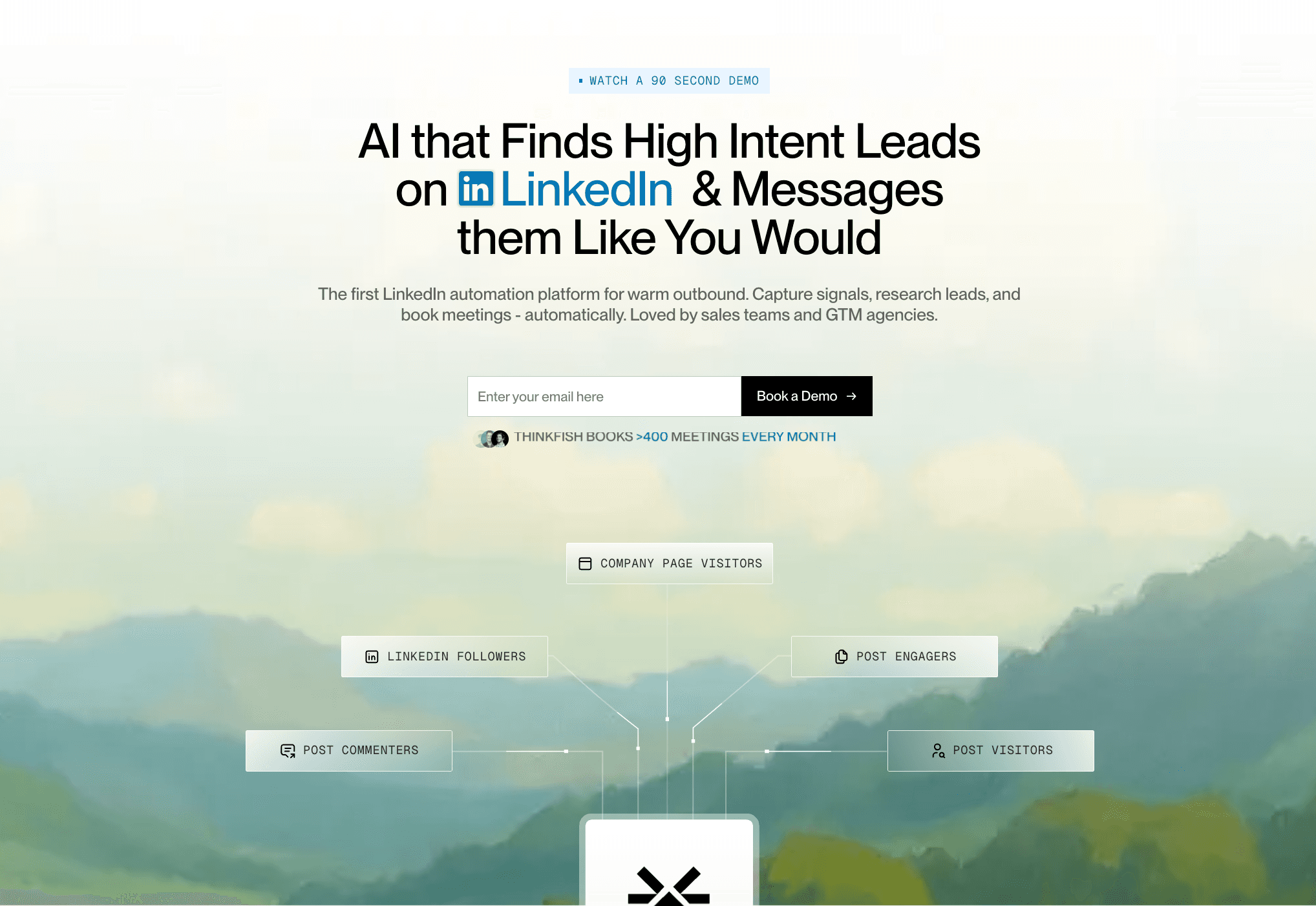
Valley captures five signal types for every client account: profile views, post engagement, company page followers, website visitors (de-anonymized via the intent tracking tool), and Sales Navigator lists. Every signal is cross-referenced against the client's defined ICP before any outreach begins.
Prospects that do not fit are excluded. Prospects that fit receive individually researched, AI-generated messages that reference something specific and real.
She described the lead generation output: "It's thousands of people with little to no manual work myself. So that's just something I could not have done on my own."
► Check Out Valley's Incredible Outreach: A compilation of real time messages and responses!
The Five-Signal Lead Generation Framework GTM Agencies Should Build Into Every Engagement
Signal 1: Profile views matched to ICP.
When a prospect views a client's LinkedIn profile and matches the defined ICP, Valley triggers research and message generation. This is the lowest-effort, highest-intent entry point the prospect sought the client out.
Signal 2: Post engagement converted to conversation.
Every post a client publishes generates engagement data. Valley identifies engagers who match the ICP and initiates outreach that references the specific post and engagement.
Signal 3: Website visitors identified and messaged.
Valley's intent tool de-anonymizes website traffic and creates campaigns targeting ICP-matched visitors who were actively researching. These are the highest-intent leads in the system they came to the client.
Signal 4: Sales Navigator lists with ICP scoring.
Agencies can import curated Sales Nav lists into Valley campaigns. Valley adds its own ICP scoring layer, excludes non-fits, and generates individualized messages for each qualifying prospect.
Signal 5: New company page followers.
New followers represent explicit interest in the client's brand. Valley captures these and routes ICP-matched followers into campaigns immediately before attention fades.
Running all five simultaneously is how agencies report booking 20+ meetings per month per client account without expanding headcount.
Comparing Lead Generation Automation Tools: What Agencies Need
Capability | |||||
|---|---|---|---|---|---|
Signal-based triggering | Yes, 5 types | No | No | Partial | No |
ICP auto-qualification | Yes | No | No | Limited | Partial |
Deep research per prospect | Yes, 5 - 7 sources | No | No | No | Limited |
Multi-client management | Yes, Studios | Yes | Limited | Limited | Limited |
Message approval workflow | Yes | No | No | No | Limited |
LinkedIn account safety | Excellent | Good | Good | Risky at scale | N/A |
Website visitor integration | Yes | No | No | No | No |
For agencies evaluating lead generation automation tools based on meeting output rather than message volume, the signal-based column is the differentiator.

If your agency is running lead generation automation for clients and meeting volume is not matching message volume, the model needs adjusting not the template copy. Signal-based warm outbound on LinkedIn with Valley converts demonstrated interest into meetings at 3 - 5x the rate of cold automation.
► Book a demo (teams of 5+) with the Valley team and see how signal-based lead generation automation integrates with your client delivery model.
Frequently Asked Questions
What is lead generation automation for B2B GTM agencies?
Software that automates the identification, qualification, messaging, and tracking of potential clients on behalf of B2B companies. Ranges from basic email/LinkedIn sequencers to signal-based platforms that trigger outreach based on prospect behavior.
What signals does Valley use to trigger B2B lead generation?
Profile views, post engagement, website visits (de-anonymized), Sales Navigator lists, and company page followers all cross-referenced against the client’s defined ICP before outreach begins.
How many meetings should B2B lead generation automation produce per month?
With Valley’s signal-based warm outbound on LinkedIn, agencies report 8 - 15 meetings per seat per month. Cold automation tools typically produce 2 - 4 meetings per seat per month.
Can one lead generation automation platform serve multiple clients?
Valley is designed for this. Each client gets a separate Studio with independent ICP settings, offer parameters, and campaign sources. Campaigns run without cross-contamination.
What is the difference between lead generation automation and warm outbound?
Lead generation automation describes the broad category of tools that automate prospecting workflows. Warm outbound is a specific approach within that category where outreach is triggered by prospect intent signals rather than cold contact lists producing significantly higher reply rates.
► Test it on your own book of business: Valley is free for 7 days. Judge the message quality yourself.
