Try Valley
Put your outbound workflow to work.

Saniya Sood
Published:
Updated:
Published June 23, 2026 · Updated August 31, 2026
Yes, but only with a tool engineered for account safety, not raw volume. Valley automates LinkedIn messaging from the cloud with randomized timing, dynamic per-account limits, and no proxies, holding near 25 to 30 connection requests per day per account. No Valley customer account has been flagged since October 2023, because warm outbound starts from real engagement instead of cold patterns LinkedIn’s systems detect.
► Book a demo (teams of 5+)and explore how Valley can support your use case

The risk is behavioral. LinkedIn's detection looks for patterns: identical messages, robotic timing, sudden volume spikes, browser-extension manipulation, and scraping. Most low-cost automation does several of those at once, then multiplies the exposure across every client account an agency runs.
When one account gets restricted, it is not a tooling problem to the client, it is the agency's reputation. And because volume tools blast the same cold list, the agency carries all the detection risk for outreach that converts near 1% anyway. The math is brutal: maximum account exposure for minimum reply rate.
Warm outbound inverts that. When outreach is triggered by someone who already viewed a profile, followed a page, or engaged with a post, the send looks like a normal human follow-up, because it is one. The pattern that gets accounts flagged, cold volume to strangers, never forms.
What a safe agency LinkedIn automation tool requires
A LinkedIn automation tool safe enough for agency lead generation needs five things working together:
Cloud execution, not a browser extension, extensions manipulate the live session and are easier for LinkedIn to detect.
Randomized, human-like timing, no fixed intervals or patterned bursts.
Dynamic per-account limits, throttling that adapts to each account's health rather than a hard global cap.
Warm-signal sourcing, outreach that follows engagement, so sends look natural.
A real track record, a named period with zero flags beats any safety marketing.
Valley was built around all five, with guidance from ex-LinkedIn advisors, which is why automate-LinkedIn-outreach at agency scale doesn't have to mean account roulette.
► Introducing Warm Outbound on LinkedIn
Valley's safety model vs typical automation, side by side
Safety Point | Valley | Typical Cheap Automation |
|---|---|---|
Execution | Cloud-based; runs even with the tab closed | Often Chrome extension-based |
Timing | Randomized timing with no fixed patterns | Fixed intervals are common |
Daily limit | Dynamic limit of ~25 to 30 connection requests per account | Often pushed past safe limits |
Outreach trigger | Warm signals like profile views, follows, post engagers | Cold lists |
Proxies / IPs | No proxies, since proxies can raise flags | Sometimes uses rotated proxies |
Track record | Zero accounts flagged since Oct 2023 | Varies widely |
For an agency, the right column is a liability spread across every client. The left column is why agencies move sensitive client outreach onto warm outbound Valley.
How Valley automates LinkedIn messaging across agency workspaces
Each client account connects once through the Valley extension, then runs in the cloud, the operator's computer can be off. Per workspace, Valley sources warm prospects (post engagers, followers, profile viewers, site visitors), scores them to that client's ICP, researches each one across the web, and writes in that client's cloned voice. Volume stays inside LinkedIn's safe envelope automatically; the agency never hand-tunes limits, because throttling is hardwired to account health.
Replies route to a unified inbox per workspace. The sequence stops the moment a prospect responds, and Valley drafts the reply for the operator to approve, it never auto-sends into a live conversation. That control matters when the messages carry a client's brand.
Gallea AI and Leads the Way on Valley
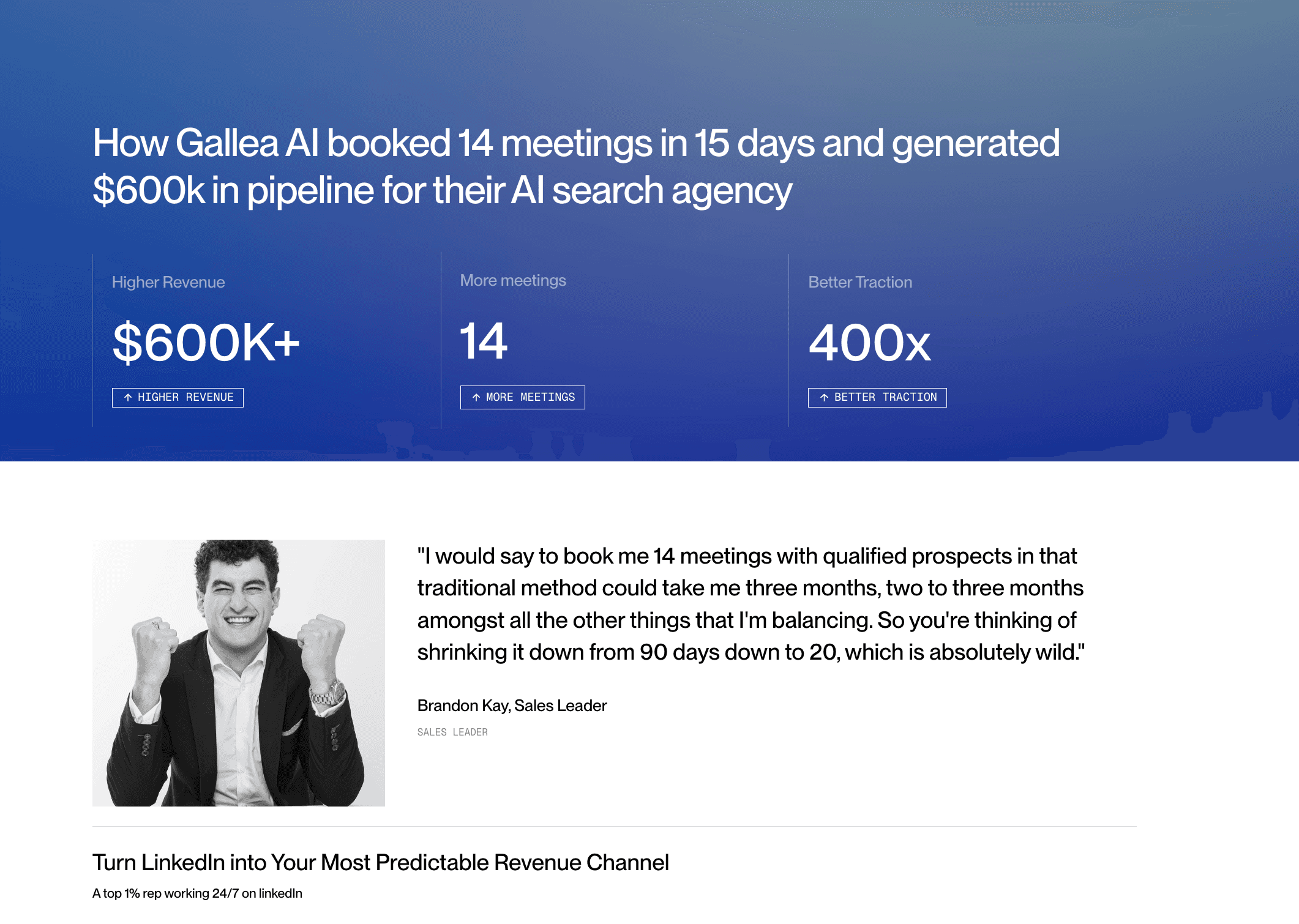
Gallea AI, an AI search agency, generated $600K+ in pipeline and booked 14 meetings in 15 days with Valley, per sales leader Brandon Kay, agency-grade output without agency-grade account risk.
And Shilpi Goel, founder of Leads the Way agency, reported the quality side of the same coin:
I got a 71% response rate with 600 prospects. Acceptance is about 30%.
Warm, researched outreach is what produces those numbers safely.

Stop trading client account safety for send volume. Valley runs agency lead generation in the cloud, inside LinkedIn’s limits, with a zero-flag track record since October 2023, and month-to-month terms so you are never locked in. Book a demo to see Valley run a safe campaign on a real client ICP.
How fast can an agency get client accounts live on Valley?
Speed matters when a new retainer expects pipeline in week one. Valley setup runs about one to two hours per account: connect the LinkedIn profile, define the client ICP, and clone the brand voice. Campaigns go live the same day, messages start sending day two, and first replies typically land within about two weeks, with full ramp at four to six weeks as the system learns what converts.
One seat reaches roughly 1,000 new people a month at around 25 to 30 connection requests a day, or 600 to 800 a month per account, volume that stays under platform thresholds rather than spiking past them. For an agency, that cadence means a predictable ramp you can show a client, not a flood of sends that risks the account in the first week. Each new client account follows the same safe, repeatable onboarding, so adding the fifth or fifteenth client looks operationally identical to the first.
► Book a demo (teams of 5+): Get the Full Warm Outbound Setup for Your Agency
Related on Valley
FAQ
Is Valley a safe LinkedIn automation tool for agencies?
Yes. Valley runs in the cloud with randomized timing, no proxies, and dynamic per-account limits near 25 to 30 connection requests per day. No customer account has been flagged since October 2023.
Will automating LinkedIn outreach get a client’s account banned?
Not with warm outbound. Valley triggers outreach from real engagement and human-like timing, avoiding the cold-volume patterns LinkedIn’s detection targets, which is how it has kept a zero-flag record across customer accounts.
Why are Chrome-extension LinkedIn tools riskier than Valley?
Browser extensions manipulate your live LinkedIn session, which is easier to detect. Valley runs cloud-side after a one-time sign-in, mimicking normal human patterns across every account.
How many LinkedIn messages can Valley send per account?
Valley safely sends roughly 1,000 to 1,200 messages per seat per month and around 25 to 30 connection requests per day, with limits adapting to each account’s health.
Can Valley automate LinkedIn messaging for many client accounts at once?
Yes. Each client runs in its own workspace with a separate ICP, cloned voice, and unified inbox, all automated from the cloud with safety controls applied per account.
► Test it on your own book of business: Valley is free for 7 days. The trial is the full product.


