
Try Valley
Put your outbound workflow to work.

Saniya
Published:
Updated:
Published June 13, 2026 · Updated August 31, 2026
The pattern has been around since the dawn of time, or at least since group projects in school.
There is always one person who outperforms the rest.
In sales, that is the rep who carries the team. Their pipeline is three times everyone else’s. They show up to every meeting locked in and close at a rate that makes the rest of the board look broken. They are the answer to every tough quarter.
That is a problem.
When I was running my first appointment-setting agency, we had exactly this. A handful of people who were genuinely exceptional at what they did. I leaned on them. Clients loved them. I kept stacking their plates because the work got done and the results followed.
Then life happened. People moved on. Suddenly the thing that was supposed to be a business started behaving more like a person, and that person had just put in their notice.
Get Enabled in your inbox each week.
My Fav Picks:
The traditional outbound playbook is dead (link)
Email open tracking is dead (link)
Growth survey insights from 100+ companies (link)
Why you should use videos in tech sales (link)
The right way to hire salespeople (link)
2 decks to share with prospects (link)
► Run this play with real leads: start a free 7-day Valley trial

The hardest thing to admit about your star rep is that the better they are, the more fragile the business becomes around them.
Every exception you make, every process you skip because they will just figure it out anyway, every deal you hand them because you trust them more than the system: all of it is a liability being built in slow motion.
Most founders in the 0 to $1M ARR range think their sales motion is working because they have good numbers and a rep they would describe as a secret weapon. When asked what happens if that person leaves next month, the room gets very quiet.
When a top rep leaves, they take the implicit knowledge with them. Their personality. The way they positioned. The objections they had already worked through. The instincts they built that never got written down anywhere.
None of that lives in your CRM.
LinkedIn Tip of the Week
Your profile can be viewed in 40+ languages. If you are targeting international prospects, add a summary in their language. Very few people do this, which means it stands out when you do.
Why Founders Let It Happen
The incentive is obvious. If someone is performing, you do not want to slow them down to systemize what they are doing. You want them selling. Every hour spent documenting a process is an hour not spent closing.
That logic makes complete sense in the short term. It is brutal in the long term.
It works like a dependency. You do not realize you have built one until it is already too late to unwind it gracefully. By the time you notice that one person is holding 60% of your pipeline, pulling back requires a conversation nobody wants to have and a reorg nobody has time for.
So you keep going. And the dependency deepens.
Free Resource
The only guide to safe outreach on LinkedIn: claim it free.
What Actually Fixes It
The lesson learned the hard way: use your best rep differently.
It sounds counterintuitive to take them off the front lines, but the best thing a top performer can do for a company is make themselves replicable. Capture the method underneath the magic so other people can run a version of it.
Practical ways to extract their process:
Call recordings reviewed and catalogued
Objection libraries built from the calls that actually closed
Co-designing the outbound sequence so the reasoning behind it is documented, not just the steps
Structured time training the rest of the team
The outbound motion cannot live in one person’s head. You have to back it up.
When someone teaches the system how to sell the way they sell, and the system learns from every edit they make, you start capturing something that actually scales. The instinct becomes the infrastructure.

If your top performer took a month off tomorrow, would your pipeline survive it?
If the honest answer is no, that is the thing to fix before anything else.
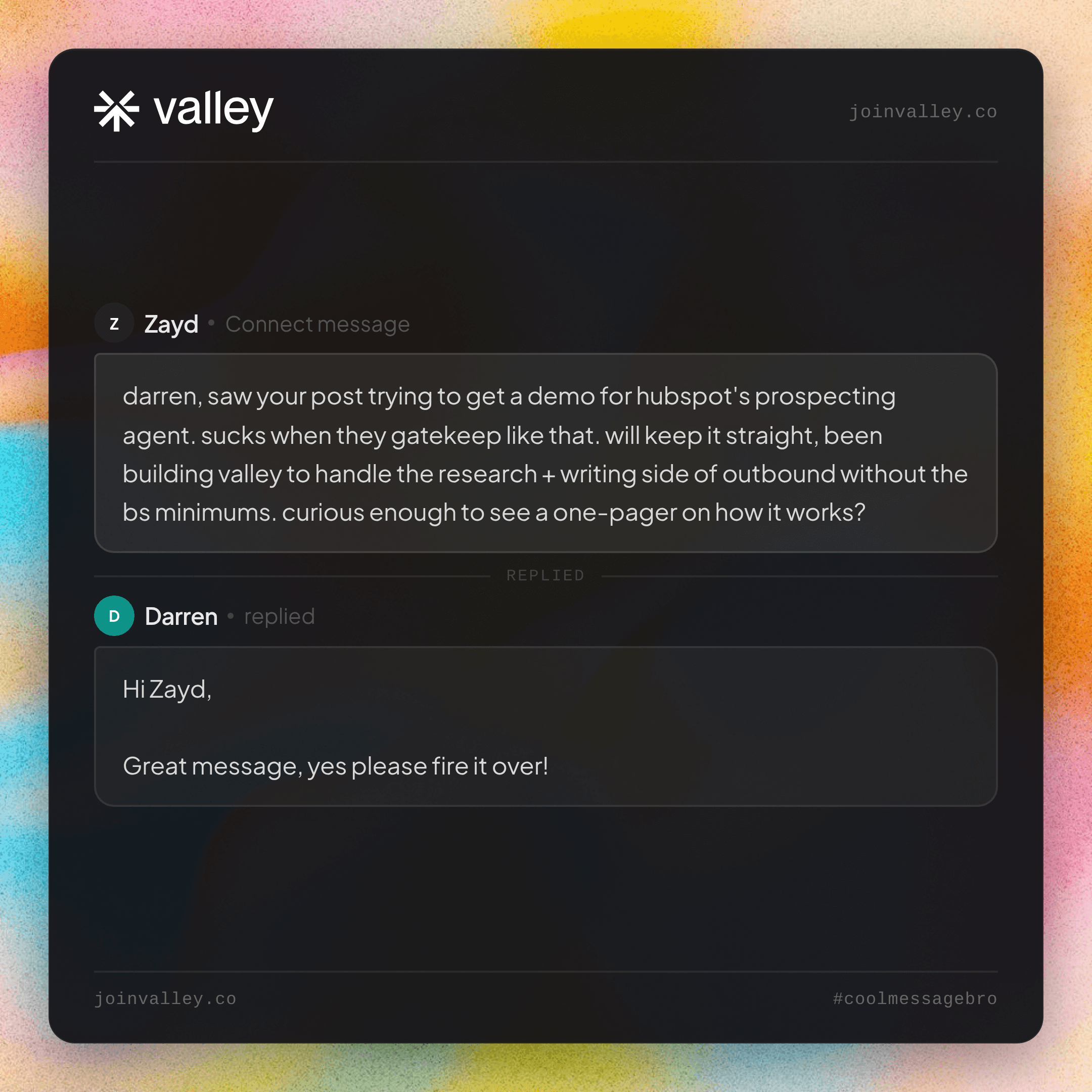
See more of Valley’s outreach examples: coolmessagebro.com
Generate more demos using LinkedIn: Book here
Become a Valley partner and earn 20% recurring commission: Join the affiliate program
Frequently Asked Questions
What is key-person dependency in sales and why is it a risk?
Key-person dependency in sales means a disproportionate share of pipeline and closed revenue flows through one individual. The risk is that when that person leaves, they take with them not just their relationships but the implicit knowledge, positioning instincts, and objection-handling logic that were never documented. The business then discovers that what looked like a sales motion was really one person’s skills running on a company’s behalf.
Why do founders tend to under-systemize their top sales rep’s process?
Because asking a top performer to spend time documenting their process feels like taking them off the field when you need them selling. The short-term cost of systemization is visible (lost selling time) while the long-term cost of not systemizing is invisible (fragility) until a rep leaves. The incentive structure consistently favors the short-term.
What is the right way to use a top-performing sales rep to reduce key-person risk?
Shift part of their role toward making themselves replicable. This means recording calls and building objection libraries, co-designing outbound sequences so the reasoning behind each step is captured, and spending structured time training the rest of the team. The goal is to transfer the instincts and judgment that live in their head into systems and documentation that survive their departure.
What information does a star sales rep carry that does not live in a CRM?
CRMs capture activity data: calls logged, deals moved, emails sent. They do not capture how the rep positioned the product for a specific persona, which objection they anticipated and addressed before it was raised, why they chose to send a particular message on a particular day, or the relationship context that made a prospect trust them. All of that leaves with the person.
How do you build a sales motion that does not depend on one person?
Three foundations: documented playbooks built from the top rep’s actual process, objection libraries sourced from real closed calls, and outbound systems that replicate their research and personalization approach at scale. Valley is built on this principle: capturing the intent-driven, research-backed outreach that top performers do manually and enabling the rest of the team to run it at volume without degrading quality.


