
Try Valley
Put your outbound workflow to work.

Saniya
Published:
Updated:
Published July 6, 2026 · Updated July 24, 2026
The best HeyReach alternatives in 2026 are Valley (signal-based outreach that finds warm buyers and writes the message, from $149/mo), Expandi (cloud-based cold sequences with a safety focus, $99/mo), Dripify (the cleanest visual sequence builder, from $39/mo annual), and Waalaxy (the cheapest way to run a first campaign, from €19/mo). HeyReach itself is still the right choice for agencies rotating cold volume across many LinkedIn accounts - its $79/mo unlimited-senders plan is the best per-sender price in the category.
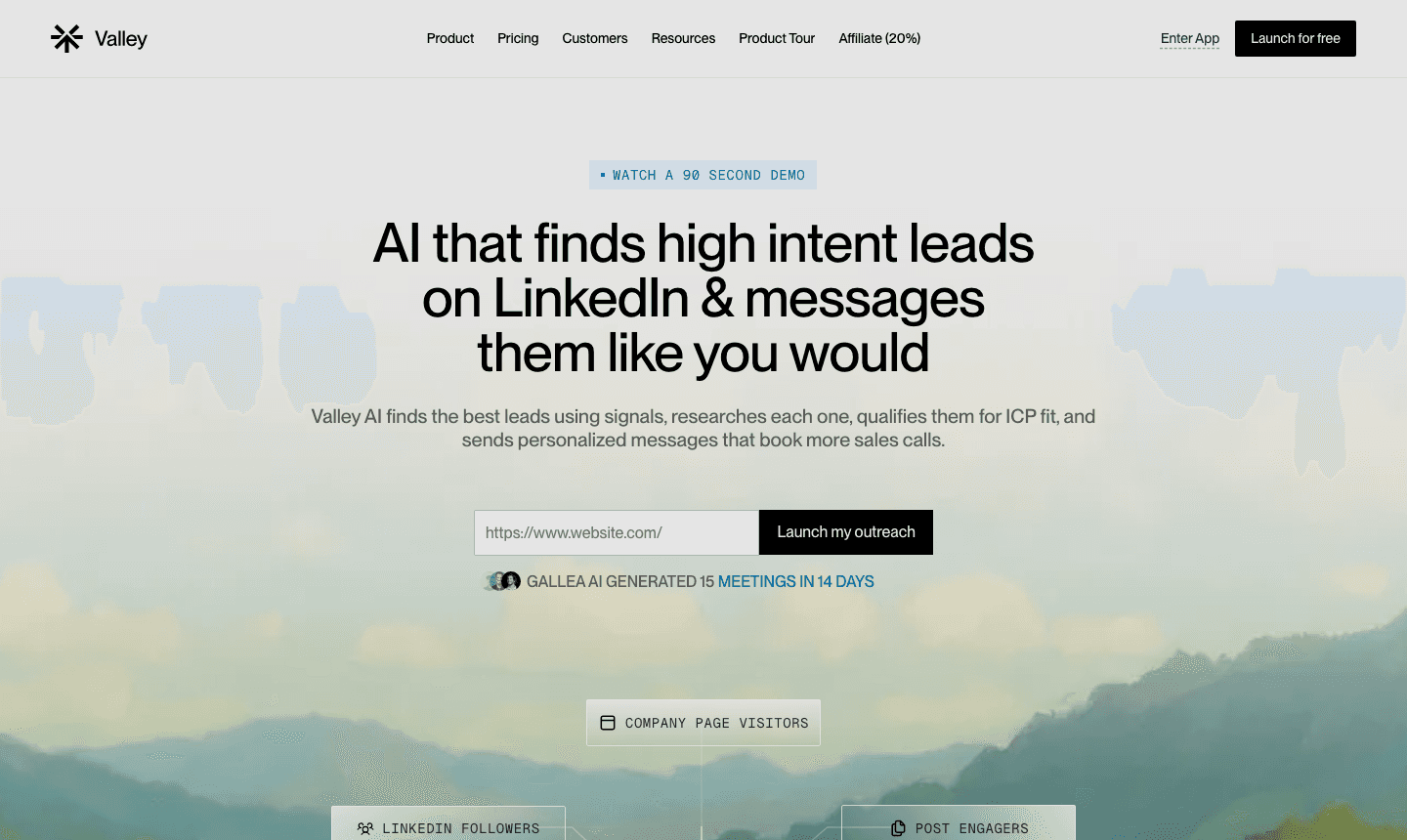
Valley is an AI outbound platform that finds the people most likely to buy from you - from live buying signals, natural-language search, or your own lists - qualifies them against your ICP, researches each one, and sends personalized messages across email and LinkedIn that get 15-45% reply rates, against a category average of about 2%.
► Testing HeyReach alternatives? Start with a free 7-day Valley trial, the full product, not a demo

Verdict | Tool |
|---|---|
Best overall (replies, not volume) | Valley - from $149/mo |
Best for agencies running volume | HeyReach - $79/mo, unlimited senders |
Best safety-focused cold sequencer | Expandi - $99/mo |
Best visual campaign builder | Dripify - from $39/mo |
Best budget starting point | Waalaxy - from €19/mo |
How we picked (and our bias, stated plainly)
Valley makes one of the tools on this list. We've marked our entry clearly, and we've included tools that beat us for specific jobs - HeyReach included.
What qualifies us to compare them: we run 1,000+ LinkedIn accounts across 300+ teams and have sent 30M+ messages through this category of software. We signed up for every tool below and checked every price on its live pricing page on July 24, 2026.
Quick comparison
Tool | Starting price | What it optimizes | Free trial | Key limitation |
|---|---|---|---|---|
Valley (that's us) | $149/mo (quarterly) · $199 month-to-month | Who you contact + what you say (signals, research, writing) | 7 days, no restrictions | Native email in-sequence since Aug 2026 (own OAuth inbox, ~30/day/seat, included) - no managed inboxes |
HeyReach | $79/mo (unlimited senders) | Cold volume across many accounts, one inbox | 14 days | No signal layer - every sender works a cold list |
Expandi | $99/mo per seat ($79 annual) | Account-safe cold sequences | 7 days | Personalization is image/GIF-level, not research-level |
Dripify | $39 - 79/mo annual ($59 - 99 monthly) | Clean drip-campaign building | 7 days | Basic plan caps you at 1 campaign |
Waalaxy | €19 - 69/mo | Cheap, simple first campaigns | 14 days | 300 invites/mo on entry plan; template-based messages |
The 5 tools, one by one
1. Valley - best for booking meetings, not sending volume (our tool)
What it is. Valley finds the people most likely to buy - warm signals (profile viewers, post engagers, website visitors), deep search, or your own lists - researches each one, and sends messages good enough to get 15 - 45% replies. The category average for cold LinkedIn outreach is roughly 2%.
What works well
The starting list is different: people already paying attention, not names from a filter. Warm and signal-based lists reply about 3× more than cold ones in our send data.
Messages are researched and written per prospect, trained on 500K+ real messages - then you approve them, or let approved campaigns run.
Safety record: zero restrictions across 1,000+ accounts and 300+ teams, backed by a 5× money-back safety guarantee.
Receipts: Bolt.new booked 25 enterprise demos in 45 days. ThinkFish runs 400+ meetings a month. WeLaunch closed $5M in client ARR.
What doesn't
No volume email - native email ships in the same sequences since August 2026 (your own OAuth inbox, ~30 sends/day/seat, included in every plan), but Valley does not manage mailboxes, warmup, or rotation, ever.
If you want 25 accounts blasting a cold list, Valley is the wrong tool - it spends its effort on fewer, better conversations.
$149/mo is not the cheapest entry on this page.
Pricing. Everything: $149/mo billed quarterly or $199 month-to-month - all signals, unlimited leads and campaigns. Everything + Deep: $499/mo (adds $300/mo in Deep research credits, white-glove onboarding). Valley Studios (done-for-you): $1,499/mo. 7-day free trial with no restrictions.
Verdict. Pick Valley when the goal is qualified replies and meetings, and you'd rather fix who you're messaging than how many accounts are sending.
"I've scaled two unicorns myself. I've seen products. But I've not seen a product like Valley. It's the best standalone product I've ever used in my company so far." - Aviral Bhutani, Founder & CEO, WeLaunch
2. HeyReach - best for agencies rotating cold volume
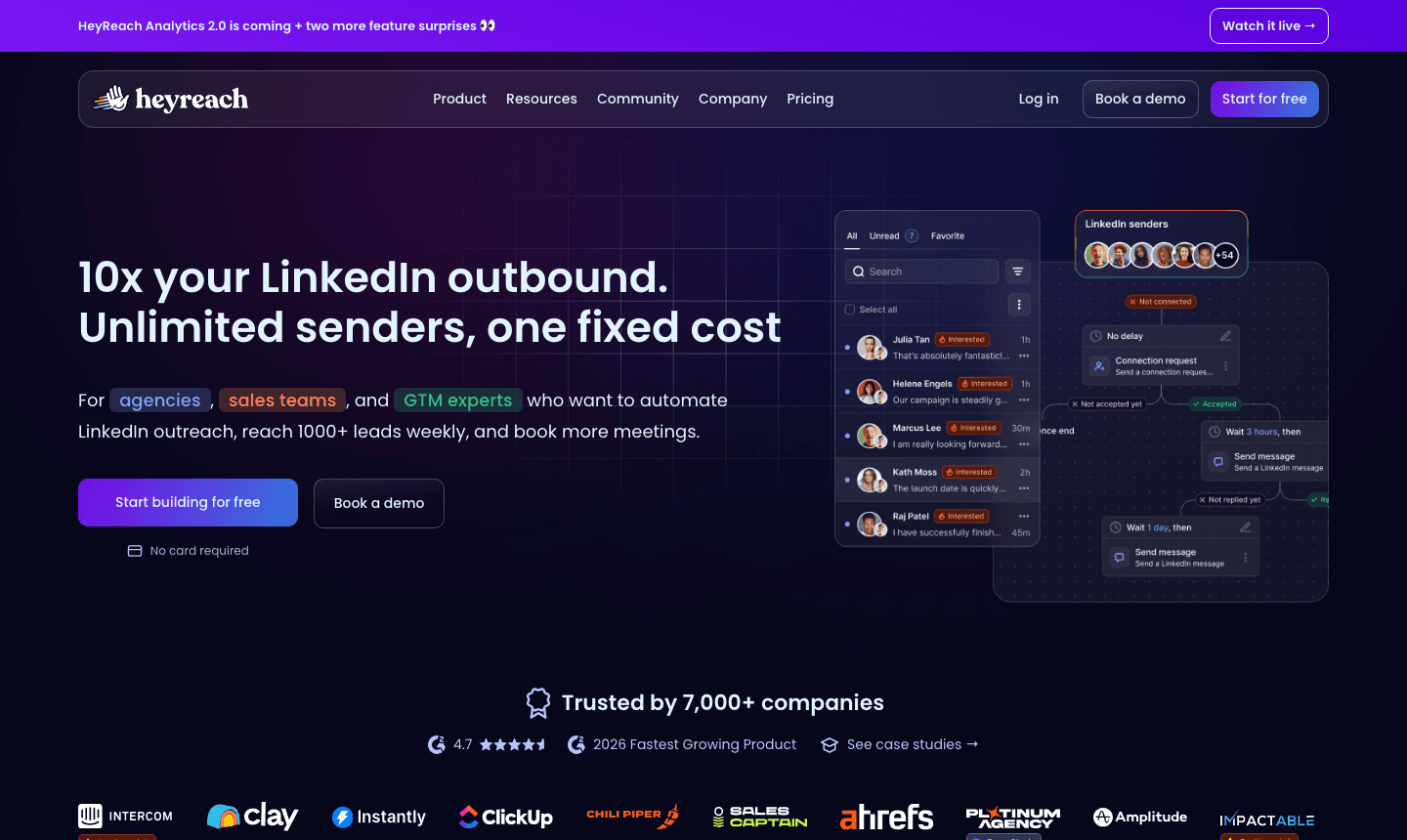
What it is. LinkedIn-only outreach built around one idea: run campaigns across many sender accounts from one dashboard, with a unified inbox for the whole team.
What works well
The 2026 pricing is genuinely aggressive: $79/mo with unlimited senders on the Growth plan. Nothing else in the category touches that per-sender price.
The unified inbox and workspaces are the best agency operations layer on this list.
Agency plan ($999/mo) adds whitelabel and done-for-you onboarding.
What doesn't
There is no signal layer. Every sender still works a cold, imported list - and sender count doesn't move reply rate. Cold LinkedIn outreach benchmarks around 2% no matter how many accounts send it.
Personalization is variable-level, not research-level.
No native email channel.
Pricing. Growth $79/mo (unlimited senders, 14-day free trial). Agency $999/mo (25 senders, whitelabel). Unlimited $2,999/mo.
Verdict. If your model is volume across many accounts - especially as an agency - HeyReach is the honest pick, and we say so as a competitor.
3. Expandi - best safety-focused cold sequencer
What it is. Cloud-based LinkedIn automation with a dedicated country-based IP per account and warm-up features; the tool people move to after a LinkedIn warning email.
What works well
Cloud architecture with dedicated IPs and smart limits - safer than browser-extension tools.
Solid campaign features: prioritization, scheduling, blacklists, duplication prevention.
What doesn't
It optimizes how a cold sequence runs, not who receives it or what it says. Image and GIF personalization costs extra and isn't research.
$99/mo per seat adds up faster than it looks for teams.
Pricing. Business $99/mo per seat ($79 annual). Agency plans custom for 10+ seats. 7-day free trial.
Verdict. Pick Expandi if account safety on cold sequences is your top concern and you're staying cold on purpose.
4. Dripify - best visual campaign builder
What it is. A browser-based LinkedIn drip-campaign tool with the cleanest drag-and-drop sequence builder in the category.
What works well
The visual builder. If you think in flowcharts, Dripify's editor is the most pleasant way to design a sequence.
Cheap annual entry: $39/mo on the Basic plan.
What doesn't
Basic caps you at 1 drip campaign and limited quotas - real use starts at Pro ($59/mo annual).
Same structural issue as the others: cold lists in, template messages out.
Pricing. Basic $59/mo ($39 annual) · Pro $79/mo ($59 annual) · Advanced $99/mo ($79 annual). 7-day free trial.
Verdict. Pick Dripify for structured cold drips at a low price with a great building experience.
5. Waalaxy - best budget starting point
What it is. A Chrome-extension LinkedIn + email tool aimed at first-time outbounders, with pre-built sequence templates.
What works well
€19/mo entry - the cheapest paid plan on this page.
Pre-built sequences mean a first campaign in minutes.
What doesn't
The entry plan caps at 300 invites/month; higher plans at 800.
Chrome-extension architecture is the riskiest way to automate LinkedIn - the pattern LinkedIn detects most easily.
No free plan anymore (despite what older articles say - we checked July 2026). It's a 14-day trial.
Pricing. Pro €19/mo · Advanced €49/mo · Business €69/mo. Yearly billing −50%. 14-day free trial.
Verdict. Pick Waalaxy to test LinkedIn outreach for the price of lunch - and plan to graduate.
Keep exploring: our hands-on HeyReach review · Valley pricing, explained · real customer results.

Be honest with yourself about which problem you have. HeyReach solves an operations problem: many accounts, many clients, one inbox, lowest per-sender cost in the category. If that’s your bottleneck, stay - the $79 unlimited-senders plan is genuinely the best deal in cold-volume LinkedIn outreach, and switching to anything on this list would be a downgrade for that job.
Valley solves a conversion problem: cold outreach replies at ~2% and no amount of sender rotation changes that, because the list is still cold. If your bottleneck is that the replies aren’t coming, the fix is who you message and what you say - that’s the job Valley does.
► The alternative that wins is the one that books meetings: test Valley free for 7 days
FAQ
What is the best HeyReach alternative in 2026? Valley, if you’re optimizing for replies and meetings - it starts from warm signals and researched messages instead of cold lists, and gets 15 - 45% reply rates against a ~2% cold benchmark. Expandi, Dripify, and Waalaxy are better fits if you specifically want cheaper cold sequencing.
Is HeyReach or Valley better for LinkedIn reply rates? Valley, structurally. HeyReach distributes cold outreach across more senders; the list stays cold and replies stay near the ~2% benchmark. Valley changes the list itself - profile viewers, post engagers, website visitors, scored against your ICP - and writes each message from research.
How much does HeyReach cost in 2026? $79/mo for the Growth plan with unlimited senders (14-day free trial), $999/mo for Agency (25 senders, whitelabel), $2,999/mo for Unlimited. Checked on HeyReach’s live pricing page, July 24, 2026.
Does HeyReach support email outreach? HeyReach is LinkedIn-focused; teams that want email alongside it typically pair a separate email tool. Valley runs email natively inside the same sequences since August 2026 - connection request → follow-up → InMail → email, from your own OAuth inbox (~30 sends/day/seat, included in every plan) - while volume email (managed inboxes, warmup) remains a separate category by design.
What’s the cheapest HeyReach alternative? Waalaxy, at €19/mo - with the caveats that it’s a Chrome extension (the riskiest architecture for your LinkedIn account) and caps invites at 300/month on that plan.
Is there a HeyReach alternative that finds warm leads automatically? That’s Valley’s core job: it captures profile viewers, post engagers, website visitors, company-page followers, and competitor-post engagers automatically, scores them against your ICP, and messages the ones worth talking to. Warm lists reply about 3× more than cold ones.
Will these tools get my LinkedIn account restricted? Cloud-based tools with dedicated IPs (Valley, HeyReach, Expandi) are structurally safer than Chrome extensions (Waalaxy). Valley’s record: zero restrictions across 1,000+ accounts over 2.5 years, backed by a 5× safety guarantee. See our full safety comparison for the per-tool breakdown.
Related: Valley vs HeyReach · Valley vs HeyReach vs Expandi · Best LinkedIn automation tools for agencies · Valley pricing


