How Does Valley Compare to Building Custom Solutions?

Try Valley
Make LinkedIn your Greatest Revenue Channel ↓

Saniya Sood
Published:
What Would It Cost to Build Valley's Capabilities Internally?
Building Valley's functionality internally would require substantial investment across multiple dimensions. Engineering costs alone would exceed $2-3 million annually for a team capable of maintaining seven LLM integrations, web scraping infrastructure, LinkedIn safety protocols, and campaign management systems. Additional costs include LLM API fees ($150+ per user monthly), data enrichment partnerships, infrastructure and hosting, and ongoing LinkedIn compliance monitoring.
The timeline would stretch 12-18 months minimum for basic functionality, with continuous development required for competitive parity. Hidden costs include opportunity cost of delayed go-to-market, technical debt from rushed development, and ongoing maintenance burden. Most companies conclude that Valley's solution costs less than just the LLM API fees required for similar functionality.
► Book a demo and explore how Valley can support your use case

How Does Valley Compare to Using Clay or Similar No-Code Tools?
While Clay excels at data orchestration, Valley provides purpose-built LinkedIn execution that Clay can't match. Valley users report that replicating Valley's functionality in Clay would require 20+ connected tools, dozens of complex workflows, extensive prompt engineering, and constant maintenance. Even then, Clay can't ensure LinkedIn safety or provide Valley's message quality.
The tools serve different purposes: Clay for data enrichment and routing, Valley for LinkedIn-specific execution. Many successful users employ both: Clay for initial list building and enrichment, Valley for research depth and personalized messaging. The combination exceeds what either tool provides independently.
Why Don't Companies Just Hire SDRs Instead of Using Valley?
Valley delivers superior ROI compared to human SDRs across multiple dimensions. Cost efficiency: Valley costs less than 10% of an SDR's fully-loaded cost. Consistency: Valley maintains quality without training degradation or motivation fluctuations. Scale: Adding Valley capacity takes minutes, not months of hiring and ramping. Reliability: Valley doesn't churn, get sick, or require management overhead.
Valley amplifies rather than replaces human capabilities. Smart companies use Valley to handle prospecting and initial outreach, freeing SDRs for valuable conversations and relationship building. This hybrid approach delivers better results than either pure human or pure automation strategies.
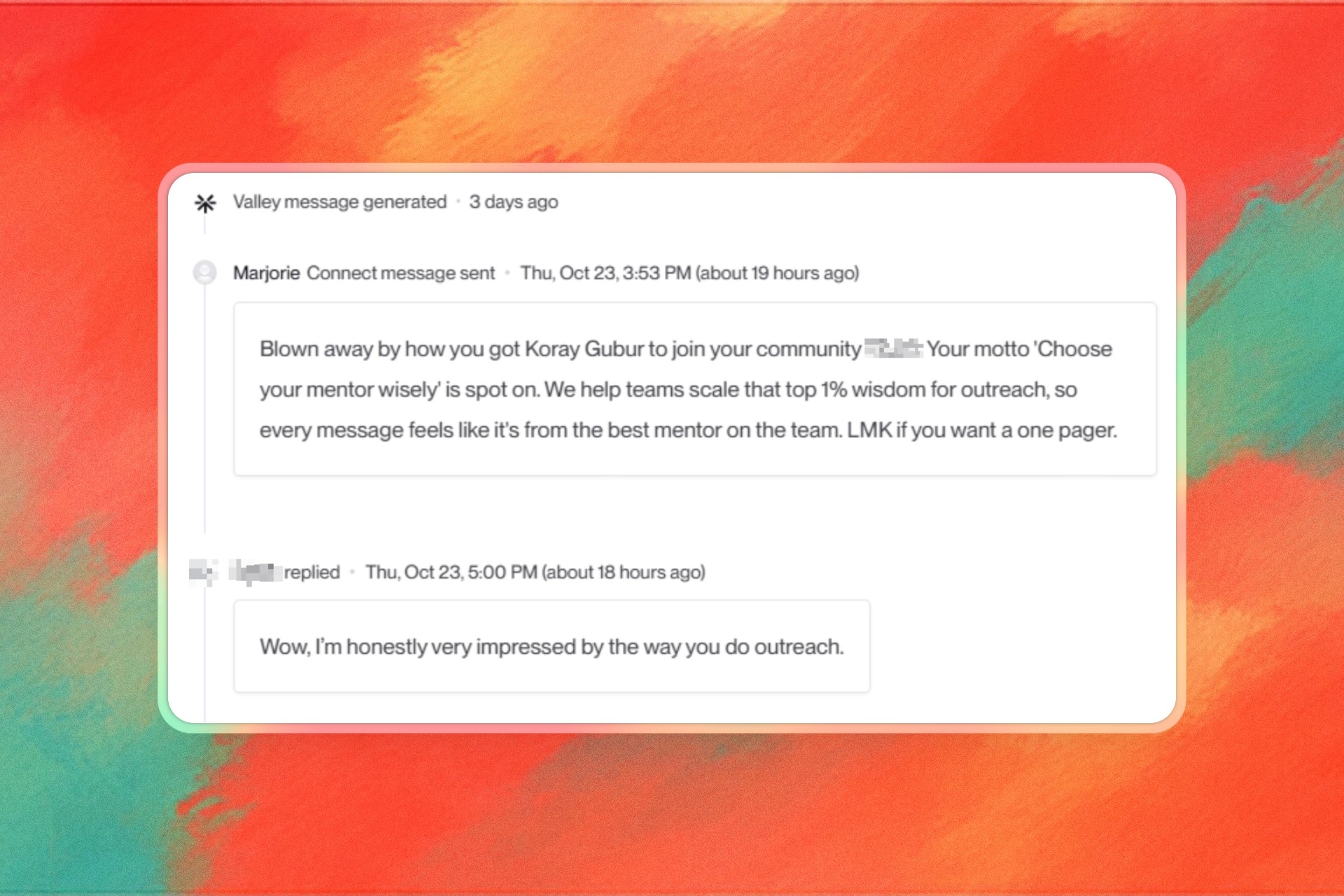
► Check Out More of Valley's Incredible Outreach: A compilation of real time messages and responses!

Can Valley's Results Be Replicated with Generic AI Tools?
Attempting to replicate Valley using ChatGPT or Claude requires massive orchestration complexity. Each prospect would need individual web scraping setup, manual research compilation, sophisticated prompt engineering, and careful message generation. This process would consume hours per prospect versus Valley's seconds.
More critically, generic AI tools can't ensure LinkedIn safety, lack Valley's LinkedIn-specific training, miss context between prospects, and can't maintain consistent voice. Valley's seven-model architecture prevents AI detection patterns that single-model approaches exhibit. The sophistication gap grows wider as Valley's models continue LinkedIn-specific training.
How Does Valley Compare to Traditional Marketing Automation?
Valley fills a gap that traditional marketing automation can't address: personalized, safe LinkedIn outreach at scale. Platforms like Marketo or Eloqua excel at email nurture but lack LinkedIn capabilities. Those offering LinkedIn features operate through risky browser automation or generic templates that achieve sub-1% response rates.
Valley users often maintain marketing automation for email nurture while using Valley for LinkedIn activation. The combination creates true omnichannel engagement: marketing automation for one-to-many broadcast, Valley for one-to-one LinkedIn personalization. This strategic division leverages each platform's strengths.
What Makes Valley Different from Other LinkedIn Automation Tools?
Valley transcends traditional LinkedIn automation through intelligence layer integration. While competitors automate actions (sending connections, messages), Valley automates intelligence (research, qualification, personalization). This fundamental difference drives Valley's 10x improvement in response rates.
Technical differentiation includes open/closed profile detection (unique to Valley), seven-model AI architecture preventing detection, deep research capabilities beyond LinkedIn data, and built-in ICP qualification. These capabilities would require multiple tools to replicate, even partially. Valley's integration saves hours daily while delivering superior results.
Should Companies Build, Buy, or Partner for LinkedIn Automation?
The build versus buy decision favors Valley for most organizations. Building requires expertise across AI/ML, web scraping, LinkedIn protocols, and safety measures - competencies most companies lack. The investment would exceed Valley's cost by 10-100x while delivering inferior results. Maintenance burden would distract from core business.
Partnership through Valley makes strategic sense: proven solution with zero customer suspensions since October 2023, continuous improvement through shared customer learning, economies of scale in LLM and data costs, and focus on your business rather than tool development. Even well-funded companies choose Valley over internal development.

Related Blogs

FEATURED READ
5 min
Valley vs HeyReach: Which LinkedIn Outreach Tool Wins More Qualified Meetings?
Read
Read

FEATURED READ
5 min
Valley in 2026: Is the Price Worth the Pipeline?
Read
Read

FEATURED READ
5 min
Valley vs Dripify: Which LinkedIn Outreach Tool Actually Converts in 2026?
Read
Read

FEATURED READ
5 min
Valley vs. Hiring an SDR: The Real Cost and ROI Breakdown for 2026
Read
Read
Which channels does Valley support?
Valley supports LinkedIn outreach, including connection requests and InMails. Valley users safely send 1000-1200 messages per seat every month.
How safe is it and does Valley risk my LinkedIn account?
Do I have to commit to an Annual Plan like other AI SDRs?
How does Valley personalize messages?
Is Valley available in my country?

VALLEY MAGIC