How Does Valley Handle Linkedin Messaging for Different Industries and Verticals?

Try Valley
Make LinkedIn your Greatest Revenue Channel ↓

Saniya
Published:
Why Industry-Specific Messaging Matters:
A message that resonates with a fintech VP of Sales falls flat with a healthcare operations director. Different industries have unique challenges, regulatory environments, buying cycles, and communication norms. Valley's industry-aware messaging adapts content, tone, and timing to match sector-specific expectations and pain points.
Generic, one-size-fits-all outreach ignores critical context that determines relevance:
Industry-Specific Pain Points:
Healthcare organizations prioritize: HIPAA compliance and patient data security, interoperability between systems, regulatory documentation requirements, and long implementation cycles due to clinical validation.
SaaS companies prioritize: rapid scaling and growth efficiency, product-led growth metrics, customer acquisition cost optimization, and integration ecosystem building.
Manufacturing companies prioritize: supply chain optimization, production efficiency, equipment downtime reduction, and regulatory compliance (ISO, safety standards).
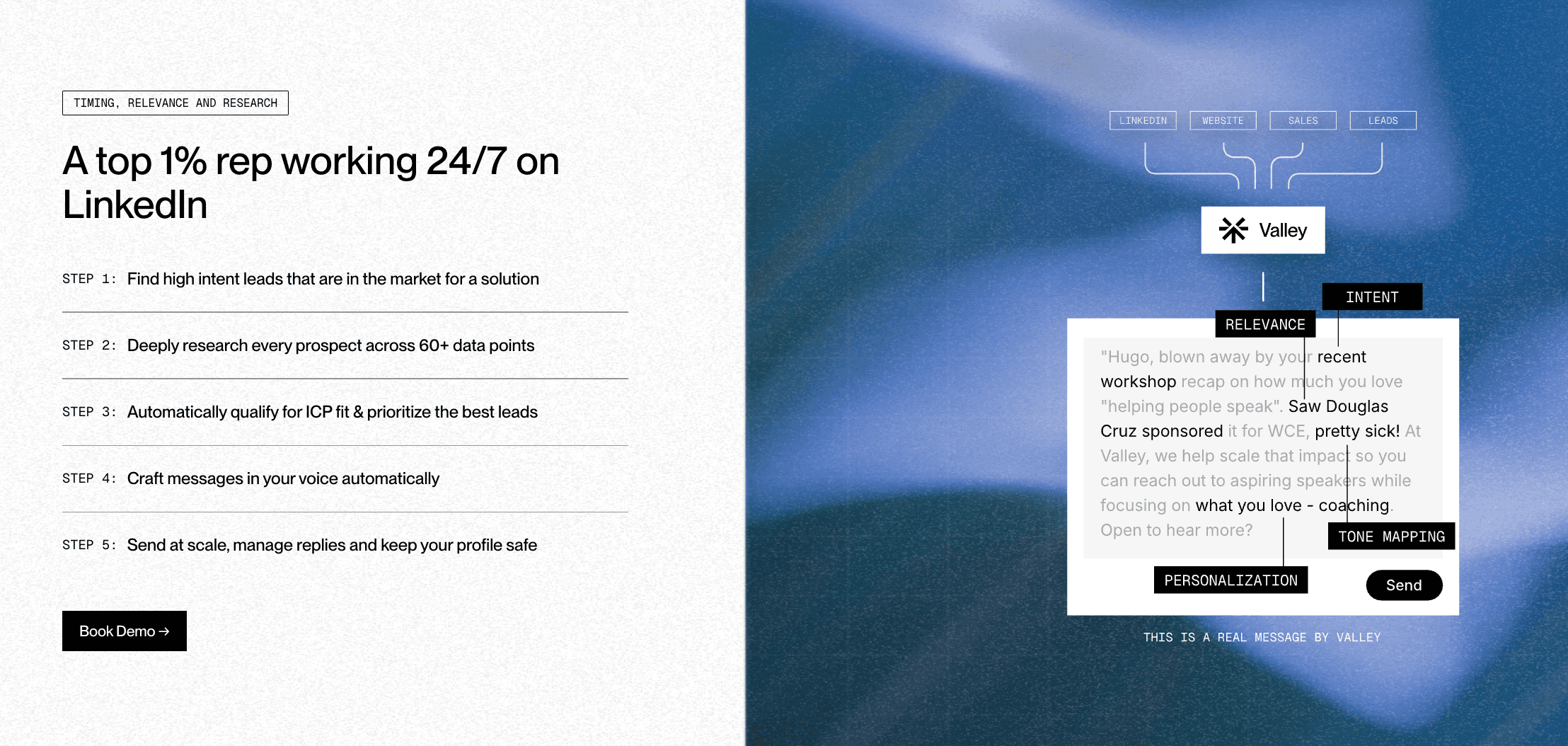
Valley's AI research identifies which industry prospect operates in and emphasizes relevant pain points automatically.
► Book a demo and explore how Valley can support your use case
Regulatory and Compliance Language:
Certain industries require specific terminology: financial services mentions SEC, FINRA, AML, KYC compliance, healthcare references HIPAA, HITECH, PHI protection, education discusses FERPA, Title IX, accreditation, and government requires FedRAMP, NIST, security clearances.
Valley incorporates industry-appropriate compliance language when relevant.
Buying Cycle Variations:
Industry purchasing patterns differ dramatically: enterprise software: 6-12 month sales cycles, multiple stakeholder approval, healthcare: 9-18 month cycles, clinical validation required, manufacturing: 3-6 month cycles, ROI-driven decisions, and professional services: 1-3 month cycles, relationship-based.
Valley adjusts expectations and follow-up cadence by industry norms.

How Valley Identifies Prospect Industry:
Accurate industry classification enables appropriate messaging.
LinkedIn Company Page Industry:
Primary source: industry classification on LinkedIn company page, standardized industry categories (LinkedIn's taxonomy), and sub-industry specificity when available.
Example: "Computer Software" (broad) → "Computer Software - SaaS" (specific).
Company Description Analysis:
Valley's AI analyzes company description text for industry indicators: keywords signaling sector (healthcare, fintech, manufacturing, etc.), products/services offered (revealing true business model), target customers mentioned (B2B vs. B2C, market served), and regulatory frameworks referenced.
Website Content Analysis:
When Valley visits prospect's company website: homepage content reveals industry focus, product pages show offerings and market, customer case studies indicate sectors served, and compliance badges signal industry (SOC 2, HIPAA, FedRAMP).
Technology Stack Signals:
Tools companies use suggest industry: Salesforce Health Cloud → healthcare, nCino or Finastra → financial services, Shopify or Magento → e-commerce, and HubSpot or Marketo → B2B SaaS.
Cross-Reference Validation:
Valley validates industry classification across multiple sources: LinkedIn says "Software," website emphasizes healthcare clients, tech stack includes healthcare tools.
Conclusion: Healthcare software company (sub-vertical), not generic software.
How Valley Adapts Messaging by Industry Vertical:
Once industry identified, Valley customizes multiple message elements.
Value Proposition Emphasis:
Different industries value different outcomes:
SaaS/Technology Companies:
Emphasis: growth efficiency, scaling without proportional cost increase, product-led growth acceleration, freemium to paid conversion, and competitive differentiation.
Example message: "We help SaaS companies generate predictable pipeline from LinkedIn signals, [Customer] scaled from 20 to 50 meetings monthly without adding SDR headcount."
Financial Services:
Emphasis: compliance and security, regulatory adherence (SEC, FINRA), data protection and privacy, audit trails and documentation, and risk mitigation.
Example: "We help wealth management firms generate compliant LinkedIn outreach—full audit trails, data encryption, and zero regulatory violations across 50+ RIA clients."
Healthcare:
Emphasis: HIPAA compliance, patient privacy protection, clinical workflow integration, provider adoption and training, and measurable patient outcomes.
Example: "We help healthcare tech companies reach decision-makers at health systems compliantly, HIPAA-compliant enrichment, secure messaging, and healthcare-specific personalization."
Manufacturing:
Emphasis: operational efficiency, production optimization, supply chain resilience, cost reduction and ROI, and equipment/process improvement.
Example: "We help manufacturing software providers connect with plant managers and operations leaders—focused on ROI, efficiency gains, and production optimization."
Professional Services:
Emphasis: client acquisition, thought leadership positioning, relationship building, expertise demonstration, and referral generation.
Example: "We help consulting firms turn LinkedIn presence into client conversations—relationship-first approach that positions expertise before pitching."
Industry-Specific Social Proof:
Valley references relevant customer examples: for fintech prospects, mention fintech customers, for healthcare, cite healthcare organizations, for manufacturing, reference industrial clients.
Peer proof resonates more than cross-industry examples.
Regulatory and Compliance Acknowledgment:
When industry has strict regulations: proactively address compliance in messaging, reference relevant certifications (SOC 2, HIPAA, FedRAMP), mention security and privacy commitments, and acknowledge regulatory complexity.
Example for healthcare: "We're HIPAA-compliant with BAAs available, understanding the patient privacy requirements you operate under."
How Valley Handles Industry Jargon and Terminology:
Using industry-specific language demonstrates expertise; using it incorrectly damages credibility.
Industry Lexicon Integration:
Valley's AI incorporates sector-appropriate terminology:
Healthcare: patients vs. customers, providers vs. users, clinical workflows vs. processes, EMR/EHR vs. CRM, and care coordination vs. customer success.
Financial Services: clients vs. customers, advisors vs. sales reps, assets under management (AUM), portfolios vs. accounts, and fiduciary vs. vendor.
Manufacturing: production vs. delivery, plant vs. office, OEE (Overall Equipment Effectiveness), shop floor vs. workspace, and SKUs vs. products.
Education: students vs. customers, faculty vs. employees, academic year vs. fiscal year, enrollment vs. sales, and accreditation vs. certification.
Jargon Validation:
Valley avoids using jargon incorrectly: researches proper usage in industry context, validates terminology through industry-specific sources, errs on side of plain language when uncertain, and never fabricates technical terms to sound knowledgeable.
Incorrect jargon worse than no jargon—immediately signals outsider status.
Acronym Awareness:
Industries have acronym-heavy languages: healthcare: HIPAA, PHI, EMR, EHR, HL7, FHIR, CCM, technology: SaaS, API, SDK, ARR, MRR, CAC, LTV, finance: AML, KYC, SEC, FINRA, RIA, CRM, and manufacturing: OEE, JIT, MES, MRP, ERP, PLM.
Valley uses acronyms appropriately after confirming prospect would recognize them.
How Valley Adjusts Tone and Formality by Industry:
Professional communication norms vary by sector.
More Formal Industries:
Finance/banking, legal services, healthcare (executive level), government contractors, and insurance.
These sectors expect: professional, business-formal tone, conservative language choices, emphasis on security and compliance, detailed, comprehensive information, and limited humor or casual language.
Valley generates accordingly: "Hello [Name], I noticed [Company] has been researching solutions for [challenge]. We provide [formal value proposition] with full regulatory compliance and security protocols appropriate for [industry]. I would appreciate the opportunity to discuss how we serve [sector] organizations."
More Casual Industries:
Technology startups, creative agencies, e-commerce, consumer software, and media/entertainment.
These sectors accept: conversational, approachable tone, informal language choices, focus on innovation and disruption, concise, punchy communication, and personality and humor welcomed.
Valley adapts: "Hey [Name], saw you were checking out our approach to [topic]. We help [industry] teams [outcome] without the usual complexity. [Customer] went from [X] to [Y] pretty quickly. Want to see how it works?"
Mixed Formality Industries:
Professional services (consulting, accounting), B2B SaaS, healthcare technology, and education technology.
These sectors require: balanced professional yet approachable tone, business-friendly but not stiff, expertise demonstrated without jargon overload, clear, direct communication.
► Check Out Valley's Incredible Outreach: A compilation of real time messages and responses!

How Valley Handles Industry-Specific Buying Cycles:
Sales process expectations vary dramatically by sector.
Enterprise Software (Long Cycles):
Typical: 6-12 months from first contact to close, multiple stakeholder approval (5-10 decision-makers), extensive evaluation and proof-of-concept, budget approval processes and procurement.
Valley's approach: patient, long-term nurture sequences, content-focused relationship building before selling, multi-stakeholder engagement strategies, and emphasis on education over urgency.
Message pacing: Touch 1 → Touch 2 (14 days) → Touch 3 (21 days) = extended nurture respecting slow cycle.
SMB/Mid-Market (Moderate Cycles):
Typical: 2-4 months sales cycle, 2-3 stakeholder involvement, faster decision-making, and budget considerations but less procurement bureaucracy.
Valley's approach: balanced urgency and patience, demonstrate ROI quickly, address objections proactively, and provide clear next steps.
Transactional Sales (Short Cycles):
Typical: 2-4 weeks from interest to close, single decision-maker or small team, and price-driven decisions.
Valley's approach: faster follow-up cadence, direct CTAs and calendar links, immediate value demonstration, and streamlined sales process.
Message pacing: Touch 1 → Touch 2 (3-5 days) → Touch 3 (7 days) = compressed urgency.
How Valley Incorporates Industry Trends and News:
Demonstrating current industry knowledge builds credibility.
Industry News Monitoring:
Valley tracks relevant industry publications and news for each vertical: healthcare: HIMSS, Becker's Hospital Review, HealthIT News, fintech: American Banker, Fintech Futures, TechCrunch fintech, manufacturing: Industry Week, Manufacturing.net, Plant Engineering, and SaaS: SaaStr, TechCrunch, SaaS Mag.
Trigger Event Correlation:
Valley connects industry trends to individual prospects: industry news: "FDA approves new telehealth regulations", prospect context: VP at telehealth company, and message opportunity: "Saw the FDA's new telehealth guidance announced this week. I imagine that's creating both opportunity and complexity for teams at [Company]. We help telehealth providers [relevant capability]. Worth discussing how you're adapting?"
Seasonal Industry Patterns:
Certain industries have calendar-based cycles: education: academic year planning (spring), budget allocation (summer), procurement (fall), retail/e-commerce: holiday preparation (Q3), post-holiday analysis (Q1), manufacturing: fiscal year end (varies by company), capital equipment budget cycles, and healthcare: ICD code updates (October), meaningful use deadlines, fiscal year (often October 1).
Valley times outreach around these industry moments when possible.
How Valley Segments Multi-Industry Campaigns:
Companies serving multiple verticals need segmented approaches.
Industry-Specific Campaign Creation:
Rather than one-size-fits-all: create separate Valley campaigns by target industry, customize messaging for each vertical, reference industry-specific customers and proof points, and adjust follow-up timing to industry buying cycles.
Cross-Industry Pattern Recognition:
Valley identifies patterns across industries: which industries respond best to LinkedIn outreach generally?, which signal types convert best by industry?, and what messaging themes resonate across verticals?
These insights inform industry prioritization.
Vertical Expansion Strategy:
When expanding to new industries: start with most similar adjacent vertical (fintech → broader financial services), test messaging with small sample before scaling, learn industry-specific objections and adapt, and build industry-specific case studies and proof points.
What Industry-Specific Results Valley Delivers:
Performance varies meaningfully by sector.
High-Performing Industries on LinkedIn:
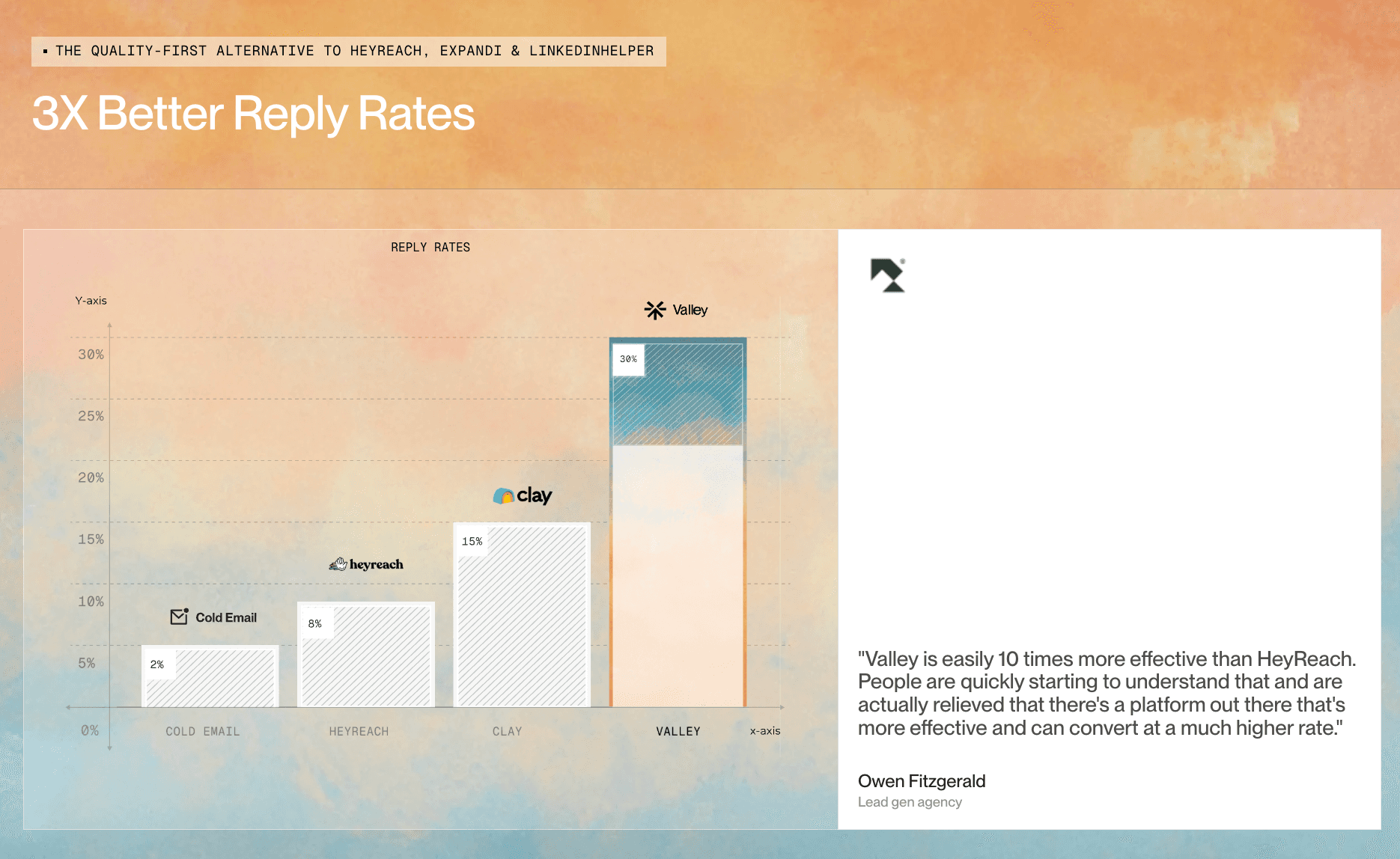
Technology/SaaS: 12-18% response rates (very active on LinkedIn), professional services: 10-15% response rates (relationship-driven), fintech: 8-12% response rates (compliance-aware but active), and B2B software: 10-16% response rates (digital-native).
Moderate-Performing Industries:
Healthcare: 6-10% response rates (compliance concerns, busy professionals), manufacturing: 6-9% response rates (less LinkedIn-active), insurance: 5-8% response rates (traditional sales approaches), and education: 5-9% response rates (budget-constrained, long cycles).
Lower-Performing Industries:
Government: 3-6% response rates (procurement restrictions, bureaucracy), retail: 4-7% response rates (high turnover, transactional), and construction: 3-5% response rates (not LinkedIn-native).
Best Practices for Industry-Specific Valley Usage:
Maximize effectiveness through industry focus:
Deep Industry Expertise:
Become expert in industries you target: understand pain points intimately, speak industry language fluently, follow industry news and trends, and build industry-specific proof points.
Segment Early:
Don't mix industries in same campaign: separate campaigns enable tailored messaging, performance tracking by industry, and optimization within verticals.
Test and Learn:
Every industry responds differently: test messaging approaches, measure what resonates, double down on winners, and cut or adapt losers.
Build Industry Networks:
Invest in industry presence: join industry LinkedIn groups, engage with industry thought leaders, publish industry-specific content, and attend (virtually or in-person) industry events.
This builds credibility that enhances outreach effectiveness.
► Book a demo and explore how Valley can support your use case
Valley's industry-aware messaging transforms generic LinkedIn automation into sophisticated vertical marketing that speaks each sector's language, understands their unique challenges, respects their buying processes, and positions your solution within their specific context, dramatically improving response rates and conversion quality compared to one-size-fits-all approaches.

Related Blogs

FEATURED READ
5 min
Valley vs HeyReach: Which LinkedIn Outreach Tool Wins More Qualified Meetings?
Read
Read

FEATURED READ
5 min
Valley in 2026: Is the Price Worth the Pipeline?
Read
Read

FEATURED READ
5 min
Valley vs Dripify: Which LinkedIn Outreach Tool Actually Converts in 2026?
Read
Read

FEATURED READ
5 min
Valley vs. Hiring an SDR: The Real Cost and ROI Breakdown for 2026
Read
Read
Which channels does Valley support?
Valley supports LinkedIn outreach, including connection requests and InMails. Valley users safely send 1000-1200 messages per seat every month.
How safe is it and does Valley risk my LinkedIn account?
Do I have to commit to an Annual Plan like other AI SDRs?
How does Valley personalize messages?
Is Valley available in my country?

VALLEY MAGIC