How Does Valley Handle Negative Responses and Objections on Linkedin?

Try Valley
Make LinkedIn your Greatest Revenue Channel ↓

Saniya
Published:
What Types of Negative Responses Valley Encounters:
Not every prospect responds positively to LinkedIn outreach. Some explicitly decline interest, others raise objections, and a few respond negatively. Valley's response frameworks help teams handle rejection professionally while preserving relationships and learning from feedback.
► Book a demo and explore how Valley can support your use case
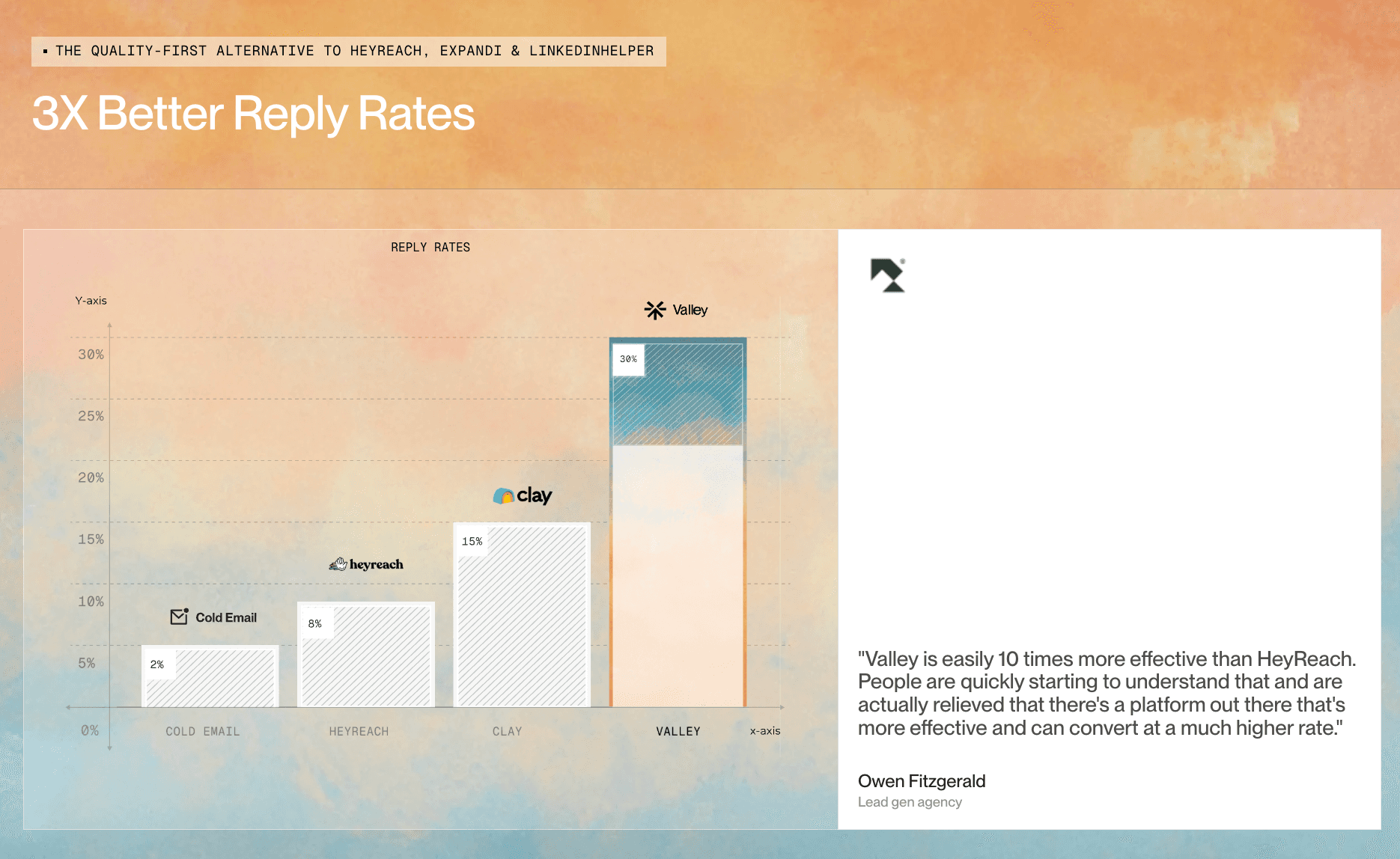
Prospects express disinterest in various ways:
Direct "Not Interested":
Clear, unambiguous rejection: "Not interested, thanks," "This isn't relevant for us," "We're not looking for this right now," and "Please don't contact me again."
These require immediate cessation of outreach and respectful acknowledgment.
Timing Objections:
Interest exists but timing wrong: "Check back in 6 months," "Maybe next year when budget refreshes," "We just implemented a competitor," and "Too busy right now to evaluate."
These warrant re-engagement at appropriate future date.
Competitive Objections:
Already using alternative: "We use [Competitor]," "Happy with current solution," "Just signed contract with [Vendor]," and "We built this internally."
These require different approach—understanding satisfaction level, identifying gaps.
Authority Objections:
Wrong person contacted: "I don't handle this—talk to [other person]," "Not my department," "I'm not the decision-maker," and "Forward this to [colleague]."
These provide routing intelligence.
Angry Responses:
Rare but intense negative reactions: "Stop spamming me!", "How did you get my contact info?", "This is harassment," and "I'm reporting this."
These require immediate de-escalation and investigation.
► Check Out Valley's Incredible Outreach: A compilation of real time messages and responses!
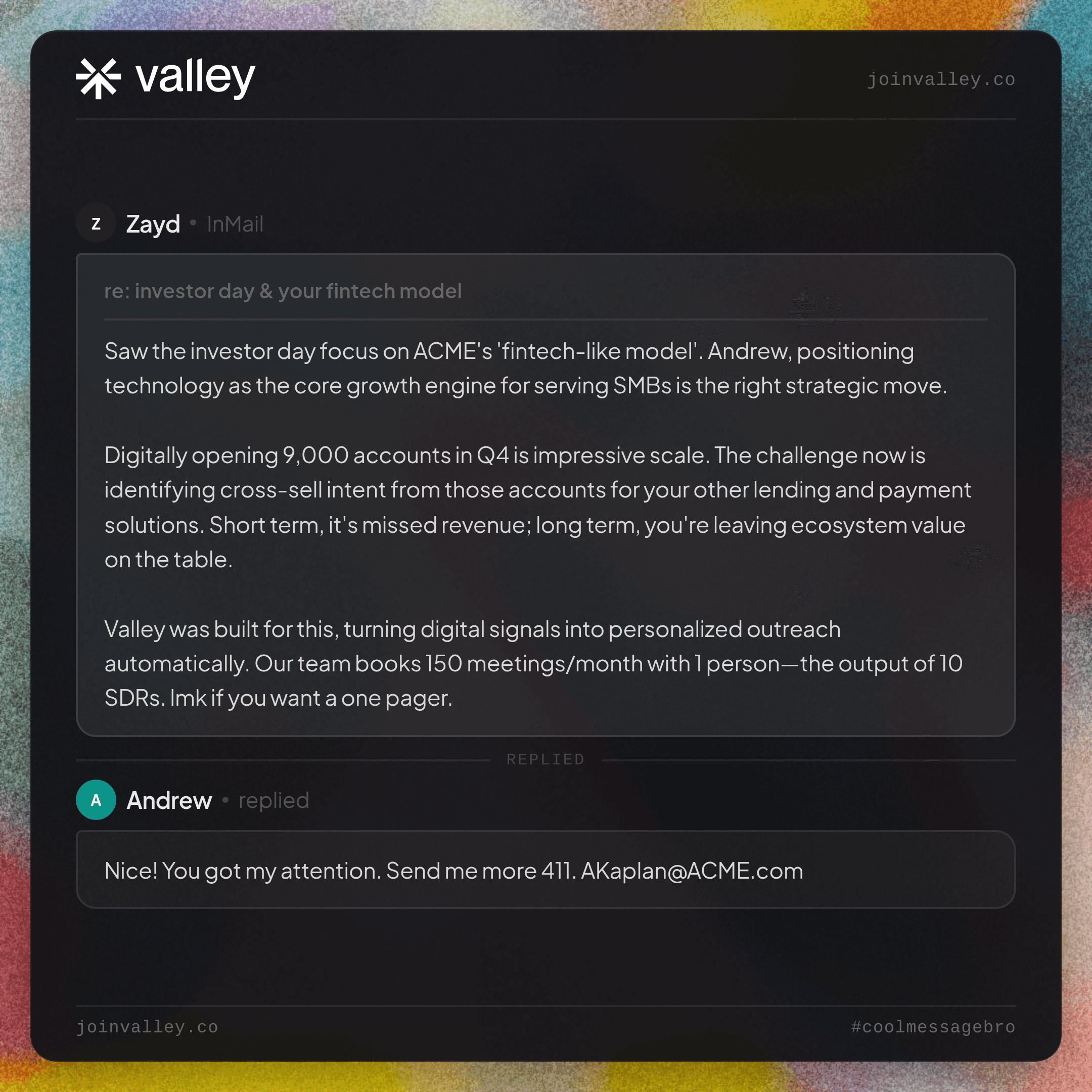

How Valley Recommends Responding to "Not Interested":
Professional handling of rejection maintains relationship possibility:
Immediate Acknowledgment:
Respond within hours: "Thanks for letting me know. I appreciate the direct response. All the best with [their company/initiatives]."
Quick response shows respect for their time and decision.
No Pushback or Persuasion:
Don't try to overcome clear objection: "Are you sure? Just 5 minutes?", "What if I told you [value prop]?", "Can I ask why not?".
Respect their decision. Arguing damages relationship permanently.
Graceful Exit:
Close conversation positively: "I'll remove you from my outreach. If priorities shift, feel free to reach out," "Totally understand. I'll make note not to contact you further," and "No problem at all. Best of luck with [relevant initiative]."
DNC List Addition:
Valley automatically: adds prospect to Do Not Contact list, stops all current and future campaigns to them, flags account-wide if entire company requests no contact, and logs reason for rejection for learning.
Bridge for Future:
Leave door slightly open without being pushy: "If your situation changes, I'm here," "Feel free to reach out if this becomes relevant later," and "Happy to help if timing aligns in future."
But ONLY if their initial rejection wasn't angry—otherwise complete cessation.
How Valley Handles Timing Objections:
"Not now" differs from "not ever"—requires different approach:
Confirm Timeline:
Clarify when to re-engage: "You mentioned checking back in Q3—would September make sense?", "When you say 'next year,' are you thinking Q1 or later?", and "What's driving the 6-month timeline, budget refresh, contract renewal, something else?".
Calendar Reminder:
Set specific re-engagement date: Valley creates future task, reminder triggers at appropriate time, and re-engagement references previous conversation.
Stay Visible:
Between now and then: add to content audience (LinkedIn posts, valuable resources), occasional non-sales touchpoints (sharing relevant article), and industry event interactions (if applicable).
Maintain presence without selling.
Re-Engagement Message:
When timeline arrives: "Hi [Name], we spoke [X months] ago and you mentioned checking back around now about [topic]. Is timing better to explore this?"
References previous conversation, respects their timeline.
How Valley Addresses Competitive Objections:
"We use [Competitor]" requires nuanced handling:
Gauge Satisfaction:
Understand their current situation: "How's [Competitor] working for you?", "Are you happy with the results you're getting?", "Any gaps or challenges with their approach?".
Responses reveal switching likelihood.
If They're Happy:
Don't badmouth competitor: "That's great to hear. [Competitor] is solid for [their use case]," "If it's working well, no reason to change," and "I'll keep you in mind if your needs evolve."
Graceful exit maintains relationship.
If They Have Complaints:
Explore gaps carefully: "What would you change about [Competitor] if you could?", "Where do you find their approach falls short?", "Is there functionality you wish they had?".
Identify if your solution addresses those gaps.
Differentiation Without Bashing:
Position your differences positively: "We take a different approach to [X] that some teams prefer when [specific scenario]," "Our focus is [differentiator] which matters more for [their situation]," and "Worth understanding the options when contract renewal comes up."
Long-Term Positioning:
Plant seeds for future: "No rush to change if you're happy. I'll share relevant insights occasionally and if your needs shift, happy to discuss," add to nurture audience for thought leadership, and re-engage around likely contract renewal timeline.
How Valley Handles Angry or Hostile Responses:
Rare but requiring immediate attention:
Immediate Cessation:
Stop all outreach instantly: add to DNC permanently, remove from all campaigns, and flag account-wide (don't contact anyone at their company).
Apologize:
Even if you did nothing wrong: "I sincerely apologize for bothering you. I'll make sure you don't receive further contact from me," "I'm sorry this message wasn't relevant. I've removed you completely," and "My mistake reaching out. You won't hear from me again."
De-escalation trumps explanation.
Investigate Root Cause:
Understand what triggered anger: was message actually spammy or inappropriate?, did they receive duplicates somehow?, are they generally hostile to outreach?, or previous bad experience with Valley or LinkedIn automation?.
Learn and Improve:
If message quality issue: adjust AI training to avoid similar messages, tighten ICP targeting to prevent future mismatches, and review approval process for that campaign.
If prospect is generally hostile: nothing to learn—some people hate all outreach.
Never Engage Further:
Don't defend yourself: "Actually, I was just...", "I only reached out because...", "LinkedIn said you viewed...".
Accept their response and move on completely.
How Valley Tracks Rejection Reasons and Patterns:
Systematic analysis of negative responses reveals optimization opportunities:
Categorize All Rejections:
Valley tags negative responses: "Not interested - no reason given", "Not interested - budget", "Not interested - timing", "Not interested - using competitor", "Not interested - built internally", "Wrong person", "Angry rejection", "Already customer (mistake)".
Response Rate Analysis:
Track negative response percentage: healthy: 5-10% explicit "not interested" (expected rejection rate), concerning: 15-20% (possible targeting or message problems), critical: 20%+ (serious issues requiring immediate investigation).
Rejection Reasons by Segment:
Identify patterns: if fintech prospects frequently say "too busy", maybe timing or approach needs adjustment.
If certain company sizes consistently reject, possibly ICP definition wrong.
If specific message variation generates more rejections, retire that variation.
Geographic or Industry Patterns:
Some regions or industries may be less receptive: European prospects more privacy-sensitive (more "stop contacting" responses), certain industries less LinkedIn-active (manufacturing, construction), and cultural differences in outreach receptivity.
Adjust strategy by segment.
How to Configure Valley's Rejection Handling Workflows:
Systematic negative response management:
Automatic DNC Addition:
Configure Valley rules: explicit "not interested" → immediate DNC, "check back later" → scheduled re-engagement, competitor mention → nurture for future, and angry response → permanent DNC + alert user.
Response Templates:
Pre-written graceful exit templates: for timing objections, for competitive situations, for wrong-person routing, and for clear rejections.
Ensures consistent professional handling.
Escalation Rules:
When to alert human: any angry response (immediate notification), multiple rejections from same company (account-level issue?), spike in rejection rate (campaign problem?), and spam reports (critical issue).
Re-Engagement Windows:
Define appropriate wait periods: general "not interested": never re-engage unless they initiate, timing objection: re-engage at specified timeline, competitor user: re-engage near typical contract renewal (12-24 months), and wrong person: re-engage correct contact immediately.

What Healthy Rejection Rates Look Like:
Benchmarking negative response expectations:
Expected Rates:
Total negative responses: 5-10% of contacted prospects, explicit "not interested": 3-5%, timing objections: 2-4%, competitive objections: 1-2%, angry responses: <0.5% (should be rare), and positive responses: 6-10% (should exceed negatives).
Red Flags:
Negative responses exceeding positive (problem with targeting or messaging), angry responses >1% (serious message quality or spam issues), competitive objections >5% (possibly targeting wrong market), or rejection rate increasing over time (message fatigue, list exhaustion).
How Rejections Inform Valley Strategy Improvement:
Negative feedback drives optimization:
ICP Refinement:
If rejections cluster in certain prospect types: tighten ICP to exclude those segments, focus on prospects who respond positively, and reduce wasted outreach to poor-fit prospects.
Message Testing:
If certain messages generate more rejections: retire underperforming variations, double down on messages generating positive responses, and test new approaches for problem segments.
Timing Optimization:
If timing objections frequent: align outreach with industry buying cycles, target trigger events more aggressively, and space out re-engagement attempts more.
Value Proposition Adjustment:
If frequent "not relevant" rejections: reassess whether value prop resonates with target market, test different positioning angles, and interview positive responders to understand what worked.
► Book a demo and explore how Valley can support your use case
Valley's systematic rejection handling transforms negative responses from discouraging setbacks into learning opportunities that refine targeting, improve messaging, and ultimately increase positive response rates by eliminating approaches that generate rejection while amplifying those that generate interest.

Related Blogs

FEATURED READ
5 min
Valley vs HeyReach: Which LinkedIn Outreach Tool Wins More Qualified Meetings?
Read
Read

FEATURED READ
5 min
Valley in 2026: Is the Price Worth the Pipeline?
Read
Read

FEATURED READ
5 min
Valley vs Dripify: Which LinkedIn Outreach Tool Actually Converts in 2026?
Read
Read

FEATURED READ
5 min
Valley vs. Hiring an SDR: The Real Cost and ROI Breakdown for 2026
Read
Read
Which channels does Valley support?
Valley supports LinkedIn outreach, including connection requests and InMails. Valley users safely send 1000-1200 messages per seat every month.
How safe is it and does Valley risk my LinkedIn account?
Do I have to commit to an Annual Plan like other AI SDRs?
How does Valley personalize messages?
Is Valley available in my country?

VALLEY MAGIC