How Does Valley Handle Re-Engagement of Old Linkedin Connections?

Try Valley
Make LinkedIn your Greatest Revenue Channel ↓

Saniya
Published:
Why Dormant Connections Deserve Re-Engagement:
Your existing LinkedIn network contains hidden pipeline, connections made months or years ago who never converted but remain relevant prospects. Valley's re-engagement capabilities identify dormant connections showing renewed interest and restart conversations with context that references your existing relationship.
First-touch outreach that didn't convert wasn't necessarily targeting wrong prospects. Timing often determines sales outcomes more than fit.
A prospect who ignored outreach six months ago might be actively seeking solutions today because: their priorities shifted (new role, new initiatives), budget became available (fiscal year refresh, funding round), pain points intensified (team growth, competitive pressure), competitive solutions failed (evaluating alternatives), or trigger events occurred (executive hire, expansion, acquisition).
Valley continuously monitors dormant connections for renewed interest signals, creating re-engagement opportunities with warmer context than cold outreach.
► Book a demo and explore how Valley can support your use case

How Valley Identifies Dormant Connections Showing New Signals:
Valley tracks all LinkedIn connections for behavioral changes indicating renewed interest:
Profile View Detection from Existing Connections:
When someone you're already connected with views your profile: Valley notes the re-engagement (they're thinking about you again), compares to previous interaction history (last contact 6 months ago, no response), flags as re-engagement opportunity (timing may have changed), and generates contextual message acknowledging existing relationship.
Example: "Hi Sarah, noticed you checked out my profile recently. We connected a while back but never got a chance to talk properly. Curious what prompted you to circle back?"
Content Engagement from Dormant Connections:
When existing connections engage with your LinkedIn posts: likes indicate passive re-awareness, comments demonstrate active interest in topic, shares suggest strong agreement or relevance.
Valley differentiates between: connections who engage occasionally (general interest, not sales signal), dormant connections showing first engagement in months (renewed interest signal), and concentrated engagement (multiple posts in short period = active research).
Website Visits from Connection's Company:
Valley's website visitor tracking identifies when companies of existing connections visit: dormant connection works at Company X, Company X visits pricing page, Valley correlates connection to visitor company, and re-engagement triggered with high intent.
Message: "Hi Tom, I saw someone from [Company] was checking out our pricing yesterday. We connected a while back, wondering if the timing is better now to explore how we might help your team?"
Job Change Notifications:
LinkedIn notifies when connections change roles. Valley monitors for relevant changes: promotion (more authority now), new company (fresh evaluation period), new role (different responsibilities, new problems), same company, new department (shifted priorities).
Job changes create natural re-engagement opportunities.
How Valley Crafts Re-Engagement Messages Differently:
Re-engagement requires different approach than initial outreach. Valley acknowledges the existing relationship while creating new value.
Acknowledge the Previous Connection:
Don't pretend you're meeting for first time: "We connected [timeframe] ago but haven't had a chance to catch up properly," "I know we're already connected, but wanted to reach out directly because [new reason]," or "Circling back after [time period]—saw [new signal] and thought timing might be different now."
This honesty builds trust and context.
Reference What Changed:
Explain why you're reaching out now: "I noticed you [new signal—viewed profile, engaged with content, visited website]," "I saw [Company] recently [trigger event—funding, expansion, hire]," "Your role shifted to [new position]—congrats! Thought our approach might be more relevant now," or "We've added [new capability] since we last connected that addresses [their challenge]."
Change provides permission to re-engage without seeming pushy.
Provide New Value:
Don't repeat original pitch. Offer something new: "Since we connected, we've published [resource] that [their role] have found valuable. Want me to send it over?" "I've been writing about [topic they care about]. Based on your [recent activity], thought you might find [specific post] relevant," or "We recently worked with [similar company] on [relevant challenge]. The approach might interest you given [their context]."
Lower Pressure CTA:
Re-engagement CTAs should feel optional, not sales-heavy: "If timing is better now, happy to chat. If not, no worries—just wanted to reconnect," "Worth a conversation or should I check back in a few months?" or "Let me know if you'd like to discuss. Otherwise, hope the new role is going well!"
This reduces resistance and feels more relationship-focused.
What Re-Engagement Timing Strategies Work Best:
Not all dormant connections should be re-engaged immediately. Valley applies strategic timing.
Signal-Based Immediate Re-Engagement:
High-intent signals warrant same-day outreach: pricing page visit from their company, multiple profile views in short period, active comment on your LinkedIn post, or share of your content.
These signals indicate active interest—respond while it's fresh.
Time-Based Re-Engagement Windows:
For connections without new signals, Valley suggests re-engagement windows: 90-120 days since last contact (respectful gap, not too pushy), fiscal year transitions (Q1, Q4—budget cycles), industry event timing (before/after conferences), or seasonal buying cycles (specific to your market).
Trigger Event Re-Engagement:
Immediate outreach when Valley detects: funding announcement (budget available), executive hire (re-evaluation likely), expansion news (growth creating need), competitor mention (actively evaluating category), or product launch (potential integration opportunity).
Content-Triggered Re-Engagement:
When you publish highly relevant content: send to dormant connections who would find it valuable, frame as "thought you'd find this interesting" not sales pitch, use as soft re-engagement that provides value first, and let them respond if interested in deeper conversation.
How Valley Segments Dormant Connections for Re-Engagement Priority:
Not all dormant connections deserve equal re-engagement effort. Valley prioritizes based on:
Original ICP Fit Score:
Dormant connections with high original ICP scores (80+) get priority re-engagement. They were qualified prospects when initially contacted—timing was likely the only barrier.
Lower original scores (50-79) get secondary priority. Moderate fit might not justify aggressive re-engagement.
Very low scores (<50) typically excluded from re-engagement unless they've shown strong new signals.
Engagement History:
Previous interaction quality matters: responded positively but timing was wrong: highest re-engagement priority, responded neutrally (questions but no commitment): medium priority, never responded at all: lower priority, unless strong new signals, or explicitly said "not interested": avoid re-engagement unless major context changed.
Time Since Last Contact:
Appropriate cooling period varies: 3-6 months: generally too soon for cold re-engagement (unless strong signal), 6-12 months: optimal re-engagement window (enough time passed), 12-24 months: extended gap allows major context changes, or 24+ months: essentially starting fresh (long enough to reset relationship).
Signal Strength Since Connection:
Dormant connections showing multiple new signals: 3+ profile views + content engagement + website visit = immediate re-engagement priority.
Single weak signal (one like) from dormant connection: lower urgency, possibly wait for additional signals.
How Valley Prevents Over-Contacting Dormant Connections:
Re-engagement requires discipline to avoid becoming annoying. Valley's safeguards:
Re-Engagement Frequency Caps:
Maximum one re-engagement attempt per dormant connection every 90 days. If they don't respond to first re-engagement, wait another quarter before trying again.
After three unsuccessful re-engagement attempts (over 9+ months): move to passive content audience only, exclude from active re-engagement campaigns, or remove entirely if they've never engaged.
DNC List Checking:
Before any re-engagement, Valley verifies: connection didn't opt-out of communication, no "not interested" response in history, not added to company DNC list for any reason, and still works at same company (job change might make them irrelevant).
Response Pattern Monitoring:
Valley tracks re-engagement effectiveness: if dormant connection segment shows <2% response rate, pause re-engagement to that segment, if specific messages generate negative responses, adjust approach, and high no-response rate signals timing still wrong—extend cooling periods.
► Check Out Valley's Incredible Outreach: A compilation of real time messages and responses!

What Re-Engagement Results to Expect from Valley:
Re-engagement performance differs from cold outreach but often exceeds it.
Response Rate Benchmarks:
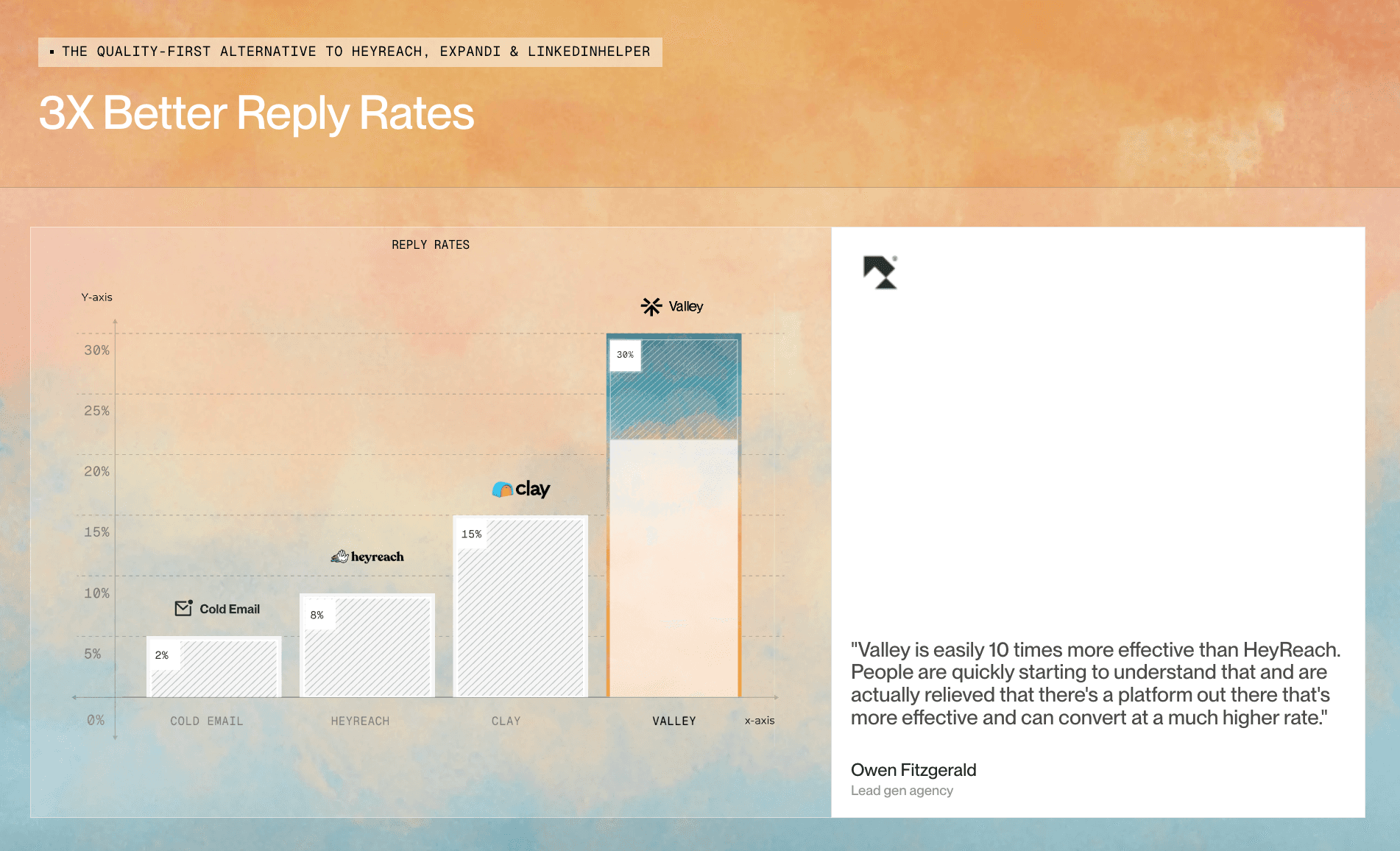
Dormant connections with new high-intent signals (website visit, multiple profile views): 12-20% response rate, comparable to warm outbound.
Dormant connections with moderate signals (content engagement): 8-12% response rate, better than cold, worse than active warm.
Time-based re-engagement without new signals (just "checking in after 6 months"): 3-5% response rate, slightly better than cold due to existing connection.
Meeting Booking Rates:
Dormant connections who respond convert to meetings at: 40-50% rate for high-signal re-engagement (they showed renewed interest), 25-35% rate for moderate signal re-engagement, or 15-20% rate for time-based re-engagement.
Pipeline Quality:
Deals from re-engaged dormant connections show: similar or better close rates vs. new prospects (fit was always good, timing is now right), faster sales cycles (existing familiarity reduces education needed), or higher average deal sizes (they've researched longer, more confident).
Volume Expectations:
Typical Valley user with 1,000 LinkedIn connections: 50-100 dormant connections worth re-engaging quarterly (5-10% of network), 15-20% show new signals warranting outreach (8-20 prospects), 8-12% response rate (1-2 responses), or 40% convert to meetings (0-1 meeting monthly from re-engagement).
Re-engagement provides supplemental pipeline, not primary source—but it's incremental value from existing assets.
How to Optimize Dormant Connection Strategy Over Time:
Strategic refinement improves re-engagement effectiveness.
Track Which Signals Predict Re-Engagement Success:
Analyze conversion rates by signal type: website visits from dormant connections: X% convert, profile views: Y% convert, content engagement: Z% convert.
Double down on highest-converting signals, reduce effort on low-converters.
Test Re-Engagement Messaging Approaches:
A/B test message frameworks: direct acknowledgment ("We connected X months ago, wanted to check in") vs. value-first ("Thought you'd find this new resource relevant") vs. signal reference ("Noticed you viewed my profile: what prompted that?").
Measure response rates and implement winners.
Identify Optimal Re-Engagement Timing:
Track time-since-last-contact for successful re-engagements: if most successful re-engagements happen 9-12 months after initial contact, target that window.
If 6-month attempts consistently fail while 12-month succeed, adjust timing strategy.
Segment by Original Outcome:
Separate dormant connections by original interaction: "Responded positively but bad timing" segment likely re-engages well, "Never responded initially" segment needs stronger new signals to justify re-engagement, or "Responded negatively" segment avoid unless dramatic context change.
► Book a demo and explore how Valley can support your use case
Valley's dormant connection re-engagement transforms your existing LinkedIn network from static contact list into dynamic pipeline source, capturing value from relationships already established when timing finally aligns with their needs, often generating highest-quality conversations because familiarity and trust already exist from prior connection.

Related Blogs

FEATURED READ
5 min
Valley vs HeyReach: Which LinkedIn Outreach Tool Wins More Qualified Meetings?
Read
Read

FEATURED READ
5 min
Valley in 2026: Is the Price Worth the Pipeline?
Read
Read

FEATURED READ
5 min
Valley vs Dripify: Which LinkedIn Outreach Tool Actually Converts in 2026?
Read
Read

FEATURED READ
5 min
Valley vs. Hiring an SDR: The Real Cost and ROI Breakdown for 2026
Read
Read
Which channels does Valley support?
Valley supports LinkedIn outreach, including connection requests and InMails. Valley users safely send 1000-1200 messages per seat every month.
How safe is it and does Valley risk my LinkedIn account?
Do I have to commit to an Annual Plan like other AI SDRs?
How does Valley personalize messages?
Is Valley available in my country?

VALLEY MAGIC