How Does Valley Handle Reply Management and Follow-Up Sequences?

Try Valley
Make LinkedIn your Greatest Revenue Channel ↓

Saniya Sood
Published:
How Does Valley's Reply Detection and Drafting Work?
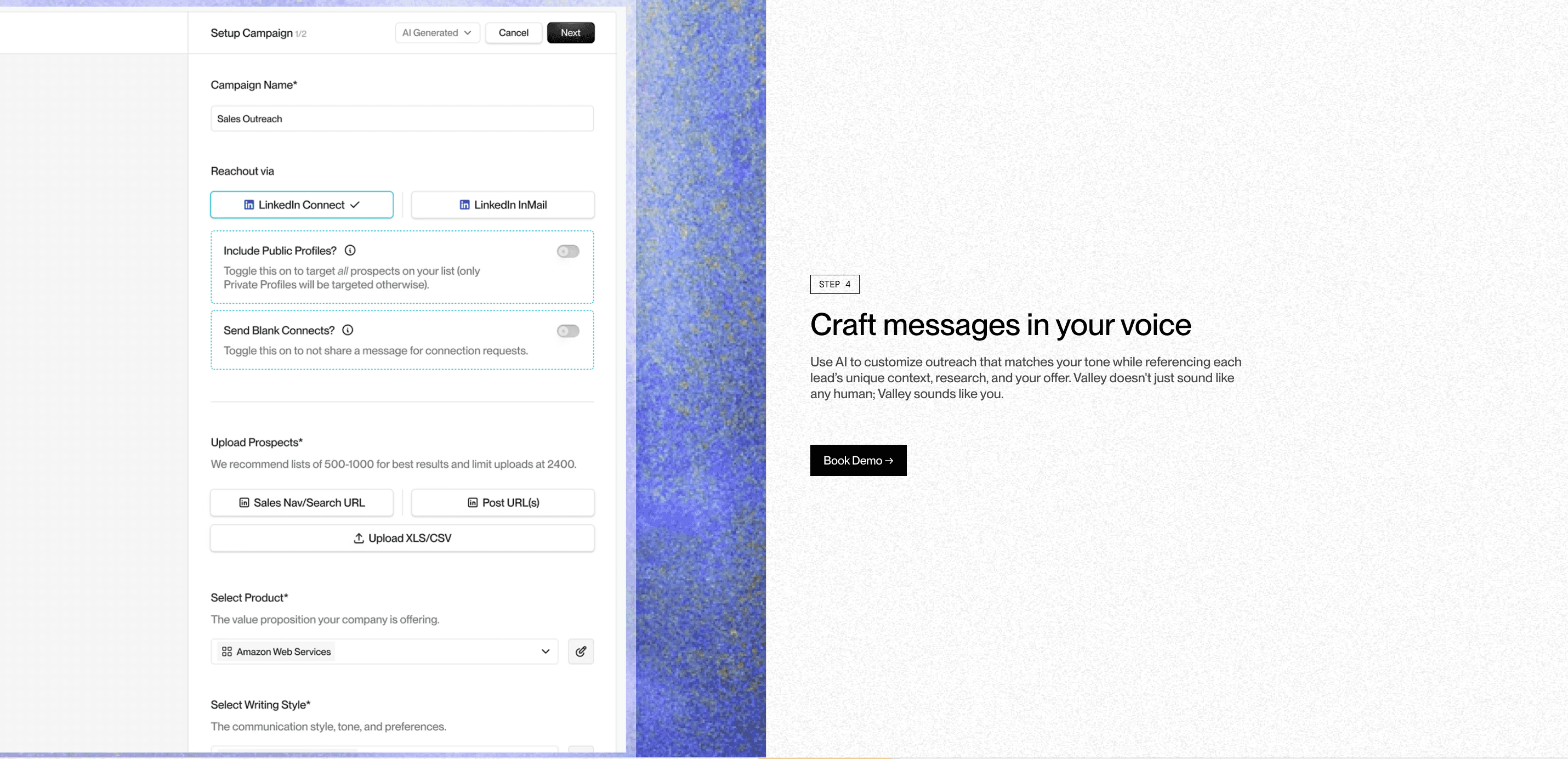
Valley employs intelligent reply detection that immediately recognizes when prospects respond and automatically pauses their sequence to prevent awkward double-messaging. The platform then analyzes the response content, categorizes it (interested, not interested, question, not now, wrong person), and drafts an appropriate reply based on your configured approach and writing style.
The draft generation is sophisticated, not templated. Valley considers: the specific content of the prospect's response, their research profile and company context, the conversation history and original outreach angle, your defined writing style and response patterns, and the appropriate next step (booking meeting, providing information, nurturing). This results in contextually appropriate responses that maintain conversation momentum.
Users consistently praise the reply quality: "Valley drafts responses for you to approve, edit, or regenerate. I generally just approve what Valley drafts, sometimes with small edits, and it doesn't take much time." The system learns from edits, improving future drafts based on your preferences and patterns.
Can Valley Automatically Send Replies Without Approval?
Currently, Valley operates on a semi-automated reply model where all responses require human approval before sending. This design choice is deliberate, as Valley's team explains: "Valley drafts responses when prospects reply, but doesn't automatically send them because responses are delicate. Users need to approve them."
The approval process is streamlined for efficiency: all drafted replies appear in a centralized queue, each draft includes prospect context and conversation history, one-click approval for appropriate responses, and quick edit capabilities for minor adjustments. Most users report spending just 5-10 minutes daily managing replies even with high-volume campaigns.
Valley is considering fully automated replies for specific scenarios based on user requests. However, the current semi-automated approach prevents embarrassing mistakes while maintaining quick response times. As one user noted: "The balance between automation and human oversight is perfect - I save hours while maintaining quality control over critical conversations."
► Check Valley's Outreach: A compilation of real time messages and responses!
How Do Follow-Up Sequences Work in Valley?
Valley's follow-up sequences are strategically designed for maximum engagement while respecting prospects. For connection requests, Valley supports multi-step sequences: initial connection request with personalized note, first follow-up (typically 3-4 days after acceptance), second follow-up (7-10 days later if no response), and optional third follow-up for high-value prospects. The sequence automatically pauses when prospects reply at any stage.
InMail sequences work differently due to LinkedIn limitations - they're single-touch only. Valley maximizes this single opportunity through deep personalization and compelling hooks. The platform compensates by identifying open profiles where you can send InMails without credit limitations, effectively increasing your InMail volume for sustained outreach.
The follow-up content evolves naturally. Rather than sending the same message repeatedly, Valley crafts each follow-up with different angles: the first might reference their recent activity, the second could share relevant insight or resource, and the third might acknowledge timing and suggest future reconnection. This variety maintains professionalism while improving response rates.
► Book a demo and explore how Valley can support your use case

What Happens When Someone Responds "Not Interested"?
Valley handles rejection responses professionally and strategically. When someone responds "not interested," Valley can draft several response types based on your configuration: a polite acknowledgment and relationship-building close, a request for feedback to improve future outreach, a soft offer to reconnect in the future, or simply marking them as unqualified without response.
The platform's intelligence shines in recognizing soft rejections versus hard nos. "Not right now" triggers different handling than "never contact me again." Valley can draft nurture responses for soft rejections: "I understand timing isn't right. Would it make sense to reconnect in Q2?" while respecting hard rejections with simple acknowledgment or no response.
Best practices for rejection handling include: always maintaining professionalism (prospects might change companies or circumstances), capturing feedback when offered for campaign improvement, noting rejection reasons in CRM for future reference, and potentially routing soft rejections to nurture campaigns. Valley facilitates all these approaches through its flexible response drafting.
Can Valley Handle Complex Multi-Touch Conversations?
Valley manages ongoing dialogues through contextual conversation threading. The platform maintains full conversation history, remembers previous talking points and commitments, and drafts each response considering the entire dialogue arc. This enables natural, progressive conversations rather than disjointed exchanges.
For example, if a prospect asks about pricing in message two, then asks about implementation in message four, Valley remembers the pricing discussion and can reference it: "As I mentioned, our pricing starts at $X. Regarding implementation, we typically..." This contextual awareness creates coherent conversations that build toward meetings.
The system handles various conversation patterns: qualification dialogues (gathering information before meeting), educational exchanges (providing value before pitching), objection handling (addressing concerns sequentially), and multi-stakeholder discussions (adapting tone for different participants). Each requires different approaches, which Valley manages through its understanding of conversation dynamics.

How Does Valley Prioritize Which Replies to Draft First?
Valley employs intelligent prioritization for reply drafting based on multiple factors: response sentiment (positive replies drafted first), prospect score (high ICP fits prioritized), conversation stage (near-meeting conversations prioritized), and response recency (newer replies addressed quickly). This ensures your most valuable opportunities receive immediate attention.
The prioritization is configurable. Teams focused on pipeline velocity might prioritize positive responses exclusively. Those building long-term relationships might balance across all response types. Agencies managing multiple clients can set client-specific prioritization rules, ensuring key accounts receive premium attention.
Users appreciate this intelligence: "Valley helps me focus on what matters. I know the most important replies are at the top of my queue, so I can quickly approve those even if I'm short on time." This prioritization transforms reply management from overwhelming to manageable, especially at scale.
What Insights Does Valley Provide About Response Patterns?
Valley tracks comprehensive response metrics that reveal campaign effectiveness and messaging optimization opportunities. The platform categorizes every response, tracks response rates by message variation, identifies common objections and questions, and correlates response quality with research types and personalization approaches.
These insights drive continuous improvement. If Valley notices certain personalization angles generate more positive responses, you can adjust writing styles accordingly. If specific industries show lower engagement, you can refine ICP definitions or adjust messaging strategies. Common objections can be proactively addressed in initial outreach.
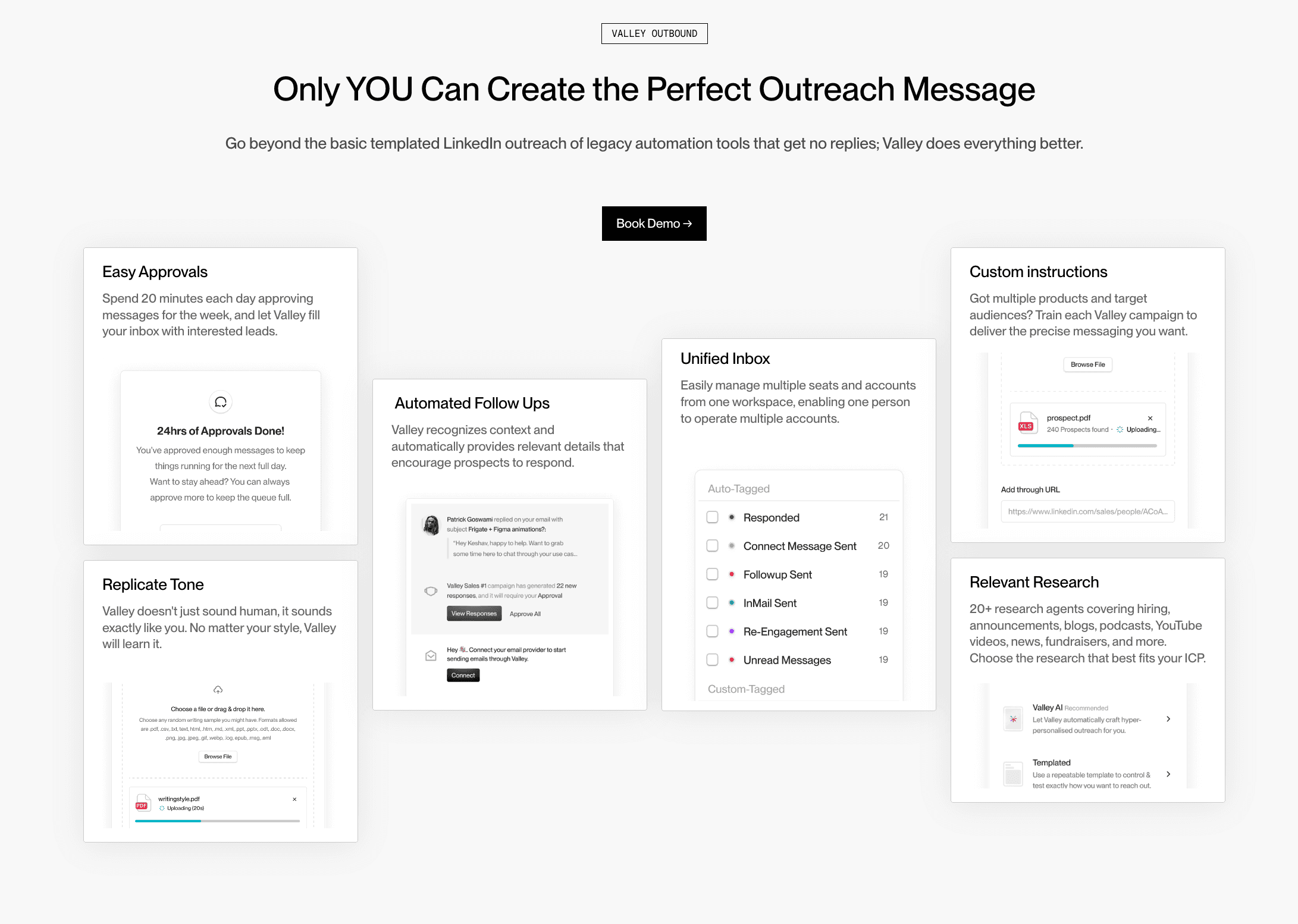
The response analytics integrate with campaign performance metrics, showing not just volume but quality patterns: which campaigns generate the most interested responses, what message types lead to meetings versus rejections, how follow-up timing affects response rates, and which prospect segments engage most positively. This data transforms reply management from reactive to strategic, enabling systematic optimization of your entire outreach approach.

Related Blogs

FEATURED READ
5 min
Valley vs HeyReach: Which LinkedIn Outreach Tool Wins More Qualified Meetings?
Read
Read

FEATURED READ
5 min
Valley in 2026: Is the Price Worth the Pipeline?
Read
Read

FEATURED READ
5 min
Valley vs Dripify: Which LinkedIn Outreach Tool Actually Converts in 2026?
Read
Read

FEATURED READ
5 min
Valley vs. Hiring an SDR: The Real Cost and ROI Breakdown for 2026
Read
Read
Which channels does Valley support?
Valley supports LinkedIn outreach, including connection requests and InMails. Valley users safely send 1000-1200 messages per seat every month.
How safe is it and does Valley risk my LinkedIn account?
Do I have to commit to an Annual Plan like other AI SDRs?
How does Valley personalize messages?
Is Valley available in my country?

VALLEY MAGIC