How Does Valley Help Sales Teams Identify When Prospects Are Ready to Buy?

Try Valley
Make LinkedIn your Greatest Revenue Channel ↓

Saniya
Published:
What Buying Readiness Actually Means:
Contacting prospects before they're ready wastes effort. Reaching out after competitors engaged costs deals.
Valley identifies buying readiness through behavioral signal combinations that reveal when prospects transition from research to active evaluation, enabling perfectly-timed outreach.
► Book a demo and explore how Valley can support your use case
Prospects progress through stages before purchasing:
Awareness (Not Ready):
Prospect recognizes problem exists: researching problem definition, understanding implications, seeking education on topic area, and consuming general content.
Behavior: reading broad educational content, single passive signals (likes), exploratory research.
Buying readiness: 0-10%, too early for sales conversation.
Consideration (Getting Closer):
Prospect evaluating solution approaches: researching different solution categories, understanding vendor landscape, comparing approaches and methodologies, and building requirements.
Behavior: engaging with solution content, multiple signals over time, visiting vendor websites.
Buying readiness: 25-40%—appropriate for relationship building, too early for hard selling.
Evaluation (Ready):
Prospect actively comparing vendors: requesting demos and information, engaging with competitive content, visiting pricing pages, and involving multiple stakeholders.
Behavior: compressed timeline activity, high-intent pages, multi-stakeholder signals, competitor engagement.
Buying readiness: 60-80%—prime sales opportunity.
Decision (Immediate):
Prospect selecting vendor and negotiating: narrowed to 2-3 finalists, requesting proposals, discussing pricing and terms, and internal approval process.
Behavior: very frequent contact, procurement involvement, legal questions, timeline pressure.
Buying readiness: 80-100%critical engagement window.
How Valley Detects Each Readiness Stage:
Behavioral signals reveal buying stage:
Awareness Stage Indicators:
Valley identifies early-stage prospects through: single content engagement (one post like, one article read), broad topic research (consuming general industry content), passive signals only (no profile views or direct research), and long time horizons (casual occasional engagement).
Valley approach: Add to content nurture, provide educational value, build awareness and credibility, and avoid aggressive sales approach.
Consideration Stage Indicators:
More serious research begins: multiple content engagements over weeks, website visits to general pages (about, product), LinkedIn profile views (researching people behind company), and solution-focused content consumption.
Valley approach: Soft outreach offering resources, educational conversation vs. sales pitch, position as thought leader/advisor, and build relationship for future evaluation.
Evaluation Stage Indicators (High Priority):
Active vendor comparison: pricing page visits (commercial intent), multiple stakeholder signals from same company, competitor content engagement (comparing options), repeated website returns (deep evaluation), and compressed timeline (3+ signals within week).
Valley approach: Immediate outreach with specific value prop, offer demo or detailed discussion, highlight differentiation vs. competitors, and push for meeting this week.
Decision Stage Indicators (Urgent):
Imminent purchase decision: very frequent activity (daily signals), specific technical/commercial questions in comments, procurement or legal stakeholder involvement, timeline questions ("how fast can you implement?"), and multiple stakeholders in conversation.
Valley approach: Prioritize above all other prospects, assign to senior sales resource, coordinate multi-stakeholder meeting, and accelerate sales process.

How Valley Combines Signals to Score Buying Readiness:
Single signals are ambiguous. Signal combinations reveal true readiness:
Signal Accumulation Scoring:
Valley assigns readiness points to behaviors:
Pricing page visit: +40 points (high intent)
3+ profile views: +30 points (sustained interest)
Competitor engagement: +35 points (active comparison)
Website visit (non-pricing): +15 points
Post comment: +20 points (active engagement)
Post share: +15 points
Post like: +5 points (passive)
Single profile view: +5 points
Readiness Tiers:
0-20 points: Awareness (nurture only) 21-50 points: Consideration (relationship building) 51-80 points: Evaluation (active sales engagement) 81-100+ points: Decision (urgent priority)
Example Progression:
Week 1: Prospect likes post (+5 points) = 5 total = Awareness Week 2: Views profile (+5), visits website (+15) = 25 total = Consideration
Week 3: Views profile 2 more times (+30), visits pricing (+40) = 95 total = Decision stage
Valley alerts team when prospects cross into Evaluation/Decision stages.
Velocity Multipliers:
Signal compression indicates urgency: signals spread over months: 1x multiplier (slow research), signals within weeks: 1.5x multiplier (active evaluation), signals within days: 2x multiplier (urgent decision).
How Valley Identifies Organizational Buying Readiness:
Individual readiness matters less than organizational readiness for B2B:
Multi-Stakeholder Coordination:
Valley detects when buying committee forms: 1 person researching: individual interest (may not have budget/authority), 2-3 people from different departments: organizational evaluation beginning, 4+ people including executive: formal buying process underway, and cross-functional team: serious evaluation with budget allocated.
Signal Clustering Timeline:
How stakeholders coordinate research: all active same week: organized evaluation (likely following internal meeting), spread over month: organic discovery, and accelerating from slow to fast: interest building momentum.
Department Diversity:
Signals from across organization indicate broader buy-in: Sales only: departmental need, Sales + Ops: process improvement focus, Sales + Finance: budget consideration occurring, and Sales + Ops + Finance + Exec: comprehensive organizational evaluation.
How Valley Prioritizes Outreach by Buying Readiness:
Not all prospects deserve equal attention:
Tier 1: Decision Stage (Highest Priority):
Prospects showing: 80-100 readiness score, multiple high-intent signals, compressed timeline activity, and multi-stakeholder involvement.
Valley action: immediate notification to sales team, auto-escalate to senior rep or AE, push for meeting within 24-48 hours, and bypass normal sequence (direct engagement).
Tier 2: Evaluation Stage (Active Sales):
Prospects showing: 51-80 readiness score, pricing page visit OR competitor engagement OR 3+ signals, and single or dual stakeholder.
Valley action: standard outreach sequence, demo offer and value prop focus, differentiation messaging, and follow up within 3-5 days.
Tier 3: Consideration Stage (Nurture):
Prospects showing: 21-50 readiness score, website visits and profile views, and general interest signals.
Valley action: educational outreach (resource offers), relationship building approach, soft CTA (not aggressive meeting push), and longer sequence (14-21 day cadence).
Tier 4: Awareness Stage (Content Only):
Prospects showing: 0-20 readiness score, single passive signals, and broad content consumption.
Valley action: add to content audience only, no direct outreach yet, nurture with valuable posts, and monitor for signal progression.
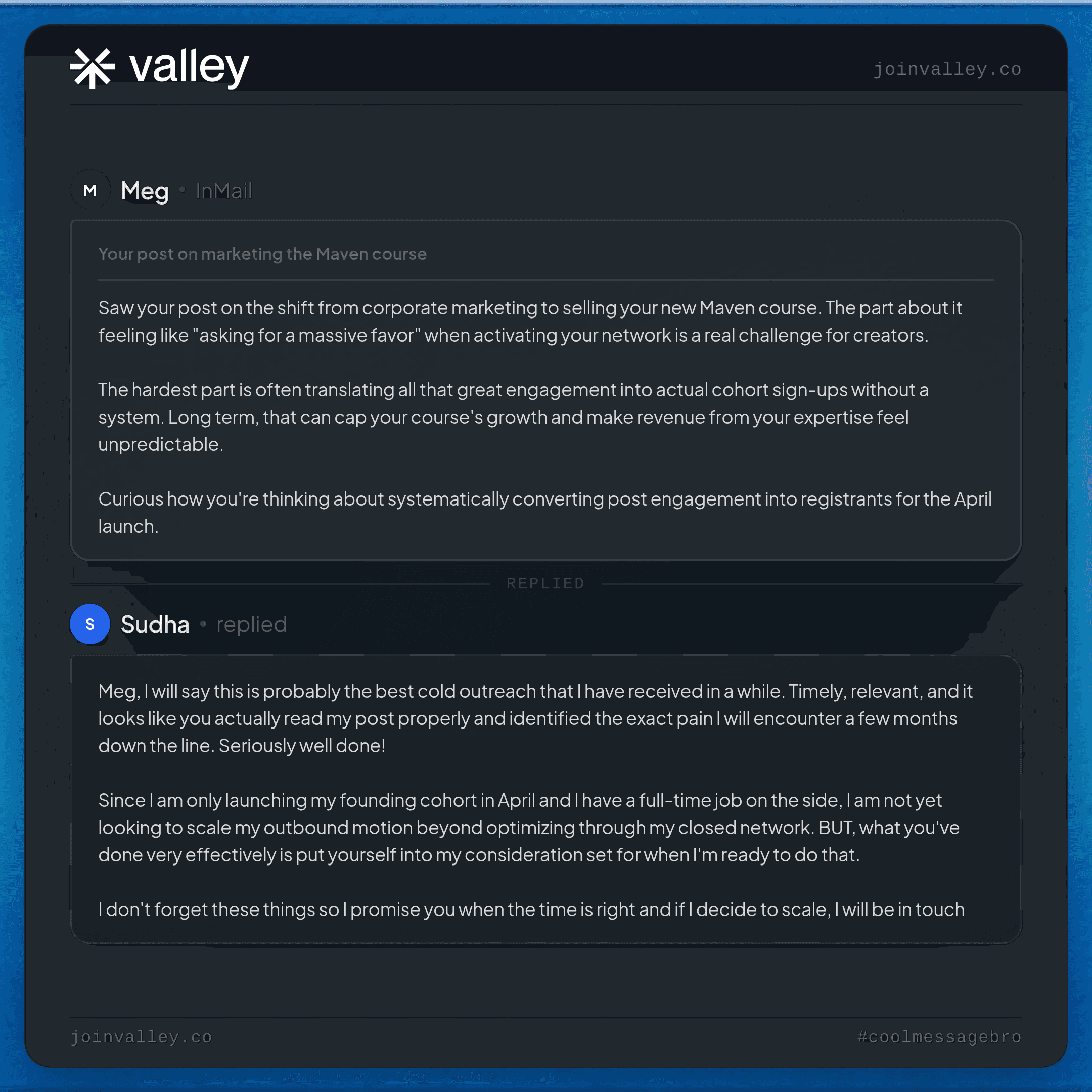
► Check Out More of Valley's Incredible Outreach: A compilation of real time messages and responses!

How Valley Detects Buying Readiness Regression:
Readiness isn't linear, prospects can cool off:
Activity Stalls:
Previously active prospect goes quiet: was showing signals weekly, no activity for 3+ weeks, and no response to outreach.
Possible causes: timing changed, competitor selected, budget cut, or champion left company.
Valley action: pause aggressive outreach, shift to gentle re-engagement, and investigate if possible.
Negative Signals:
Indicators of lost interest: unsubscribes from content, LinkedIn disconnection after conversation, "not interested" responses, and competitive selection announcement.
Valley action: add to DNC if explicitly requested, long-term nurture if timing issue, and analyze for pattern (is this segment/message generating rejections?).
Competitive Loss Indicators:
Evidence competitor won: company announces partnership with competitor, stakeholder joins competitor's webinar, engagement with competitor's customer announcement, and "we selected another vendor" response.
Valley tracks competitive losses for learning.
How Valley Reveals Buying Timeline Compression:
Early signals indicate timeline acceleration:
Signal Frequency Increases:
Comparing activity patterns: baseline: one signal every 2 weeks (slow research), acceleration: 3 signals this week (evaluation intensifying), compression: multiple signals daily (decision imminent).
Valley alerts: "Prospect X showing 5x activity increase—buying decision approaching."
High-Intent Signal Progression:
Movement up intent ladder: started with passive likes, progressed to active comments, now visiting pricing page repeatedly, and latest: involving multiple stakeholders.
Trajectory indicates readiness increasing.
Urgency Language:
If prospects comment or respond: "we need to solve this soon", "timeline is Q1", "evaluating options this month", and "when could we implement?".
Valley flags urgency keywords in responses.
Trigger Event Correlation:
External events creating buying urgency: company just raised funding (budget available), new executive hired (new priorities), competitor won major account (pressure to respond), regulatory change (compliance requirement), or fiscal year approaching (budget allocation deadline).
Valley connects trigger events to prospect behavior.
What Buying Readiness Metrics Valley Tracks:
Measuring readiness accuracy:
Readiness Score Distribution:
How prospects distribute across stages: awareness (0-20): 40% of database, consideration (21-50): 35%, evaluation (51-80): 20%, and decision (81-100): 5%.
Healthy funnel has prospects at all stages.
Stage Progression Velocity:
How fast prospects move through stages: awareness → consideration: average 45 days, consideration → evaluation: average 30 days, evaluation → decision: average 14 days, and total: awareness → decision: 90 days average.
Conversion Rates by Readiness:
Meeting booking rates by stage: awareness stage: 2-4% book meetings (too early usually), consideration stage: 8-12% book meetings, evaluation stage: 20-30% book meetings (ready to talk), and decision stage: 40-50% book meetings (actively seeking vendors).
False Positive Rate:
How often high readiness scores don't convert: 80+ score prospects: 40-50% convert to opportunity (some "tire-kickers" score high), 90+ score: 60-70% convert (higher confidence), and patterns to reduce false positives (certain signal combinations more reliable).
How Sales Teams Use Valley's Buying Readiness Intelligence:
Practical applications:
Daily Prioritization:
Sales reps start each day reviewing: decision stage prospects (80-100 score): immediate attention, evaluation stage (51-80): active pipeline work, consideration stage (21-50): relationship building, and awareness stage: content engagement only.
Work down priority tiers as capacity allows.
Resource Allocation:
Assign prospects to appropriate resources: decision stage (80-100): senior AE handling, evaluation stage (51-80): standard AE, consideration stage (21-50): SDR nurture, and awareness stage: marketing automation.
Outreach Customization:
Adapt messaging to readiness: decision stage: "I see you're evaluating [solution category]. We've helped [similar companies] make this decision quickly. Want to compare approaches this week?", evaluation stage: "Based on your research, you're likely comparing vendors. Here's how we're different: [differentiation]. Worth discussing?", consideration stage: "I see you're exploring [topic]. We've put together a framework that might be helpful. Want me to send it over?".
► Here's the Valley Warm Outbound Launch Video
Valley's buying readiness intelligence eliminates guesswork about when to engage prospects, enabling perfectly-timed outreach that meets buyers where they are in their journey, building relationships early in awareness, providing value during consideration, engaging aggressively during evaluation, and closing urgently during decision stages.

Related Blogs

FEATURED READ
5 min
Valley vs HeyReach: Which LinkedIn Outreach Tool Wins More Qualified Meetings?
Read
Read

FEATURED READ
5 min
Valley in 2026: Is the Price Worth the Pipeline?
Read
Read

FEATURED READ
5 min
Valley vs Dripify: Which LinkedIn Outreach Tool Actually Converts in 2026?
Read
Read

FEATURED READ
5 min
Valley vs. Hiring an SDR: The Real Cost and ROI Breakdown for 2026
Read
Read
Which channels does Valley support?
Valley supports LinkedIn outreach, including connection requests and InMails. Valley users safely send 1000-1200 messages per seat every month.
How safe is it and does Valley risk my LinkedIn account?
Do I have to commit to an Annual Plan like other AI SDRs?
How does Valley personalize messages?
Is Valley available in my country?

VALLEY MAGIC