How Does Valley Identify and Qualify Your Ideal Customer Profile (ICP)?

Try Valley
Make LinkedIn your Greatest Revenue Channel ↓

Saniya
Published:
How Valley's ICP Configuration Works:
Manual prospect qualification consumes hours of sales capacity: researching company size, validating job titles, confirming budget authority, assessing problem fit, and determining sales-readiness. Valley automates this entire workflow through AI-powered ICP qualification that scores every prospect against your criteria within seconds of signal capture.
Effective automated qualification requires thoughtful setup that captures your unique buyer definition and qualification criteria.
Firmographic Parameters:
Define company-level characteristics: company size ranges (e.g., 50-500 employees), target industries and verticals, geographic focus areas, funding stage requirements (e.g., Series A-C preferred), revenue estimates when critical, and technology stack indicators (e.g., must use Salesforce or HubSpot).
Be specific but not overly restrictive: "VP Sales, SVP Sales, Head of Sales, Chief Revenue Officer" captures variations while maintaining role focus.
Role-Based Criteria:
Beyond company fit, Valley evaluates individual prospect relevance: job title and seniority level, functional department (sales, marketing, operations, finance), decision-making authority (economic buyer vs. influencer), tenure in role (new to role vs. established), and LinkedIn activity level (active vs. dormant accounts).
A VP of Sales at a perfectly-fit company scores higher than an SDR at the same company because the VP has budget authority and strategic decision-making power.
Behavioral Signal Requirements:
Signal quality dramatically impacts conversion likelihood: multiple signal types (profile view + post engagement + website visit) indicate higher intent than single signals, repeated signals over time (viewed profile 3 times) show sustained interest, recent signals (this week) matter more than old signals (last quarter), and high-intent pages visited (pricing, case studies) beat low-intent pages (about us, careers).
Valley weights these behavioral factors when scoring qualification, recognizing that perfect ICP fit with weak signals converts worse than strong ICP fit with strong signals.
► Book a demo and explore how Valley can support your use case
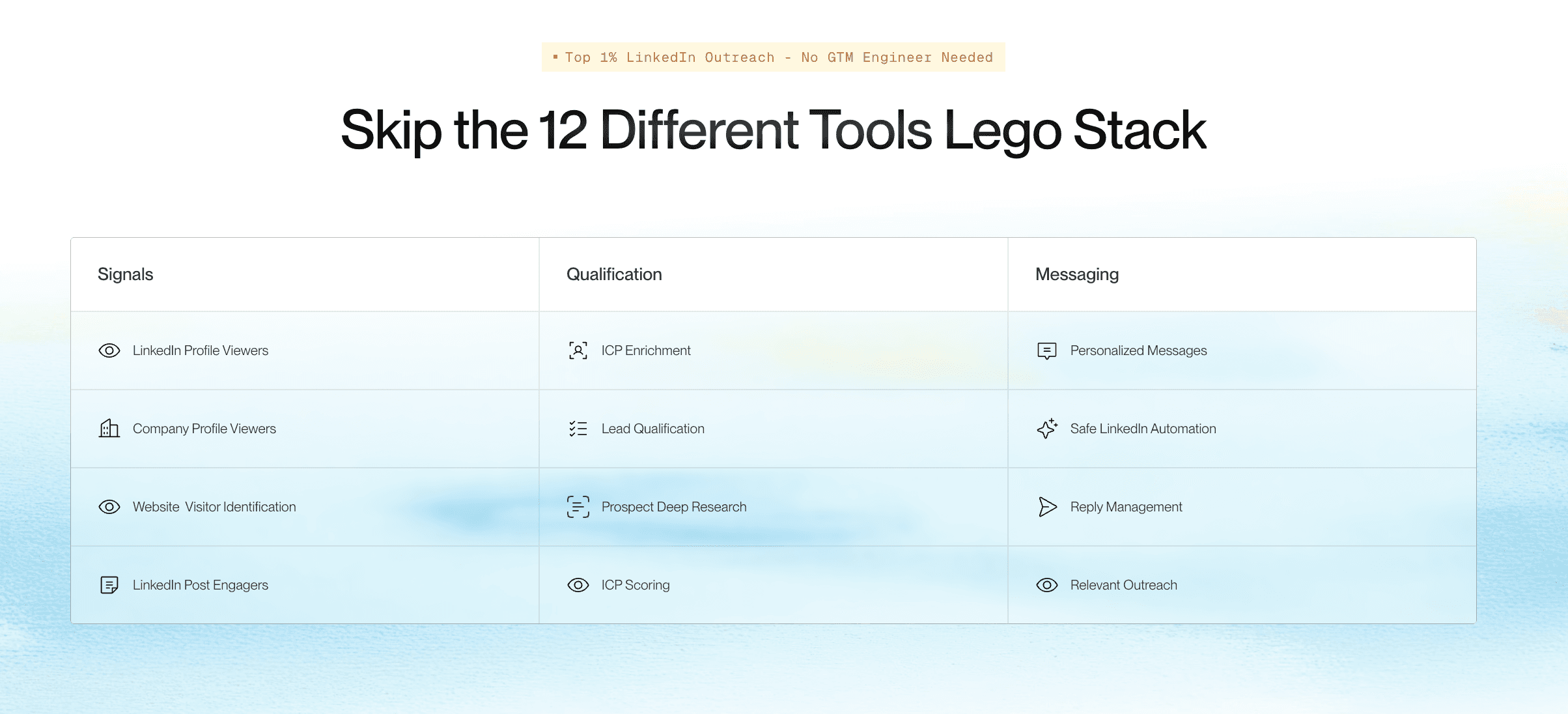

How Valley Scores Prospects as Best Fit, Okay Fit, or Not a Fit:
Valley's three-tier classification system provides clear prioritization guidance while maintaining transparency about why each prospect receives their score.
Best Fit (Score 80-100):
Prospects meeting all or nearly all ICP criteria with strong behavioral signals. These represent your highest conversion probability and deserve immediate attention.
Example: VP of Sales at 200-person Series B SaaS company in target industry, viewed your profile 3 times this week, engaged with 2 posts about warm outbound, visited pricing page—Score 92.
Valley automatically routes best-fit prospects to immediate outreach campaigns with high personalization and sales rep attention.
Okay Fit (Score 50-79):
Prospects meeting most ICP criteria but with gaps or weaker signals. These have conversion potential but lower probability than best-fit prospects.
Example: Director of Sales Operations at 300-person company in adjacent industry, liked one post, viewed profile once, Score 64.
Valley routes okay-fit prospects to automated nurture sequences or lower-touch campaigns, conserving manual effort for best-fit prospects.
Not a Fit (Score Below 50):
Prospects failing to meet minimum ICP requirements or showing characteristics that predict low conversion.
Example: SDR at 20-person early-stage startup outside target industry, one profile view, no other engagement, Score 35.
Valley automatically excludes not-a-fit prospects from outreach campaigns, preventing wasted capacity on low-probability leads.
What Research Valley Uses for ICP Qualification:
Valley analyzes 25+ data sources to build comprehensive prospect profiles for accurate qualification:
LinkedIn Profile Data:
Current job title and seniority, company name and industry, location and timezone, profile completeness and activity level, skills and endorsements, recommendations and validation, connection count (network size), and years of experience.
Company Intelligence:
Employee count (precise numbers from business databases), revenue estimates when available, funding stage and total raised, growth trajectory (hiring patterns, expansion), technology stack (tools they use), recent news and announcements, competitive positioning, and office locations.
Behavioral Signals:
Which LinkedIn signals triggered capture (profile view, post engagement, website visit), signal frequency and recency, engagement quality (like vs. comment vs. share), pages visited on website, time spent researching, and multi-signal patterns.
Trigger Events:
Recent funding announcements, executive hires or departures, company expansions or relocations, product launches or rebrands, mergers or acquisitions, regulatory changes affecting industry, and hiring sprees indicating growth.
Valley synthesizes all these inputs into a single qualification score with transparent reasoning.
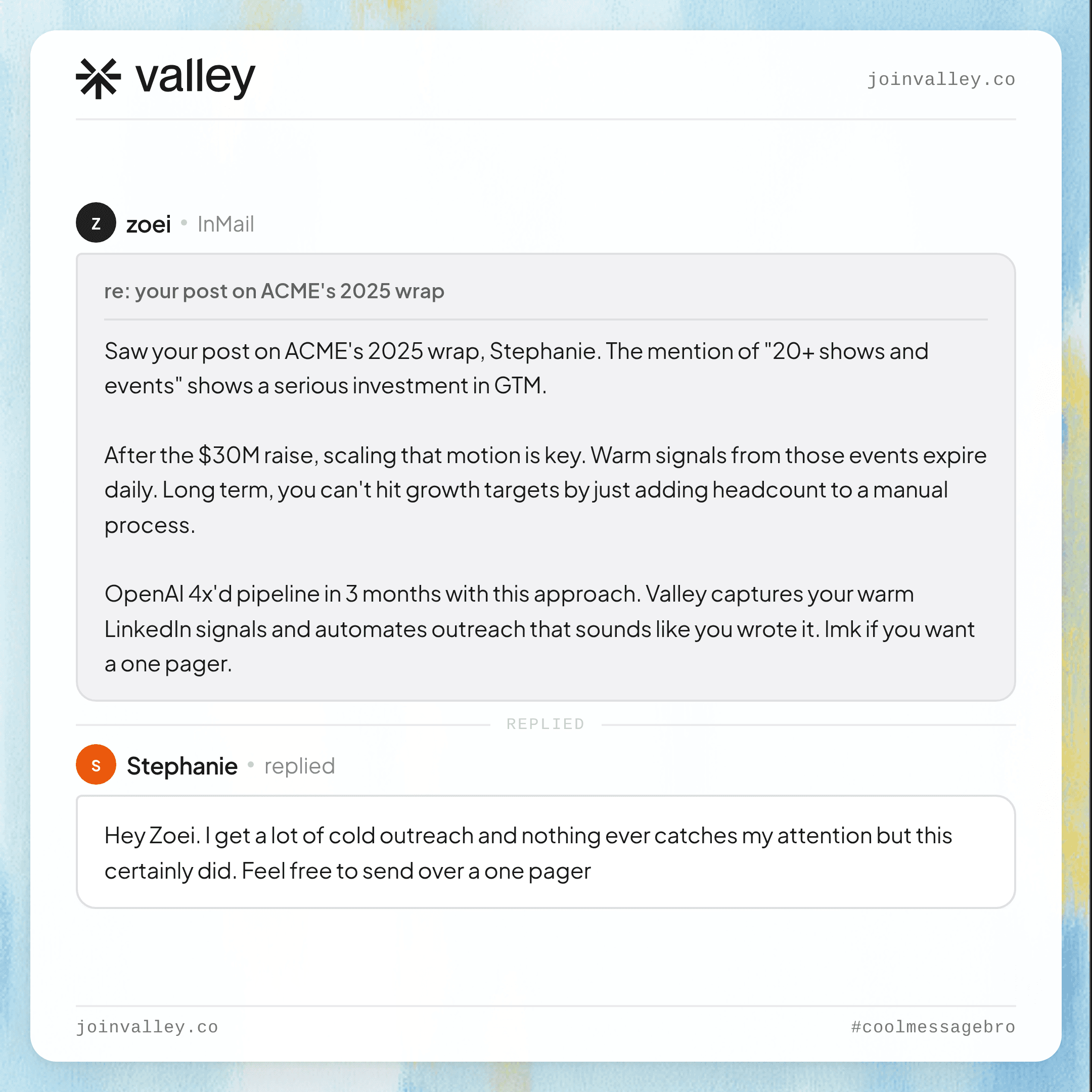
► Check Out Valley's Incredible Outreach: A compilation of real time messages and responses!
How Valley's Qualification Compares to Manual Research:
The speed, consistency, and depth advantages of automated qualification become clear when comparing Valley's approach to traditional manual research.
Speed Comparison:
Manual qualification: 5-15 minutes per prospect to research company, validate role, assess fit, document findings, and assign score.
With 100 new prospects weekly, this represents 8-25 hours of research time—one person's nearly full-time job or distributed burden reducing team selling capacity.
Valley qualification: 30-60 seconds per prospect automatically, with zero human effort required. 100 prospects qualified in 1-2 hours total processing time, all happening in the background while your team focuses on conversations.
Consistency Comparison:
Manual qualification varies by who's reviewing: optimistic reps over-qualify marginal prospects, conservative reps under-qualify good prospects, qualification standards drift over time without documentation, and subjective judgment creates inconsistency.
Valley applies identical criteria to every prospect: same scoring rubric every time, no mood-based variations, documented reasoning for every decision, and consistent standards that improve through feedback rather than drift.
Depth Comparison:
Manual research typically covers company size and industry, job title verification, and LinkedIn profile review basics that take 5 minutes but miss crucial context.
Valley's automated research analyzes 25+ data sources: recent company news and announcements, funding and growth trajectory, technology stack and integrations, hiring patterns and team expansion, competitive positioning and market presence, executive team backgrounds, blog content and thought leadership, customer case studies and reviews, social media presence and activity, and industry trends and challenges.
This depth reveals insights manual researchers would need 20-30 minutes to discover—insights Valley surfaces automatically for every prospect.
How Valley Handles Prospects Who Don't Qualify:
Not every captured signal represents a qualified opportunity—and that's valuable information. Valley's handling of unqualified prospects prevents wasted outreach while preserving potential future value.
Automatic Exclusion from Outreach:
Prospects scoring below your minimum threshold (typically 50) never enter outreach campaigns. Valley automatically filters them out, preventing message sends to poor-fit prospects who would never convert.
This exclusion protects your LinkedIn account from spam patterns (sending messages to obviously irrelevant prospects) and preserves outreach capacity for qualified leads.
Retention for Future Re-Qualification:
Valley retains unqualified prospect records rather than deleting them. If prospects show additional signals later (engage with new content, visit website again, view profile multiple times), Valley re-qualifies them automatically.
A prospect who initially scored 45 (not qualified) but later engages with three posts and visits pricing twice might jump to 78 (okay fit), triggering campaign inclusion.
What ICP Refinement Looks Like Over Time:
Initial ICP definitions come from assumptions about who your ideal customers are. Real-world data reveals who actually converts.
Monthly ICP Performance Review:
Track conversion metrics by ICP segment: which company sizes convert to closed deals most efficiently, which industries have highest win rates, which role levels engage and close fastest, which geographic regions show best conversion patterns, and what signal combinations predict deals.
ICP Tightening Based on Data:
If 100-200 employee companies convert at 35% while 200-500 employee companies convert at 18%, tighten ICP definition around 100-200 range. If Director-level prospects book meetings but rarely close while VP-level prospects close at 40%, elevate minimum seniority to VP+.
This data-driven refinement focuses effort on highest-probability prospects.
ICP Expansion for Scale:
When current ICP saturates (you've contacted most prospects in addressable market), identify adjacent segments showing promise: industry adjacencies (fintech performing well, try insurtech), geographic expansion (US working, test UK/EU), company stage expansion (Series B successful, test Series A), or role variations (VP Sales converting, test CROs).
Valley's transparent qualification scoring reveals which expansions maintain quality vs. which dilute pipeline.

How Teams Use Valley's ICP Scoring for Workflow Automation:
ICP scores don't just prioritize outreach, they trigger different workflows based on prospect quality.
Score-Based Campaign Routing:
Best Fit (80-100): Immediate personalized outreach from senior reps, manual message review and approval, multiple follow-up touches, and calendar links with fastest available slots.
Okay Fit (50-79): Automated outreach with AI-generated messages, selective manual review, standard follow-up sequence, and calendar links with standard availability.
Score-Based Response Prioritization:
When multiple prospects respond simultaneously, reps engage highest scores first: 90+ score responses: Reply within 1 hour, 70-89 score responses: Reply within 4 hours, 50-69 score responses: Reply within 24 hours.
This ensures top opportunities receive immediate attention.
Score-Based Meeting Allocation:
For teams with SDRs and AEs, ICP scores determine handoff: 85+ scores: Book directly with AE (skip SDR qualification), 70-84 scores: SDR qualifies then hands to AE, 50-69 scores: SDR handles full cycle.
Valley's qualification enables intelligent workflow routing that matches prospect quality to appropriate resources, maximizing conversion while optimizing team capacity.
The combination of comprehensive data analysis, transparent scoring methodology, and continuous learning from outcomes transforms ICP qualification from manual bottleneck to automated competitive advantage.
► Book a demo and explore how Valley can support your use case

Related Blogs

FEATURED READ
5 min
Valley vs HeyReach: Which LinkedIn Outreach Tool Wins More Qualified Meetings?
Read
Read

FEATURED READ
5 min
Valley in 2026: Is the Price Worth the Pipeline?
Read
Read

FEATURED READ
5 min
Valley vs Dripify: Which LinkedIn Outreach Tool Actually Converts in 2026?
Read
Read

FEATURED READ
5 min
Valley vs. Hiring an SDR: The Real Cost and ROI Breakdown for 2026
Read
Read
Which channels does Valley support?
Valley supports LinkedIn outreach, including connection requests and InMails. Valley users safely send 1000-1200 messages per seat every month.
How safe is it and does Valley risk my LinkedIn account?
Do I have to commit to an Annual Plan like other AI SDRs?
How does Valley personalize messages?
Is Valley available in my country?

VALLEY MAGIC