
Try Valley
Put your outbound workflow to work.

Saniya
Published:
Updated:
Published December 31, 2025 · Updated August 31, 2026
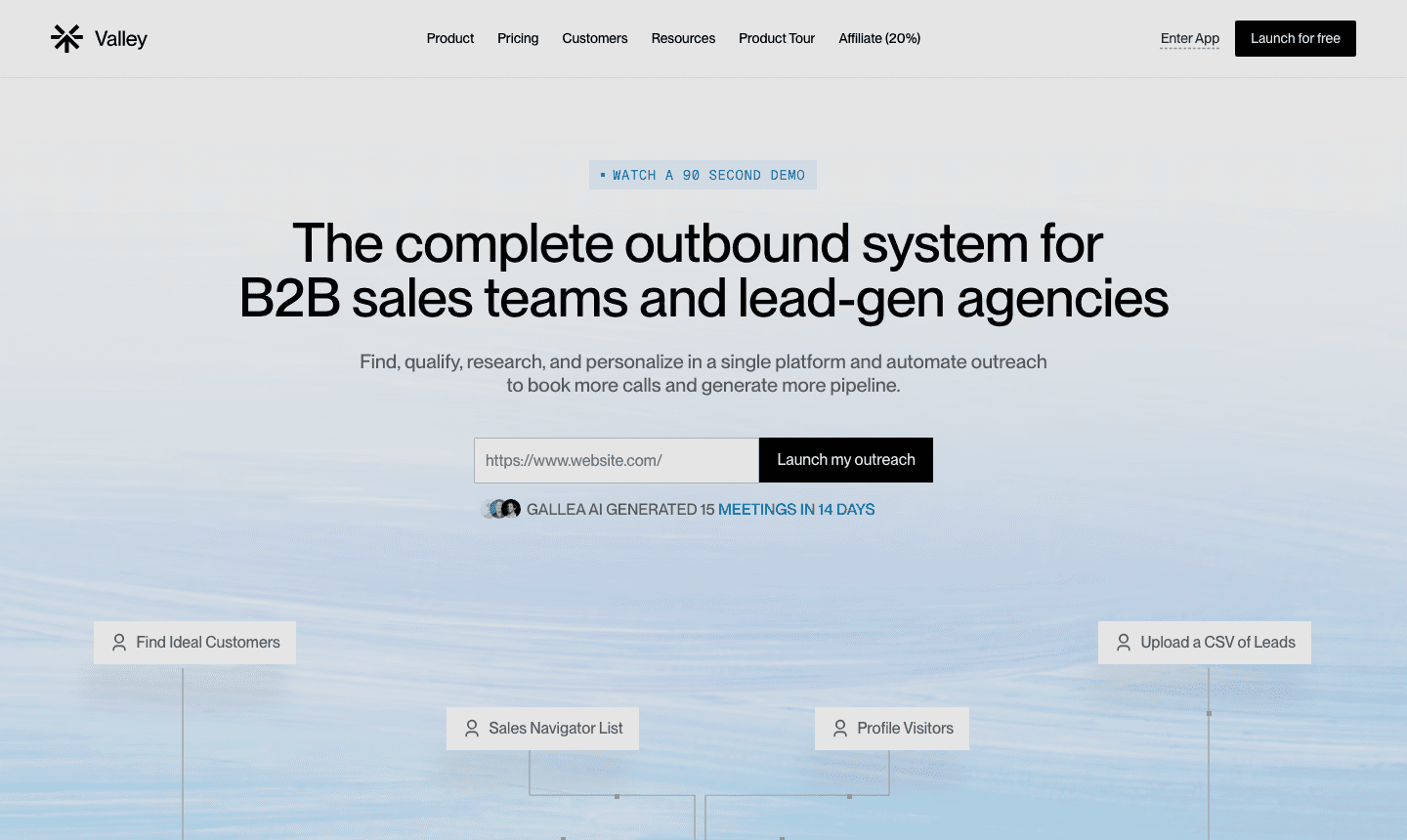
Valley uses seven different AI models (LLMs) working in coordination to craft each message.
The process begins with Valley pulling 20-30 pages of research on each prospect using over 100 data points.
One AI model filters through this research to identify relevant information, another stack-ranks details based on what will resonate most with the prospect, and additional models ensure the message sounds human and matches your specific writing style.
This multi-model architecture represents a significant departure from how most AI tools approach personalization.
Single-model systems like tools that simply plug prospect data into ChatGPT or Claude; lack the specialized capabilities Valley has developed.
Each of Valley’s seven models serves a distinct purpose in the message generation pipeline: research aggregation, relevance filtering, priority ranking, draft composition, tone matching, human-sound verification, and hallucination checking.
The research aggregation model pulls data from over 100 sources simultaneously, creating comprehensive prospect profiles.
The relevance filtering model then evaluates which pieces of information actually matter for your specific value proposition, if you’re selling HR software, the fact that a prospect recently posted about talent retention matters more than their opinion on industry conferences.
The priority ranking model determines which of the relevant details should be mentioned first, second, or held for follow-up messages.
► Book a demo (teams of 5+)and explore how Valley can support your use case
What information sources does Valley’s AI research pull from?
Valley’s research agents access public engagements, podcasts, YouTube videos, LinkedIn profiles and posts, company websites, SEC filings, press releases, industry news from sources like Bloomberg, New York Times, Gartner, Accenture, and McKinsey, G2 reviews, Crunchbase data, financial reports (including specialized documents like the 5300 report for banks), and even specific details like airline routes and destinations when relevant to your prospect’s industry.
The breadth of these sources creates research depth impossible to achieve manually. Consider a prospect who’s the VP of Operations at a mid-sized manufacturing company. Valley doesn’t just see their LinkedIn profile, it finds their recent interview on a supply chain podcast, reads their company’s latest press release about facility expansion, checks their Glassdoor reviews to understand employee sentiment, examines their company’s product pages to understand what they manufacture, and reviews industry reports about trends affecting their sector.
This comprehensive research happens automatically for every prospect. Manual research of this depth would take 30-45 minutes per prospect, making it impossible to scale. Valley completes the same research in 20-40 minutes across hundreds of prospects simultaneously, creating a detailed intelligence foundation for personalized messaging.

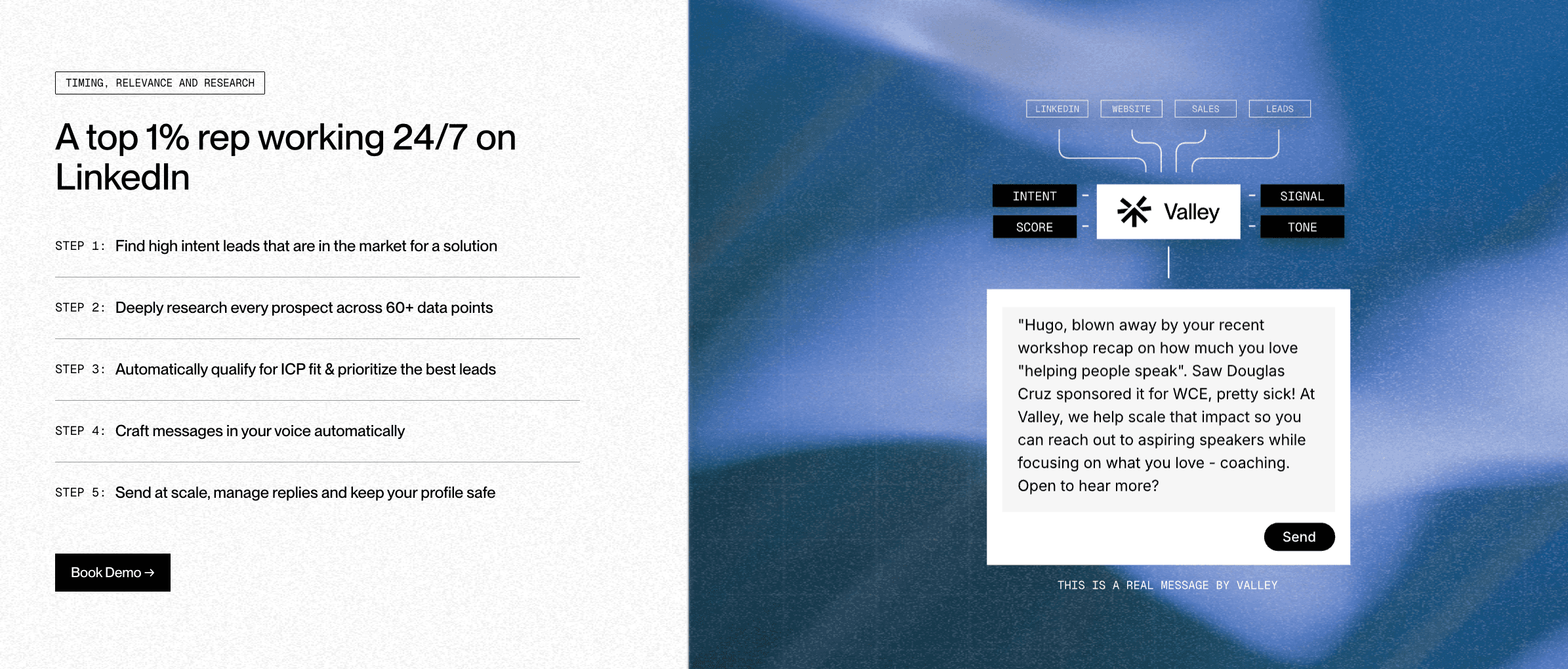
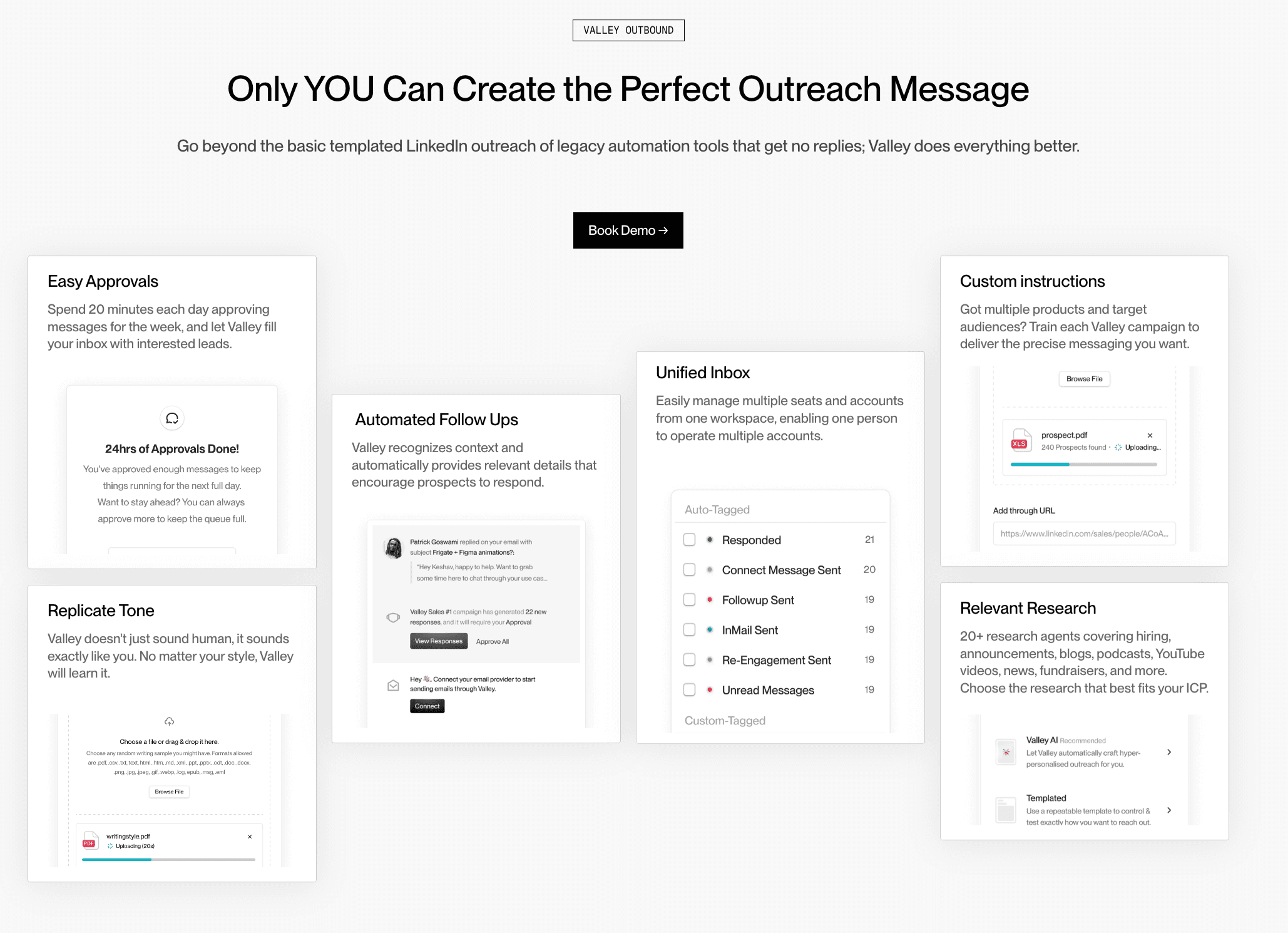
Valley replicates your writing style through the Studio section where you input examples of past messages, emails, or content you've written. The AI analyzes your word choice, slang, acronyms, sentence structure, grammar patterns, and tone preferences.
Valley also allows you to specify do's and don'ts, essentially giving the AI a sticky note of rules about how you communicate, similar to instructions you'd give a human BDR.
The analysis goes beyond surface-level pattern matching. Valley examines how you construct arguments, do you lead with problems or solutions?
How do you transition between topics?
Do you use questions to engage, or statements to inform?
How formal or casual is your language?
Do you use industry jargon comfortably, or avoid it?
How do you create urgency without being pushy?
For example, if your writing samples consistently use short, punchy sentences with occasional fragments for emphasis, Valley replicates this rhythm.
If you frequently use rhetorical questions to engage readers, Valley incorporates this technique.
If you have a habit of using specific phrases like "here's the thing" or "the reality is," Valley integrates these verbal signatures that make your messages recognizably yours.
Can Valley handle multiple different writing styles for different audiences?
Yes. Valley's writing style section allows you to create different personas and approaches. You can set up separate writing styles for engineering leaders, product leaders, HR leaders, or salespeople.
Each style can have unique structural elements, tone preferences, and research priorities. When creating campaigns, you select which writing style to apply, ensuring your messaging matches the recipient's context.
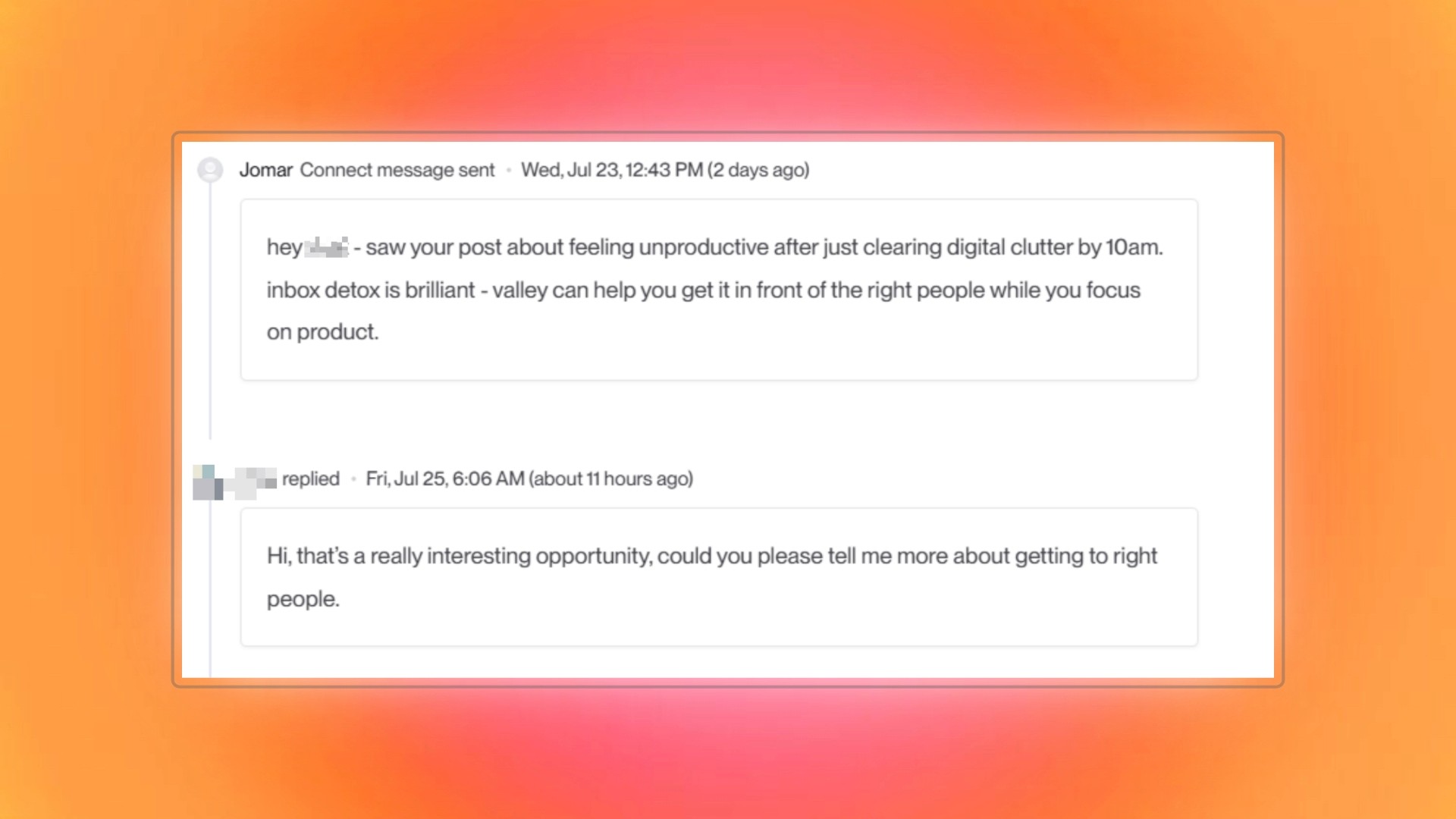
► Check Out Valley's Incredible Outreach: A compilation of real time messages and responses!
This multi-style capability enables sophisticated audience segmentation.
Your engineering leader style might emphasize technical specifications, include more jargon, reference open-source projects or GitHub contributions, and focus on implementation details.
Your C-suite style might strip out technical details, emphasize ROI and business impact, reference board-level concerns, and include more strategic framing.
The ability to switch between styles within a single Valley workspace prevents the need for multiple tools or accounts.
You might run three simultaneous campaigns, one targeting CTOs with technical messaging, one targeting CFOs with financial impact messaging, and one targeting COOs with operational efficiency messaging; all using different writing styles but managed from the same dashboard.
How does Valley determine which research details to include in each message?
Valley triangulates three elements: your value propositions, the pain points you solve, and the prospect's specific situation. The AI stack-ranks research findings based on relevance to what you're selling and what would capture the prospect's attention most effectively.
For example, if you're selling to financial services and a prospect's bank just released quarterly earnings, Valley prioritizes that information over less timely details.
The triangulation process works like a three-dimensional filter.
First dimension: Does this research point relate to what we're selling?
Second dimension: Does it connect to a pain point we solve?
Third dimension: Is it timely, specific, and meaningful to this individual prospect?
Research details that score high across all three dimensions get prioritized for inclusion in the initial message.
Consider selling marketing automation software to a marketing director.
Valley's research reveals:
(1) the prospect recently posted about struggling with lead attribution,
(2) their company just raised Series B funding,
(3) they attended MarketingProfs conference last month,
(4) their company website shows they're hiring three marketing roles,
(5) they previously worked at a competitor using your software.
Valley's stack-ranking identifies that items 1, 4, and 5 directly relate to your value proposition (attribution tracking, team scaling, and proven track record), while items 2 and 3, though interesting, are less directly relevant.
Does Valley's AI improve over time as I give it feedback?
Valley learns marginally from your message edits and approvals, understanding your preferences inconsistently. The more reliable training method is explicitly updating your writing style settings in the Studio section. When you see messages you don't like, add those patterns to your "don'ts" list to codify preferences permanently. Valley is developing autonomous learning from rejections, but currently requires manual refinement.
The current feedback mechanism works like this: when you edit a message before approving (for example, consistently shortening Valley's drafts or removing certain phrases), Valley's models observe these patterns and attempt to adjust future messages accordingly. However, this learning isn't guaranteed - Valley might adapt for some messages while reverting to old patterns in others.
The more effective approach treats your writing style configuration as a living document. After running campaigns for a week, review the messages Valley generated and identify patterns you consistently edit. Add these as explicit rules: "Keep messages under 150 words," "Never use the phrase 'I hope this finds you well,'" "Always include a specific question in the closing," etc. These codified rules ensure 100% consistency versus relying on Valley to infer your preferences.
► Don't imagine the message quality, read it: Valley's live outreach compilation

Traditional tools use templates with merge tags like
“Hi {{FirstName}}, I saw you work at {{CompanyName}}.”
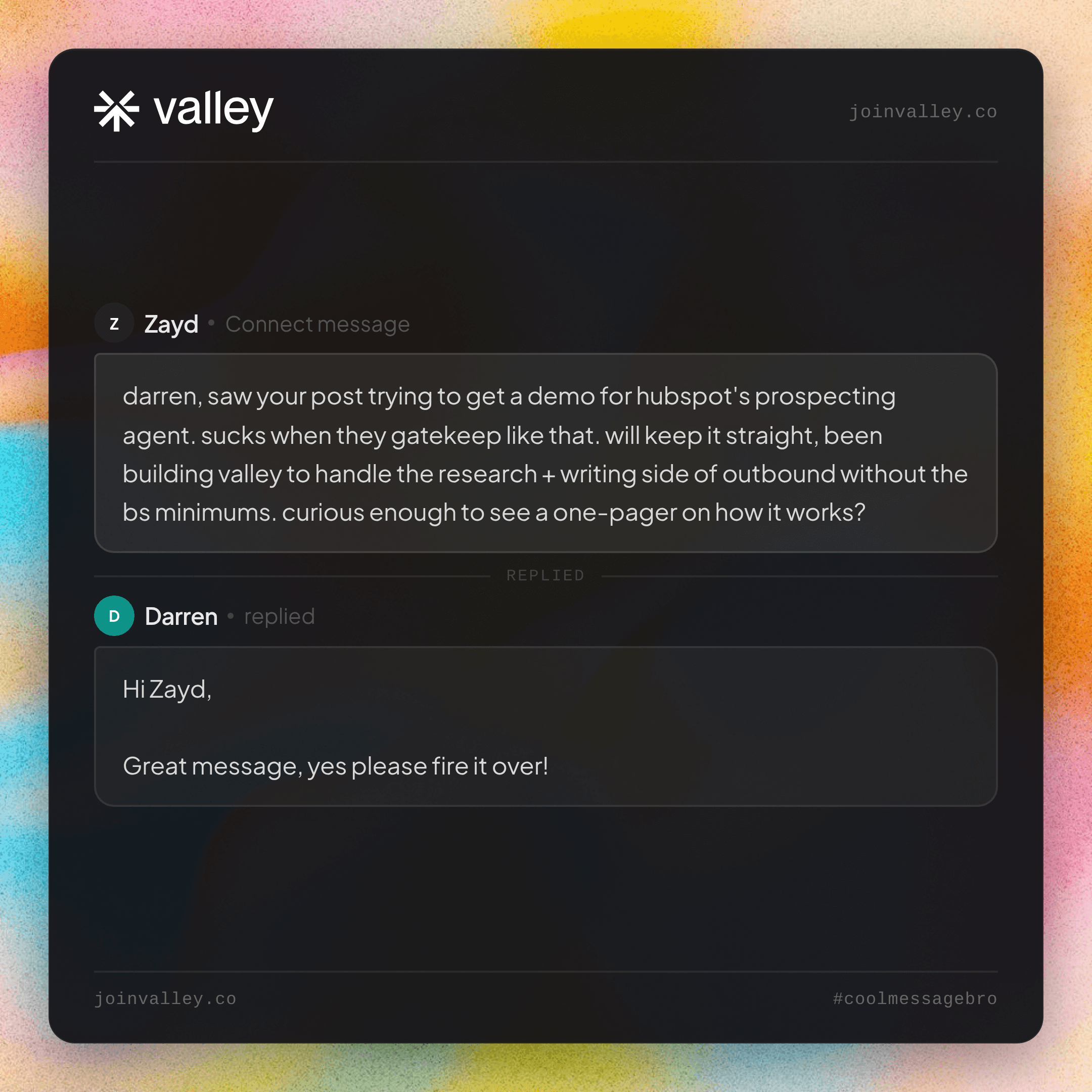
Valley drafts each message from scratch using the research and instructions you’ve provided. The AI doesn’t fill in blanks, it writes unique messages that incorporate relevant context naturally.
This fundamental difference is why Valley customers see 9-10% reply rates compared to the 1% industry average for template-based tools.
► Check Out More of Valley’s Incredible Outreach: A compilation of real time messages and responses!
Template-based personalization creates superficial customization that prospects immediately recognize as automated.
Everyone has received messages that say “I noticed you’re a [Job Title] at [Company Name] working in [Industry]”
The structure screams automation even with the variables filled in correctly. Templates also limit personalization to available merge fields; you can only customize what your database contains.
Can Valley handle different languages for international outreach?
Yes. Valley has strong language capabilities, including Portuguese for Brazilian markets (customer Franq uses Valley in Portuguese). Valley doesn’t translate from English, it clones how you naturally write in your target language. You load instructions and message examples in that language, and Valley replicates your voice in that language specifically.
The AI understands grammatical nuances, cultural context, and language-specific communication styles.
Language replication goes beyond literal translation. Communication norms vary significantly across cultures, German business communication tends toward formality and directness, while Brazilian Portuguese business communication often includes more warmth and relationship-building elements.
Valley adapts to these cultural contexts by learning from your native-language examples rather than attempting to translate English patterns that might not resonate.
A Valley customer targeting Brazilian prospects wouldn’t write their English messages and have Valley translate them.
Instead, they’d provide examples of how they naturally communicate in Portuguese business contexts; the greetings they use, how they build rapport, the level of formality they maintain, and how they transition to business discussion.
Valley replicates this authentic communication style rather than producing awkward translations that native speakers immediately recognize as foreign.
