
Try Valley
Put your outbound workflow to work.

Saniya Sood
Published:
Updated:
Published March 16, 2026 · Updated August 31, 2026
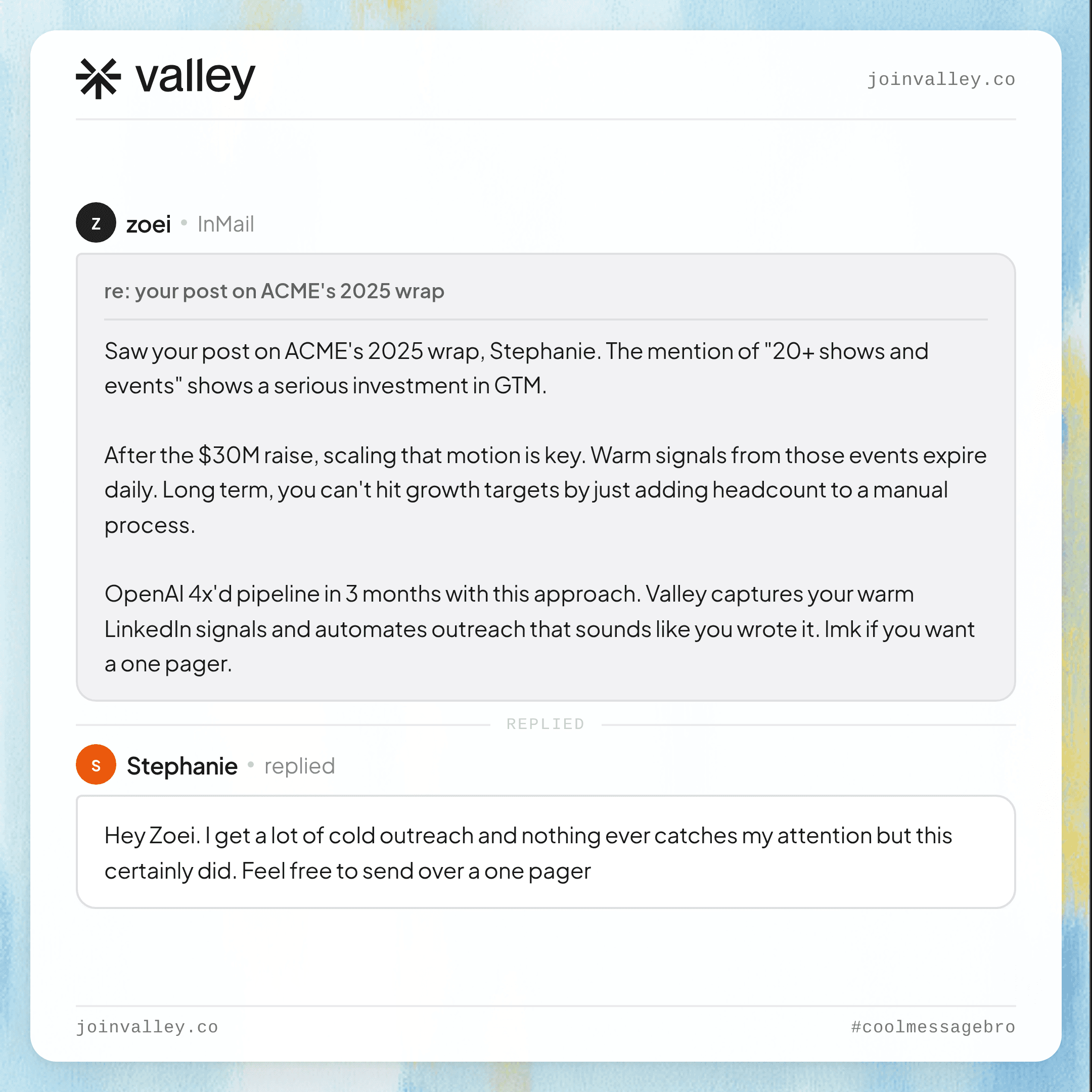
The fundamental challenge in AI-powered outreach is the personalization paradox: automation at scale typically sacrifices message quality, while maintaining quality limits scale. Valley solves this through a multi-model AI architecture specifically designed to research deeply and write contextually rather than simply filling templates with merge tags.
Most LinkedIn automation tools use single AI models with basic prompting:
“Write a connection request for {{FirstName}} who works at {{Company}} as {{Title}}.”
The output sounds generic because the input is generic, just basic profile data with no context about why this person matters or what makes them relevant today.
Valley takes a fundamentally different approach using seven separate large language models, each optimized for specific tasks in the personalization workflow. One model specializes in company analysis, another in role-based pain point identification, another in tone matching, another in message structure, and so on. This division of labor allows each model to excel at its specific function rather than one model attempting everything.
The process begins with complete research across 25+ data sources: LinkedIn profile and activity, company website and blog, recent news articles and press releases, funding announcements and growth metrics, hiring patterns and job postings, technology stack and integrations, competitor mentions and positioning, industry trends and challenges, and executive social media activity.
This research feeds into the AI personalization engine, which identifies relevant talking points (funding announcement, new product launch, team expansion, market entry), determines likely pain points based on role and company stage, selects the most appropriate message angle from multiple options, generates personalized copy in your voice and style, and references the specific signal that triggered outreach.
The result: messages that demonstrate genuine research and provide relevant context rather than generic outreach that could apply to anyone.

Give your sales team
an unfair advantage.
Valley's use of seven different AI models for message generation represents a significant technical and strategic advantage over single-model competitors. Each model contributes specific capabilities that combine to produce superior personalization.
Model 1: Company Intelligence Analyzer This model processes company-level information: recent news, funding rounds, growth trajectory, competitive positioning, market challenges, strategic initiatives. It identifies what's happening at the organizational level that creates buying urgency or openness to new solutions.
Model 2: Role-Based Pain Point Identifier Different roles face different challenges. A VP of Sales struggles with pipeline generation and team scaling. A Head of Revenue Operations grapples with tool consolidation and measurement. This model maps prospect roles to likely pain points with high accuracy.
Model 3: Signal Context Interpreter This model analyzes the specific signal that triggered outreach: which LinkedIn post they engaged with and what it covered, what website pages they visited and in what sequence, how many times they viewed your profile and when, whether they follow your company page or competitors. It determines what their behavior reveals about their interests and needs.
Model 4: Tone and Voice Matcher Trained on your writing style examples, dos and don'ts guidelines, and approved message history, this model ensures output matches your communication patterns: sentence structure, vocabulary choices, formality level, use of questions vs statements, and overall tone.
Model 5: Message Structure Optimizer This model determines optimal message length, opening hook style, call-to-action format, and overall flow based on what performs best for different prospect types and signal sources.
Model 6: Personalization Quality Validator This model reviews generated messages to ensure they include genuine personalization (specific references to research findings) rather than generic statements, maintain logical coherence and natural language flow, avoid AI detection patterns and obvious template structures, and align with professional communication norms for the industry.
Model 7: Conversation Context Manager For follow-up messages, this model analyzes previous conversation history, determines appropriate next steps and messaging, maintains consistency in tone and positioning, and adapts based on prospect response patterns.
Each model operates on the output of previous models, creating a pipeline where information flows through multiple specialization layers before final message generation. This architecture produces personalization quality that single-model systems cannot match.
Here's the Valley Warm Outbound Launch Video
How Do You Train Valley's AI to Match Your Voice?
Effective AI personalization requires training the system to replicate your communication style rather than imposing generic AI writing patterns. Valley's training process takes 30 days to reach optimal performance, with iterative improvement based on your feedback.
Initial Setup: Writing Style Configuration During onboarding, you provide 3-5 examples of your best-performing LinkedIn messages, a list of dos (preferred phrases, approaches, tone characteristics), a list of don'ts (words to avoid, styles to never use, off-brand approaches), your value proposition and key differentiators, and common objections and how you address them.
Valley uses these inputs to establish baseline tone parameters: formality level, average sentence length, question usage frequency, use of statistics and data points, industry jargon appropriateness, and emotional tone.
Week 1-2: Message Review and Feedback Valley generates messages for your first campaigns. You review each message, approving those that match your voice well and editing or providing feedback on those that need adjustment. The AI learns from both approvals (reinforcing what works) and edits (understanding what to change).
Critical feedback areas include whether the message sounds like you personally, if personalization feels genuine or forced, whether the call-to-action matches your style, if message length is appropriate, and whether tone suits the prospect's seniority level.
Week 3-4: Refinement and Optimization As the AI accumulates approved messages and incorporated feedback, personalization quality improves noticeably. Messages that initially required 50% editing might now need only 10-20% adjustments. You continue providing feedback, but increasingly for edge cases rather than core message quality.
Post-30 Days: Autopilot Readiness After 30 days of training, most customers report the AI generates acceptable messages 80-90% of the time without editing. At this point, you can enable autopilot for high-confidence messages while maintaining manual review for lower-confidence prospects or new campaign types.
The training never truly ends - the AI continues learning from your approvals and feedback indefinitely. But 30 days represents the threshold where automation delivers consistent quality without constant supervision.
How Does Valley's AI Identify Pain Points Without Explicit Input?
One of Valley's most sophisticated AI capabilities is inferring prospect pain points from role, company stage, recent activity, and industry context without requiring prospects to explicitly state their challenges. This inference enables relevant messaging even for prospects you've never spoken with.
Role-Based Pain Point Mapping: Valley maintains detailed pain point profiles for hundreds of B2B roles based on common challenges, responsibilities, metrics they're measured on, and typical frustrations. A Chief Revenue Officer typically struggles with pipeline predictability, revenue attribution across channels, sales and marketing alignment, and efficient growth without proportional headcount increases.
When Valley identifies a CRO as a prospect, the AI automatically associates these likely pain points and determines which aligns most closely with your solution's value proposition.
Company Stage Indicators: Early-stage startups (pre-Series A) face resource constraints, need to prove product-market fit, and struggle with doing more with less. Growth-stage companies (Series A-B) grapple with scaling processes that worked at small scale, building repeatable systems, and maintaining culture through rapid growth. Mature companies focus on efficiency optimization, competitive differentiation, and market share defense.
Valley identifies company stage through funding data, team size, founding date, and growth trajectory, then associates stage-appropriate pain points with prospects.
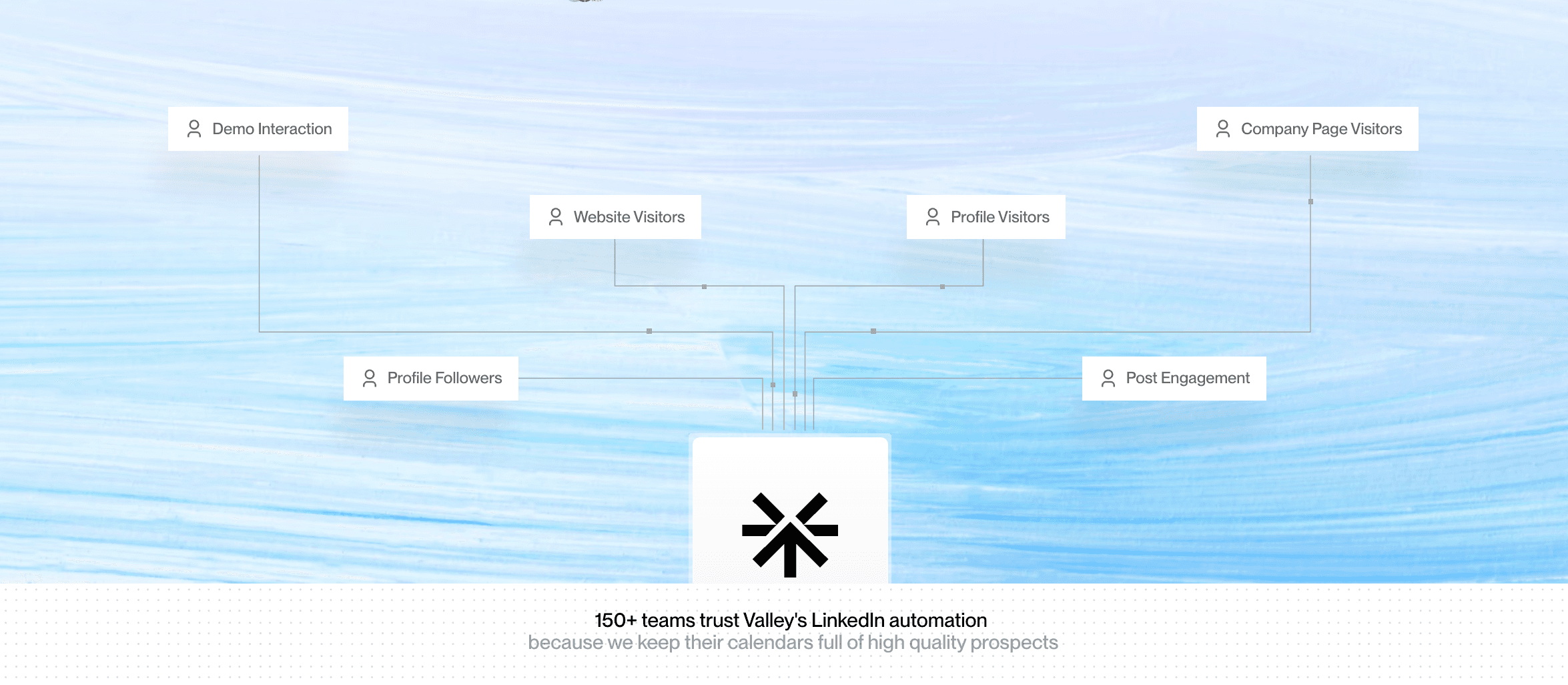
Trigger Event Analysis: Recent events often create specific pain points. A company that just raised funding needs to deploy capital effectively and scale revenue to justify valuation. A company that just hired a new executive in sales or marketing is likely re-evaluating their current approach and seeking improvements. A company expanding into new geographic markets faces localization, new team building, and process replication challenges.
Valley's AI analyzes recent trigger events and infers the pain points they create, enabling timely outreach with relevant positioning.
Competitive Context Understanding: When prospects engage with competitor content on LinkedIn, Valley analyzes what topics and challenges that content addresses, then infers similar pain points for the prospect. If someone engages with a competitor's post about reducing SDR costs, they likely struggle with expensive outbound operations.
This inference capability means Valley generates relevant, pain-aware messaging even for prospects you've never spoken with, dramatically improving response rates compared to generic outreach.
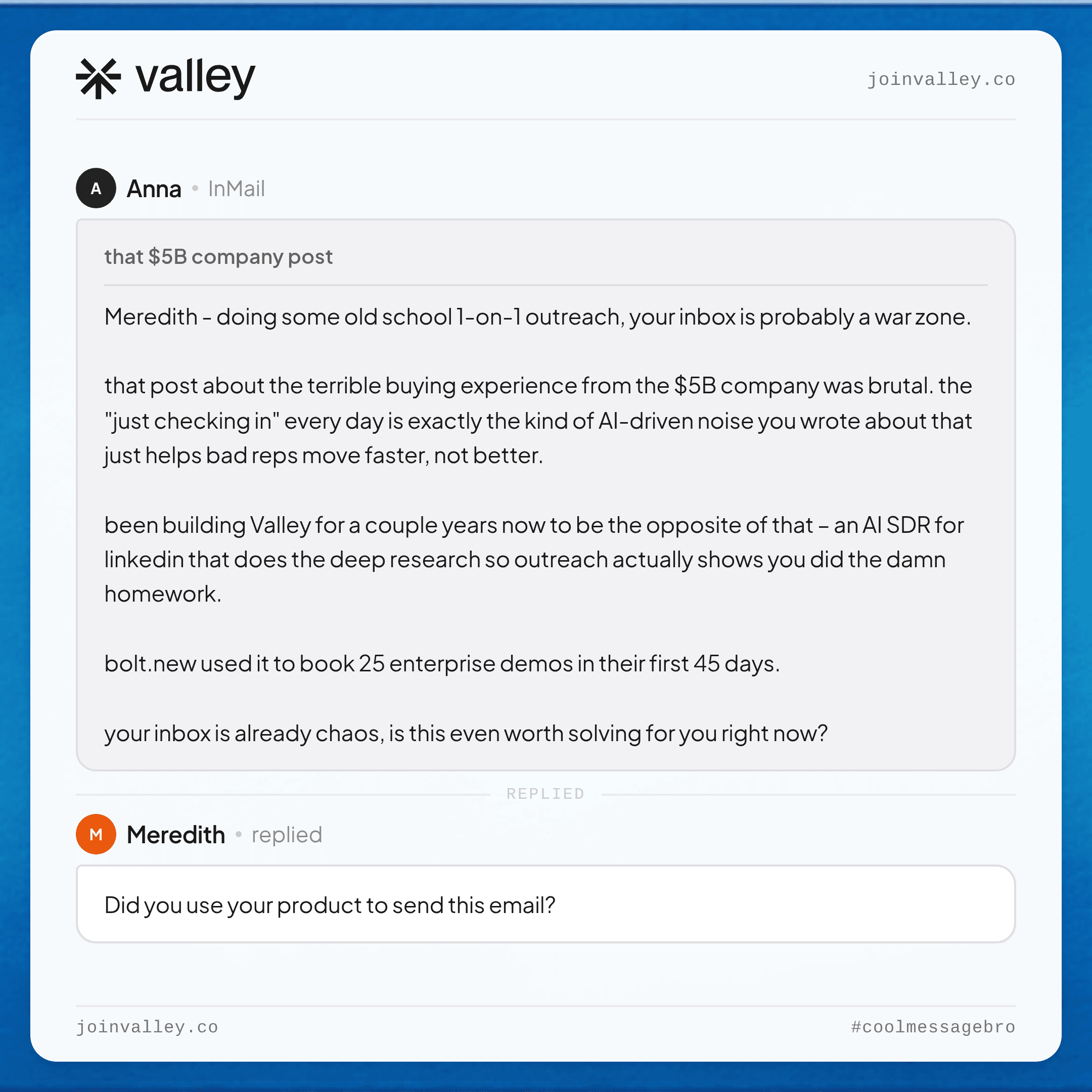
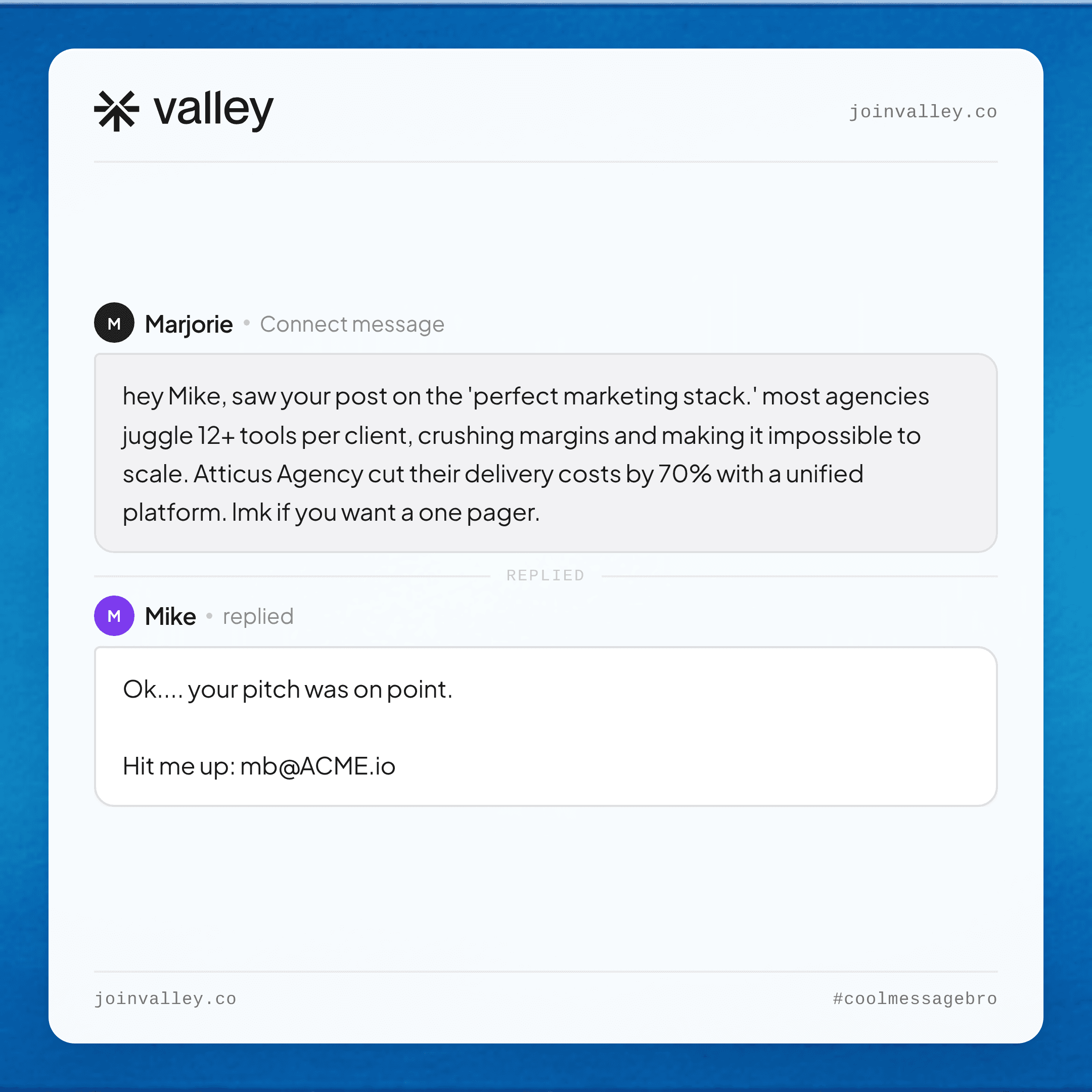
► What does good outreach actually look like? Real Valley messages, real replies

Give your sales team
an unfair advantage.
B2B companies rarely serve a single buyer persona. You might sell to both Sales Leaders and Revenue Operations professionals, or target both startups and enterprise accounts. Valley allows complete customization of AI personalization for different ideal customer profiles.
Multiple Product Configurations: Create separate “products” in Valley for each distinct ICP: one for VP Sales at Series A SaaS companies, another for Head of Revenue Operations at growth-stage B2B tech companies, another for agency founders. Each product maintains its own value proposition, pain points, proof points, competitive differentiation, and messaging guidelines.
When Valley personalizes messages, it references the appropriate product configuration for each prospect based on their role, company, and characteristics.
ICP-Specific Research Parameters: Different buyer types care about different information. Sales leaders want to hear about pipeline generation, quota attainment, and team efficiency. Operations leaders focus on tool consolidation, measurement, and process improvement. Valley allows you to select different research parameters for each ICP, ensuring the AI focuses on gathering relevant context.
For sales leader prospects, you might emphasize recent post engagement analysis, growth trajectory research, and sales team size trends. For operations prospects, you might prioritize technology stack analysis, integration requirements, and efficiency metrics.
Vertical-Specific Messaging: Industries have unique characteristics, challenges, and communication norms. Healthcare buyers care about compliance and security. Financial services buyers prioritize risk management and regulatory adherence. Valley allows you to create vertical-specific messaging frameworks that the AI incorporates into personalization.
Campaign-Level Customization: Beyond product-level configurations, you can customize AI behavior per campaign. A campaign targeting profile viewers might emphasize curiosity and research: “I noticed you’ve been checking out our LinkedIn profile.” A campaign targeting post engagers focuses on the content topic: “Your comment on our post about warm outbound suggests this is top of mind for you.”
This multi-level customization ensures Valley’s AI personalization remains relevant across diverse prospect types, markets, and use cases - all without requiring you to write individual messages manually.
► Check Out More of Valley’s Incredible Outreach: A compilation of real time messages and responses!
Related: How to Train Valley's AI to Match Your Voice · How Does Valley's AI Research and Personalization Actually Create Human-Quality Messages? · How Valley's AI Research Identifies Pain Points · Valley pricing
► Book a demo: see how Valley would find, research and message your buyers
See also: How Does Valley's AI Personalization Work for LinkedIn Outreach? · How Does Valley's AI Message Personalization System Work? · How Does Valley Work for Agencies and Multi-Client Management?


