
Try Valley
Put your outbound workflow to work.

Saniya
Published:
Updated:
Published December 8, 2025 · Updated August 31, 2026
Successful Valley users follow a structured 30-day optimization timeline.
Week 1 focuses on foundation: complete product configuration, establish initial writing style, launch first campaign with 100-200 prospects, and review every message for learning.
Week 2 emphasizes refinement: adjust based on initial responses, expand to 500-1,000 prospects, and enable partial autopilot for connection requests.
Week 3 accelerates scaling: launch InMail campaigns alongside connections, activate warm lists for profile viewers, and refine ICP scoring based on response patterns.
Week 4 achieves full productivity: enable complete autopilot for initial outreach, launch post engager campaigns, and establish steady-state operation.
This timeline consistently produces meetings by week 2-3 with full productivity by month 2.
► Book a demo (teams of 5+)and explore how Valley can support your use case
Which Valley Research Agents Should Users Prioritize?
Research agent selection dramatically impacts message quality. Universal high-performers include Company Deep Dive and Recent News - valuable for all audiences. For executives, prioritize Press Releases and Financial Performance. For technical buyers, focus on Hiring Trends (reveals tech stack) and Blog/Newsletter content. For operations roles, emphasize Growth Indicators and Industry Deep Dive.
Power users often discover unexpected combinations. Pairing Sustainability Initiatives with Financial Performance resonates with ESG-conscious prospects. Combining Leadership Changes with Press Releases identifies transformation opportunities. The key is experimentation - try different combinations for 100-prospect batches, measure response rates, and scale successful patterns.
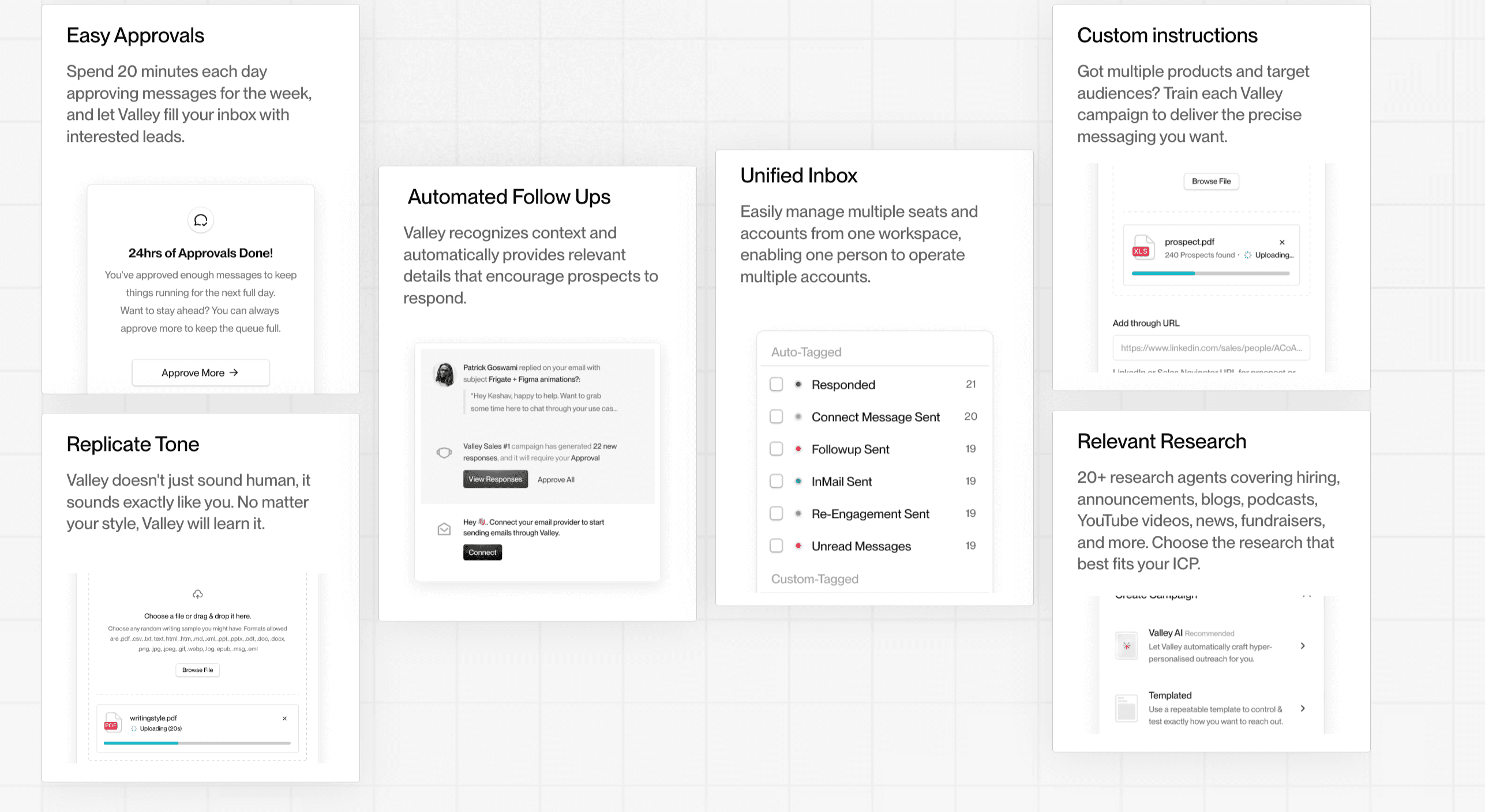
► Check Out More of Valley’s Incredible Outreach: A compilation of real time messages and responses!

Optimal Valley deployment involves 4-6 parallel campaigns with distinct purposes. Foundation campaigns include primary ICP connection requests (40% of volume) and InMail to high-value targets (30% of volume). Warm campaigns capture profile viewers (15% of volume) and post engagers (15% of volume). This portfolio balances volume generation with intent capture.
Advanced users add experimental campaigns: testing new ICPs, different messaging approaches, or alternative research configurations. Maintain 80% volume through proven campaigns while testing with 20%. This ensures consistent pipeline while continuously improving. Valley’s campaign isolation prevents failed experiments from affecting core performance.
What Daily Habits Make Valley Users Most Successful?
High-performing Valley users establish consistent daily rituals. Morning (10 minutes): review overnight responses, approve/edit Valley’s draft replies, and check campaign performance. Afternoon (5 minutes): approve any remaining messages and note patterns for optimization. Weekly (30 minutes): analyze response patterns, update writing style based on learnings, and refresh prospect lists if needed.
The key is consistency rather than time investment. Users spending 15 minutes daily consistently outperform those doing sporadic deep dives. Valley rewards regular attention through AI learning - consistent feedback improves message quality faster than periodic bulk reviews.
How Can Valley Users Improve Their Response Rates?
Response rate optimization follows predictable patterns. Message quality improvements: reference specific, recent prospect activity, lead with unexpected insights or questions, keep messages under 75 words, and end with low-commitment CTAs. Targeting refinements: tighten ICP criteria for higher qualification, focus on prospects showing intent signals, and exclude oversaturated titles like “CEO” or “Founder.”
Timing optimizations: send InMails Tuesday-Thursday for highest engagement, avoid Mondays and Fridays for initial outreach, and follow up within 3-5 days for maximum response. Valley users consistently achieving 15%+ response rates follow these patterns religiously while continuously testing improvements.
► Book a demo (teams of 5+)and explore how Valley can support your use case

Focus on actionable metrics that drive improvement. Acceptance rate indicates profile and initial message quality. Response rate per campaign reveals messaging effectiveness. ICP score correlation shows targeting accuracy. Time to response indicates message relevance. Meeting conversion rate demonstrates qualification quality.
Avoid vanity metrics like total messages sent or total connections made. Valley’s value comes from quality, not quantity. Track ratios and rates rather than absolute numbers. Create weekly benchmarks: 35%+ acceptance rate, 10%+ response rate, 30%+ meeting conversion from interested responses. Use these benchmarks to identify underperforming campaigns for optimization.
How Should Valley Users Handle Seasonality and Timing?
Valley performance follows predictable seasonal patterns. Q4 (October-December) shows highest engagement as prospects plan next year. Q1 (January-March) maintains strong performance with new budgets. Q2 (April-June) varies by industry but generally strong. Q3 (July-September) shows lowest engagement due to vacations.
