How to Simplify Your LinkedIn Outbound Tech Stack

Try Valley
Make LinkedIn your Greatest Revenue Channel ↓

Saniya Sood
The Tool Trap: Why LinkedIn Outreach Stacks Over-Proliferate
The Tool Trap: Why LinkedIn Outreach Stacks Over-Proliferate
LinkedIn outreach stacks grow because most tools are built around single functions — signal detection, enrichment, personalization, sequencing, safety — and none of them cover the adjacent functions required for a complete outreach motion. Each gap drives a new tool purchase. The consolidated bill and the operational overhead of maintaining five integrations typically costs more than a single all-in-one platform, and the latency introduced by handoffs between tools actively degrades results.
The specific way stacks over-proliferate in LinkedIn outreach:
Step 1: You start with a LinkedIn automation tool (Expandi, HeyReach, Dripify). It sequences but personalizes only with merge tags.
Step 2: You add an enrichment tool (Clay, Apollo, ZoomInfo) to get better data for personalization.
Step 3: You add an AI writing tool (ChatGPT, Jasper, Lavender) to generate better openers from the enriched data.
Step 4: You add an intent data tool (Bombora, Koala, Common Room) because enrichment tells you who fits your ICP but not who is interested right now.
Step 5: You realize your sequencer is getting LinkedIn accounts restricted and add a safety-specific setup (dedicated IPs via a VPN service or a separate sending infrastructure).
Step 6: You add a LinkedIn post engager scraper (PhantomBuster) because the intent data does not capture LinkedIn-specific behavioral signals.
Step 7: You add a CRM middleware tool (Zapier, Make) to connect everything together.
At step 7, you have seven tools and a full-time integration maintenance job. And the latency between step 1 (signal appears) and step 7 (outreach sends) is now 48–72 hours. Your warmest signals have gone cold by the time the pipeline catches up.
The Stack Audit: What Each Tool Actually Contributes
Before consolidating, audit your current stack against the five core functions of LinkedIn outreach:
Function | What It Needs | Does Your Current Tool Do It? |
|---|---|---|
Signal detection | Real-time capture of LinkedIn behavioral intent signals | ___ |
ICP qualification | Automatic filtering of signals against ICP criteria before human review | ___ |
Prospect research | Individual-level research (recent posts, news, growth signals, role context) | ___ |
Message generation | AI drafting in sender's voice, based on individual research | ___ |
Outreach execution | LinkedIn-safe sending (dedicated IPs, daily limits, profile detection) | ___ |
For each function, answer honestly: which tool in your current stack covers it? Which functions have gaps that you work around manually? Which functions are covered by a dedicated tool that could be replaced by a function inside a single platform?
Most LinkedIn outreach stacks have:
Signal detection: partially covered (intent data at account level, but not LinkedIn-specific behavioral signals)
ICP qualification: manual (someone builds the list, someone else reviews it)
Prospect research: partially covered (enrichment data, but not live research synthesis)
Message generation: covered by an AI writing tool, but disconnected from the research data
Outreach execution: covered by a sequencer, but with shared IP safety risk
The functions that are genuinely missing — real-time LinkedIn signal detection, automatic ICP qualification, research-to-message generation in the same workflow, and safe execution — are the ones that require the most manual work to compensate for.
The Consolidation Point: What One Platform Needs to Cover
A single LinkedIn outreach platform that genuinely replaces a fragmented stack must cover all five functions without requiring manual data movement between steps.
Valley AI is built to be that consolidation point. Here is how each stack component maps:
Intent data platform → Valley's signal monitoring. Profile viewers, post engagers, company page followers, website visitors — all four LinkedIn intent signal types captured continuously, with real-time ICP filtering. No third-party intent data subscription required for LinkedIn-specific signals.
Enrichment tool → Valley's prospect research. For each qualified prospect, Valley conducts up to five dimensions of individual research before generating a message. Unlimited research, no credits to manage, no separate enrichment subscription. For proactive campaigns using large account lists where enrichment depth beyond Valley's research layer matters, Clay can feed CSV exports to Valley — but for most outreach workflows, Valley's research layer is sufficient.
AI writing tool → Valley's message generation. Valley generates messages in your defined writing style, informed by the individual research it conducted. The AI drafts; you review and approve. No separate AI writing subscription, no copy-pasting research into a writing tool.
LinkedIn sequencer → Valley's outreach execution. Dedicated IP per account, automatic daily limit enforcement (maximum 25 connections per day), open/closed profile detection, follow-up sequencing. No shared IP risk, no separate safety infrastructure.
Middleware/Zapier → Valley's integrated workflow. Signal detection, research, message generation, and outreach execution all happen inside Valley without requiring external integration. CRM sync runs via Zapier for the Valley → HubSpot handoff when a prospect reaches qualified opportunity stage — one Zapier workflow, not five.

The Practical Consolidation Plan
The Practical Consolidation Plan
Simplifying a LinkedIn outbound tech stack without disrupting the pipeline it generates requires a transition plan, not a hard switch:
Week 1: Audit and configure Valley in parallel.
Set up Valley alongside your existing stack. Connect your LinkedIn account, configure your Studio (ICP, offer, writing style), and launch one signal campaign — profile viewers is the fastest to show results. Do not shut down existing tools yet.
Week 2–3: Run both stacks, compare results.
Valley's warm signal campaigns run simultaneously with your existing cold sequence campaigns. Compare reply rates, connection acceptance rates, and meeting conversion between the warm signal outreach and the cold sequence outreach. The data will make the consolidation case for you.
Week 4: Migrate and consolidate.
Import your existing prospect lists as CSVs to Valley's proactive campaign queue. Configure Sales Navigator search URLs as campaign sources in Valley. Shut down the tools that Valley now covers — PhantomBuster, the AI writing tool, the sequencer. Keep Clay if your enrichment requirements genuinely justify it as a list-enrichment layer feeding Valley CSVs.
Ongoing: One dashboard, one workflow.
Valley's analytics show reply rates, acceptance rates, meetings booked, and signal source performance across all campaigns. Your RevOps dashboard consolidates into one platform rather than aggregating across five.
[Visual suggestion: Before/After stack comparison — left shows 7-tool fragmented stack with arrows between tools and latency markers; right shows Valley as single platform with CRM sync arrow to HubSpot. Alt text: "LinkedIn outbound tech stack before and after consolidation — from 7 tools to 1 platform."]
The Metrics That Confirm Stack Simplification Is Working
The proof that the simplified stack is performing at or above the fragmented stack appears in three metrics within 30 days:
Reply rate by campaign type. Valley's warm signal campaigns (profile viewers, post engagers) should produce 6–11% reply rates. If they are producing above your cold sequence reply rate within 30 days, the signal-based approach is already outperforming.
Signal-to-outreach latency. In the fragmented stack, measure how many hours pass between when a warm signal appears and when outreach executes. In Valley, this is typically under 24 hours. The latency reduction alone produces measurable reply rate improvement on warm signals.
Operational time on stack maintenance. Track the hours per month your team spends on integration maintenance, data cleaning, Phantom configuration, and tool troubleshooting before and after consolidation. This time either goes away or converts to campaign optimization — a direct productivity improvement.

Proof: Stack Simplification Produces Pipeline Improvement
Proof: Stack Simplification Produces Pipeline Improvement
ButteredToast replaced their multi-tool outreach stack with Valley and generated $1 million in pipeline with 5x the output of their previous approach. The improvement came not from better ICP targeting or better message quality in isolation — those improved too — but from eliminating the latency and failure points that the fragmented stack introduced between signal and outreach.
Sam Z. at 10X Management described their previous multi-channel, multi-tool approach as "a dead end road" and noted that Valley's integrated website intent data was producing eight to ten times more qualified hits than the competing tool they tested simultaneously. The consolidation was not just simpler — it was better.
Book a demo with Valley and see how a consolidated LinkedIn outbound workflow compares to your current stack. The audit takes 30 minutes. Setup takes under 24 hours.
Frequently Asked Questions
Q: How many tools does Valley replace in a typical LinkedIn outbound stack?
Valley typically replaces three to five tools: the LinkedIn automation/sequencer (Expandi, HeyReach, Dripify), the AI writing tool (Jasper, Lavender, ChatGPT for outreach), the LinkedIn signal scraper (PhantomBuster post engager extraction), and the intent signal monitoring layer (LinkedIn profile view dashboards). Clay remains for teams with deep enrichment requirements for proactive lists.
Q: What is the biggest risk of consolidating to a single LinkedIn outbound platform?
The main risk is losing capability that was covered by a specialized tool in your stack. Audit what each tool does that Valley does not before switching. Valley's notable current limitation: email outreach (LinkedIn-only), and enrichment depth for very large proactive list-building compared to Clay's 50+ source waterfall. Both are manageable with the right complementary setup.
Q: How does Valley integrate with our existing CRM?
Valley integrates with HubSpot via Zapier for opportunity-triggered sync — when a prospect books a meeting or is marked as a qualified reply, a Zap creates or updates the HubSpot contact and deal record. One Zapier workflow handles the Valley → CRM handoff. Native CRM sync is on Valley's product roadmap.
Q: Will simplifying our stack hurt pipeline volume during the transition?
With a parallel run approach (Valley running alongside existing tools during weeks 1–3), there is no pipeline gap. The transition period actually generates more data about which outreach approach performs better, informing a more confident consolidation decision.
Q: How do I know when my current stack is too complex to maintain effectively?
Signs your stack is over-built: your RevOps team spends more time on integration maintenance than on campaign optimization, warm signal data is more than 48 hours old when outreach executes, tool failures regularly interrupt pipeline generation, and the combined tool cost exceeds what a single platform would cost for equivalent capability.

Related Blogs
FEATURED READ
5 min
Valley LinkedIn Safety Features Explained
Read
Read
FEATURED READ
5 min
Our Biggest Quarter, 4 Winning ICP Segments, and What We're Fixing
Read
Read
FEATURED READ
5 min
How to Use Stripe and Claude to Find Your ICP Golden Segment (6-Step Process)
Read
Read
FEATURED READ
5 min
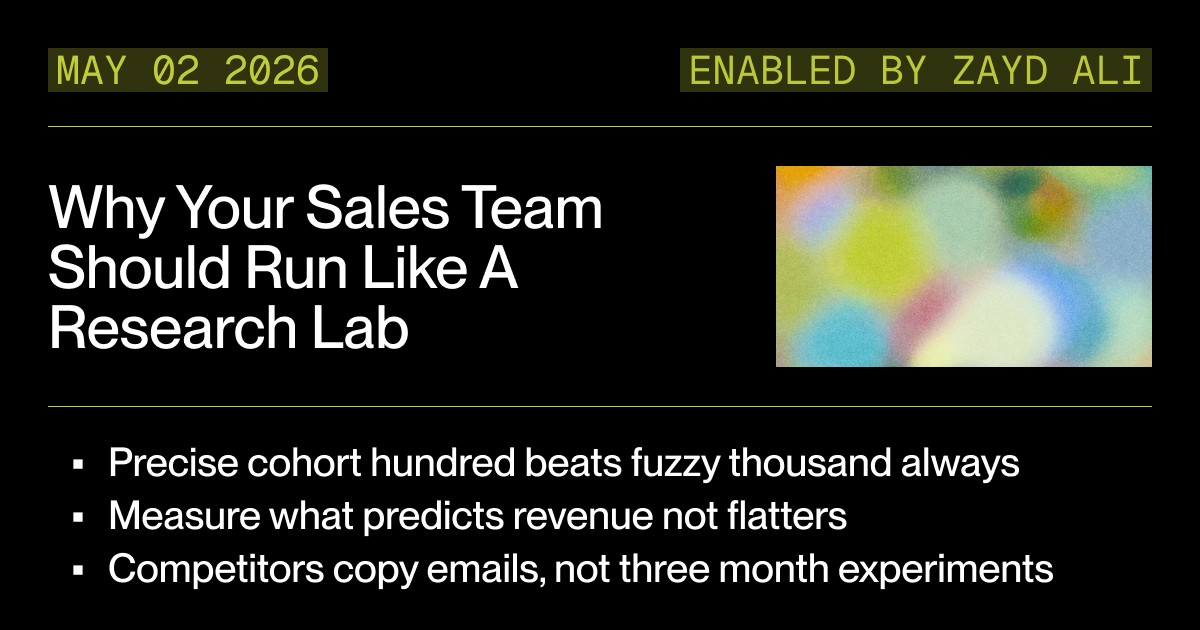
Why Your Sales Team Should Run Like a Research Lab: The 100-Prospect Experiment
Read
Read
Which channels does Valley support?
Valley supports LinkedIn outreach, including connection requests and InMails. Valley users safely send 1000-1200 messages per seat every month.
How safe is it and does Valley risk my LinkedIn account?
Do I have to commit to an Annual Plan like other AI SDRs?
How does Valley personalize messages?

VALLEY MAGIC