
Try Valley
Put your outbound workflow to work.

Saniya
Published:
Updated:
Published February 6, 2026 · Updated August 31, 2026
Generic AI-generated messages sound robotic because they lack authentic voice - the unique communication style, word choices, and personality that make your messages recognizably yours. When prospects receive obviously AI-generated outreach, trust evaporates and response rates plummet.
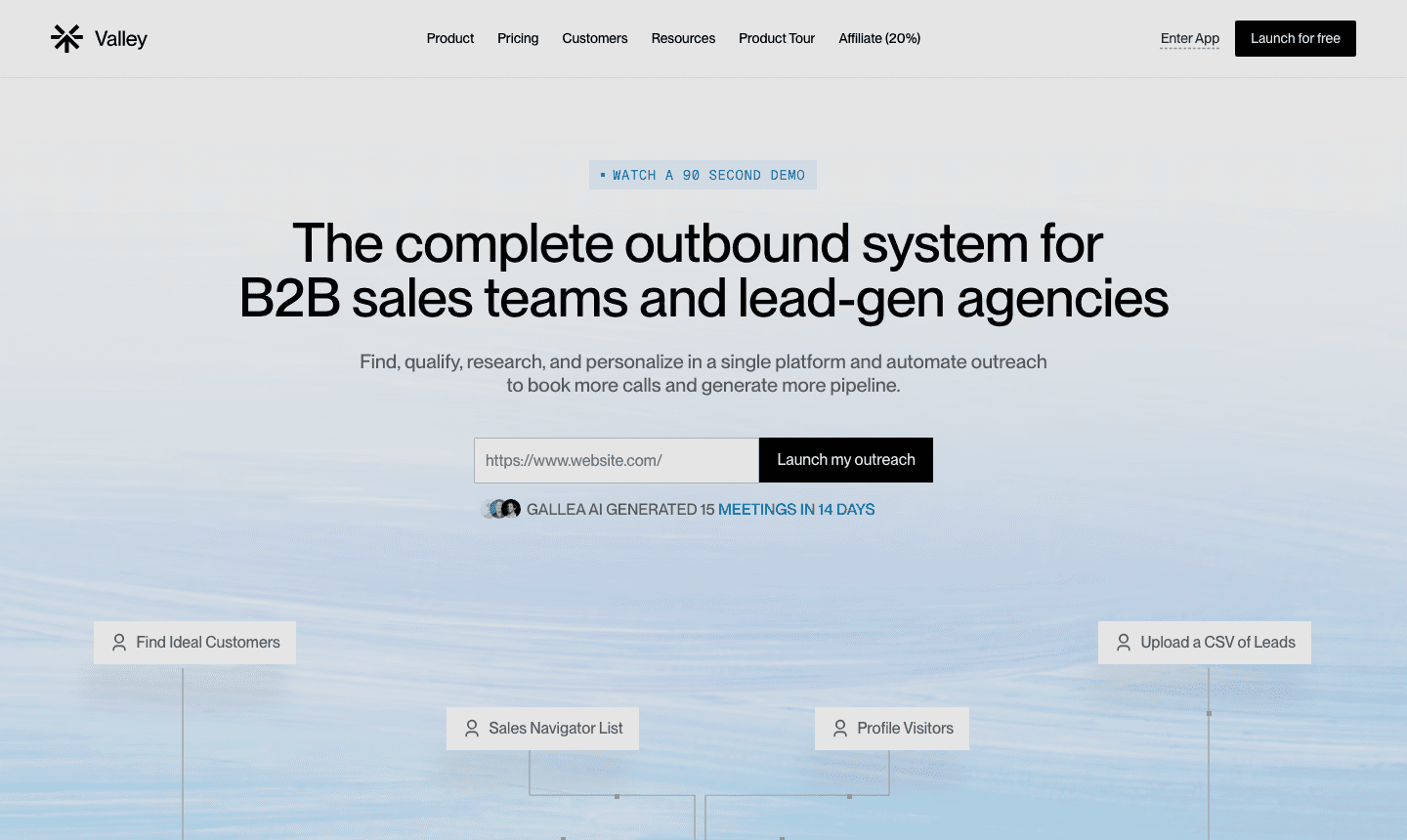
Valley’s success depends on generating messages that sound like you personally wrote them, not messages that announce “I’m automated.” This requires training the AI to replicate your voice: sentence structure and rhythm, vocabulary and word choice, formality level and tone, use of questions vs. statements, humor and personality elements, and industry-specific language.
Without proper training, AI defaults to corporate-speak: “I hope this message finds you well. I wanted to reach out regarding your interest in innovative solutions for optimizing operational efficiency…” This stilted language screams automation.
With effective training, AI generates natural messages: “Saw you checked out our pricing page yesterday. Seems like you’re evaluating options for LinkedIn outbound. Want to see how we’re helping similar teams book 2x more meetings?”
The difference determines whether prospects engage authentically or dismiss your outreach as spam. Valley’s 30-day training framework transforms generic AI into personalized message generation that matches your unique voice.
► Book a demo (teams of 5+)and explore how Valley can support your use case.
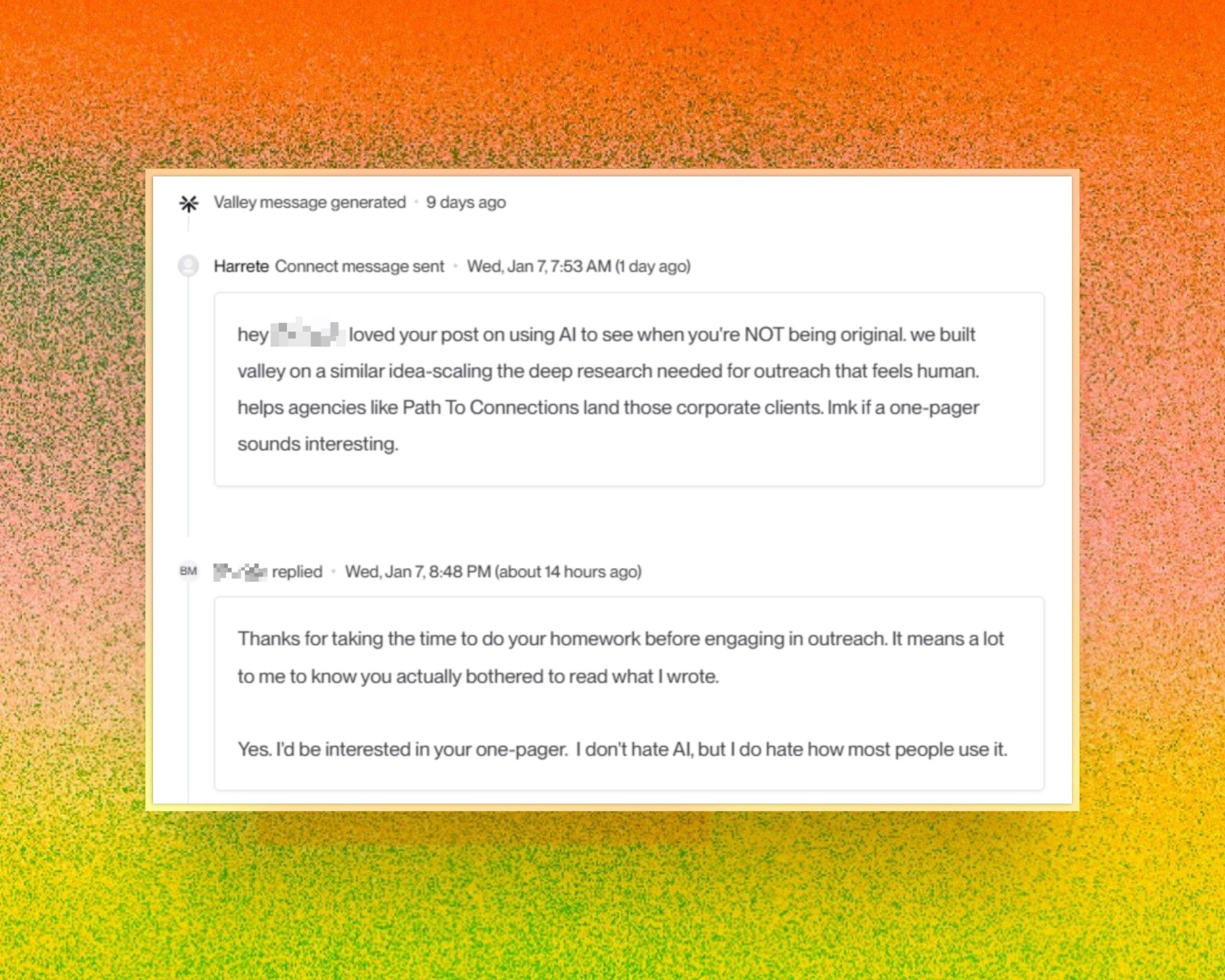

Valley's AI learns your voice through iterative feedback over roughly one month, progressing from basic imitation to sophisticated replication that captures nuance and personality.
Days 1-7: Foundation Setting D
uring initial onboarding, you provide Valley with foundational training data: 3-5 examples of your best-performing LinkedIn messages that generated responses, your value proposition and key differentiators in your own words, a list of "dos" preferred phrases, approaches, and tone characteristics, a list of "don'ts" words to avoid, styles to never use, off-brand approaches, and common objections and how you typically address them.
Valley's AI analyzes these inputs to establish baseline voice parameters: average sentence length (short and punchy vs. longer and flowing), question frequency (consultative question-based vs. declarative statement-based), data usage patterns (heavy on metrics vs. story-focused), formality level (casual vs. professional vs. highly formal), and emotional tone (enthusiastic vs. measured vs. direct).
You launch your first campaign and Valley generates initial messages based on these baseline parameters.
Days 8-14: Active Refinement Through Feedback Valley presents generated messages for your review before sending. For each message, you choose to approve as-is (message matches your voice perfectly), edit and approve (minor adjustments needed), or regenerate (message misses the mark significantly).
When you edit messages, Valley's AI analyzes your changes: which words did you replace with what alternatives, which phrases did you remove or add, how did you restructure sentences, and what tone adjustments did you make.
These edits train the AI more effectively than abstract guidelines. If you consistently replace "innovative" with "new" and "leverage" with "use," the AI learns to avoid business jargon in favor of plain language.
Provide explicit feedback on specific issues: "Too formal - write more casually," "Don't use questions in the opening; start with a direct statement," "Reference their specific post topic, not just 'your recent content'," or "Shorten this- I never write messages longer than 4 sentences."
Valley incorporates this feedback into future message generation immediately.
Days 15-21: Pattern Recognition and Consistency By week three, Valley's AI identifies consistent patterns in your preferences. You notice that generated messages increasingly match your voice without extensive editing - perhaps 60-70% of messages need only minor tweaks or no changes.
The AI understands your voice characteristics: you prefer sentence fragments for emphasis, you use specific metaphors or analogies repeatedly, you always acknowledge their signal before pitching, you end messages with questions that invite response, and you avoid superlatives ("best," "fastest," "only") preferring concrete specifics.
Continue providing feedback, but focus on edge cases and exceptions: how you adjust tone for C-level vs. director-level prospects, how you modify messaging for different industries, and how you handle different signal types (profile viewers vs. post engagers).
Days 22-30: Optimization and Autopilot Readiness By the fourth week, Valley generates messages matching your voice 80-90% of the time without editing. You still review messages but increasingly approve them as-written.
At this point, you can enable autopilot mode for high-confidence prospects (ICP score 80+) while maintaining manual review for lower-confidence or edge-case scenarios.
The AI continues learning indefinitely from your approvals and edits, refining voice matching as your communication style naturally evolves.
What Writing Style Elements Can You Configure in Valley?
Valley's writing style configuration goes beyond simple templates, allowing granular control over how the AI generates messages.
Sentence Structure Preferences: Configure preferred sentence patterns: short and punchy (5-10 words average), medium conversational (10-15 words), or longer flowing (15-20+ words). Specify fragment usage for emphasis, whether you prefer simple or complex sentence structures, and how you use punctuation for rhythm (dashes, ellipses, parentheticals).
Example configuration: "I prefer short sentences. Mix in occasional fragments for emphasis. Use dashes to add context - like this - instead of parentheses."
Opening Hook Styles: Define how you typically start messages: direct signal reference ("Saw you viewed my profile yesterday"), question-based ("Quick question about your LinkedIn outreach"), shared connection ("[Mutual connection] suggested I reach out"), or value-first offer ("Thought you'd find this LinkedIn outreach framework useful").
Valley learns which opening styles you prefer for different scenarios.
Personalization Depth Guidelines: Specify how deeply you personalize: minimal (name and company only), moderate (name, company, and one specific detail), or deep (name, company, specific signal reference, and researched context).
Example: "Always reference the specific signal (which post they engaged with, what page they visited, how many times they viewed profile). Don't use generic 'I noticed you work at [Company]' personalization."
Call-to-Action Preferences: Configure your preferred CTA styles: direct ask ("Want to see how this works? Book 15 minutes here: [link]"), soft invite ("Worth a conversation? Let me know."), question-based ("Would you be open to a quick call this week?"), or resource offer ("I put together a guide on this - want me to send it over?").
Valley matches your preferred CTA approach automatically.
Tone and Formality Specifications: Define appropriate formality for your market: casual and conversational ("Hey [Name], saw you checked out our site. Cool stuff you're building at [Company]."), professional and friendly ("Hi [Name], I noticed [Company] was exploring our pricing page. I'd love to share some insights relevant to your role."), or formal and executive ("Hello [Name], I observed that [Company] has demonstrated interest in our LinkedIn automation platform. I would appreciate the opportunity to discuss how we serve organizations in the [Industry] sector.").
Vocabulary and Phrasing Guidelines: Create lists of preferred and prohibited words and phrases:
Prefer: use, help, show, specific numbers, concrete examples Avoid: leverage, synergy, innovative, solutions, modern, major advantage, paradigm, empower
Valley's AI references these lists during message generation.
Message Length Boundaries: Set minimum and maximum message lengths: short (2-3 sentences, 40-60 words), medium (3-5 sentences, 60-100 words), or long (5-7 sentences, 100-150 words).
Example: "Never exceed 5 sentences. Aim for 60-80 words total. Shorter is better."
These granular controls ensure Valley's AI generates messages matching your exact communication preferences.
How to Provide Effective Feedback to Valley's AI?
The quality of AI output directly correlates with the quality of feedback you provide. Strategic feedback accelerates training and improves long-term performance.
Be Specific About What's Wrong: Instead of: "This doesn't sound like me" (too vague) Try: "I never use the word 'innovative' - replace with 'new' or delete entirely"
Instead of: "Too salesy" (subjective without context) Try: "Don't pitch features in first message - just reference their signal and ask if the topic is relevant"
Specific feedback teaches the AI exactly what to change.
Explain Your Reasoning: When editing messages, briefly note why: "Removed this sentence because it's too long for an opening message," "Changed question to statement - I don't like opening with questions," or "Added specific post reference - personalization was too generic."
These explanations help the AI understand the principle behind your edit, applying it to future messages.
Provide Positive Reinforcement: When Valley generates excellent messages, approve them explicitly and note what worked well: "Perfect tone and length," "Great specific reference to their website visit," or "This opening hook is exactly my style."
Positive feedback reinforces what the AI should continue doing.
Use the Regenerate Function Strategically: If a generated message completely misses the mark, use "regenerate" to get an alternative rather than extensively editing. This signals to the AI that the entire approach was wrong, not just specific words.
If regeneration produces better output, approve it. If not, provide detailed feedback explaining what both attempts missed.
Create Example-Based Guidance: Instead of abstract rules, provide before/after examples:
"Instead of: 'I hope this message finds you well and trust that your week is going smoothly.' Write: 'Quick note about your recent website visit.'"
"Instead of: 'I wanted to reach out regarding your interest in our innovative platform.' Write: 'Saw you checked out our pricing page yesterday.'"
Examples teach more effectively than rules.
Differentiate Edge Cases from Core Voice: Note when feedback applies broadly vs. specific situations: "Always avoid business jargon" (core voice rule) vs. "For C-level prospects, use slightly more formal tone than for directors" (edge case adjustment).
This prevents the AI from overgeneralizing specific feedback.
Review and Approve Quickly: Delayed feedback reduces AI learning effectiveness. Review generated messages within 24 hours of creation when possible, approve or provide feedback promptly, and maintain consistent review patterns during the 30-day training period.
The faster and more consistently you provide feedback, the faster Valley learns your voice.
► Browse the receipts: real Valley outreach and the responses that came back
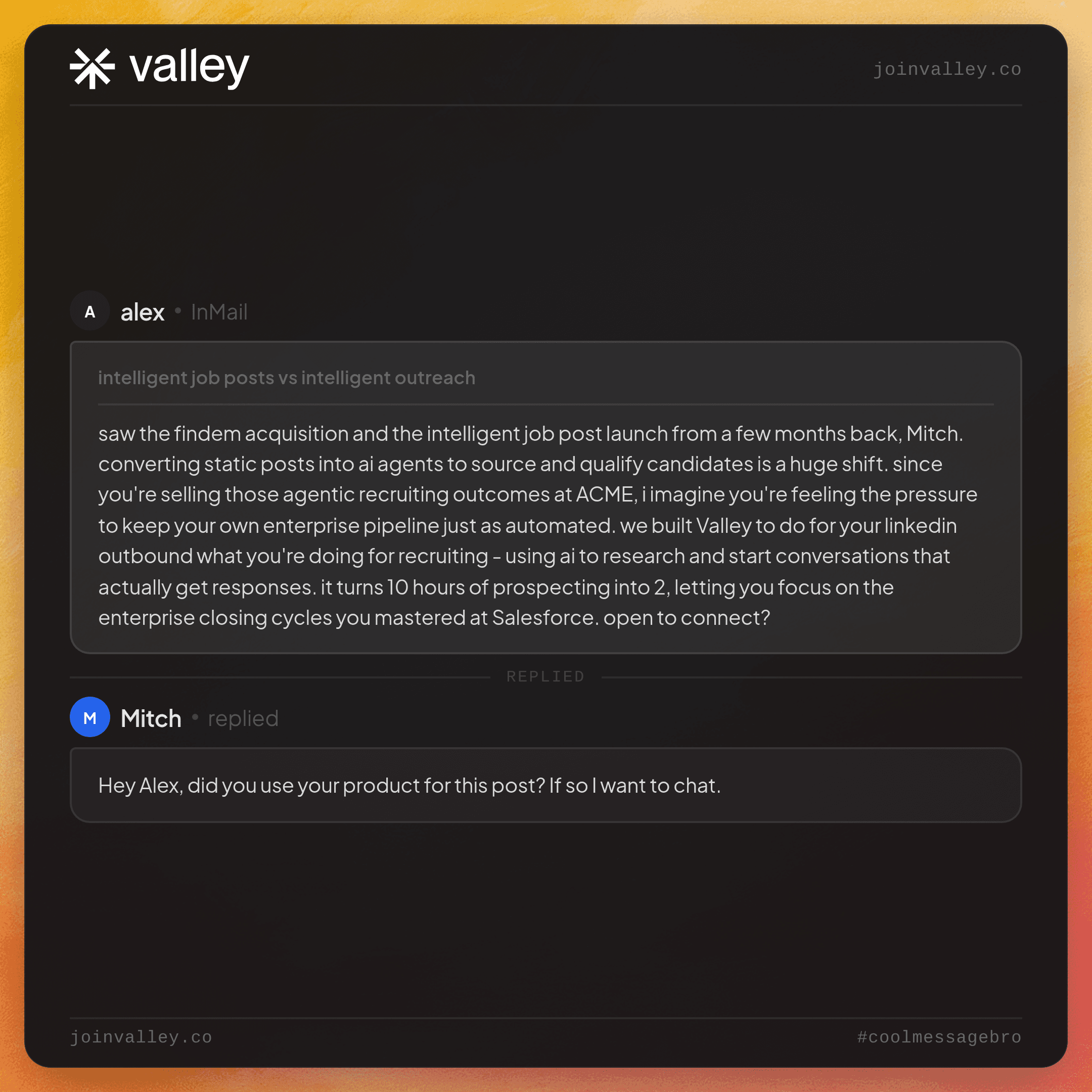
► Check Out More of Valley's Incredible Outreach: A compilation of real time messages and responses!

Your voice likely varies slightly depending on context: who you’re messaging, why you’re reaching out, and what stage of conversation you’re in. Valley’s AI adapts to these contextual variations.
Audience-Based Tone Adjustment: Configure different voice parameters for different prospect levels: C-level executives (slightly more formal, emphasize strategic outcomes, shorter messages), VP/Director level (balanced professional tone, mix strategy and tactics), Manager level (conversational, tactical focus, specific examples), and Individual contributors (very casual, peer-to-peer tone, technical depth).
Valley automatically adjusts tone based on prospect seniority.
Signal-Based Messaging Variation: Different signals warrant different approaches: Profile viewers (“I noticed you checked out my profile - glad to connect”), Post engagers (“Your comment on my post about [topic] resonated - you raised a great point”), Website visitors (“Saw someone from [Company] was exploring our pricing page”), Company page followers (“Thanks for following [Company] on LinkedIn - wanted to reach out personally”), and Competitor post engagers (“I saw you engaged with [Competitor]’s content about [topic]. We take a different approach you might find interesting”).
Valley references the specific signal and adjusts messaging appropriately.
Conversation Stage Adaptation: Voice evolves as conversations progress: Initial connection request (brief, context-setting), First message after acceptance (value-focused, specific personalization), Follow-up after no response (different angle, fresh value), Response to positive reply (conversational, focused on next steps), and Meeting scheduling (direct, logistical).
Valley maintains voice consistency while adapting to conversation stage.
Campaign-Specific Customization: Different campaigns serve different purposes requiring tone variations: High-intent campaigns (profile viewers 3+, pricing page visitors) use more direct approaches assuming buying intent, Nurture campaigns (single likes, low-priority signals) use educational value-first approaches, Competitor displacement campaigns emphasize differentiation and alternative positioning, and Re-engagement campaigns reference past interactions and why you’re reaching back out.
Configure campaign-specific voice guidelines that override general settings when appropriate.
Response Handling: When prospects respond, Valley’s AI generates suggested replies matching your voice for common scenarios: positive interest (“Great! Here’s my calendar link: [link]”), objections (“I understand [objection]. Other customers initially felt the same. What changed their mind was [value].”), requests for information (“Absolutely. The quick summary is [info]. Want to jump on a brief call to discuss specifics?”), and timing pushbacks (“No problem - when’s better for you? I’ll circle back then.”).
Train Valley on your typical response patterns during the first 30 days by editing its suggested replies.
This contextual variation ensures every message sounds authentic regardless of who you’re reaching, why you’re reaching out, and what stage of conversation you’re in.
How to Maintain AI Voice Quality Over Time?
Voice training isn’t a one-time setup - it requires ongoing attention to maintain quality as your communication style evolves and as you encounter new scenarios.
Monthly Voice Audits: Once monthly, review a sample of recently sent messages: select 10-20 messages Valley sent without editing, evaluate whether they still match your current voice, identify any drift or emerging patterns that don’t align, and provide corrective feedback through the writing style settings.
Communication styles naturally evolve - monthly audits ensure Valley evolves with you.
Update Writing Style Documentation: As you refine your messaging approach, update Valley’s writing style configuration: add new prohibited phrases you’ve started avoiding, include preferred phrasings you’ve adopted, adjust tone guidelines based on what’s working, and document new voice rules for emerging scenarios.
Keep the writing style section current rather than treating it as static initial setup.
Provide Feedback on Edge Cases: Even after the initial 30-day training, continue providing feedback when Valley handles unusual scenarios: new prospect types you haven’t targeted before, different industries requiring adjusted tone, responses to uncommon objections, and messaging for new products or offers.
This ongoing feedback prevents voice quality degradation in edge cases.
Re-Train After Major Changes: If you significantly change your positioning, messaging strategy, or target market, consider a partial re-training period: update writing style guidelines to reflect new approach, review and edit messages more actively for 1-2 weeks, provide extensive feedback on the new direction, and monitor voice quality closely during the transition.
Team Voice Consistency: For teams with multiple people using Valley, establish shared voice guidelines: document company-wide tone preferences, create approved and prohibited phrase lists, define voice variations by team member or territory, and conduct quarterly voice alignment reviews.
This ensures consistent brand voice across team members while allowing for individual personality.
Valley’s AI maintains voice quality indefinitely with minimal ongoing attention but periodic reviews and updates ensure the quality stays high as your needs evolve.
