How to Use Valley for B2B Sales Prospecting

Try Valley
Make LinkedIn your Greatest Revenue Channel ↓

Saniya Sood
How Does Valley Transform B2B Sales Prospecting From Manual to Systematic?
B2B sales prospecting has traditionally consumed 40-50% of a sales rep's time: searching for contacts, researching companies, identifying decision-makers, finding relevant talking points, and crafting personalized outreach. Valley fundamentally restructures this process by automating research and prioritization while maintaining the personalization that drives responses.
Traditional prospecting follows a linear, manual workflow: build a list, research each contact individually, write custom messages, send outreach, track responses, and follow up. Each step requires hours of human effort, creating a bottleneck that limits how many prospects your team can engage effectively.
Valley flips this model by starting with signals rather than lists. Instead of searching for people who might be interested, the platform identifies people already demonstrating interest through their LinkedIn behavior. This signal-first approach means every prospect in your pipeline entered because they took an action, viewing your profile, engaging with content, visiting your website, or following your company.
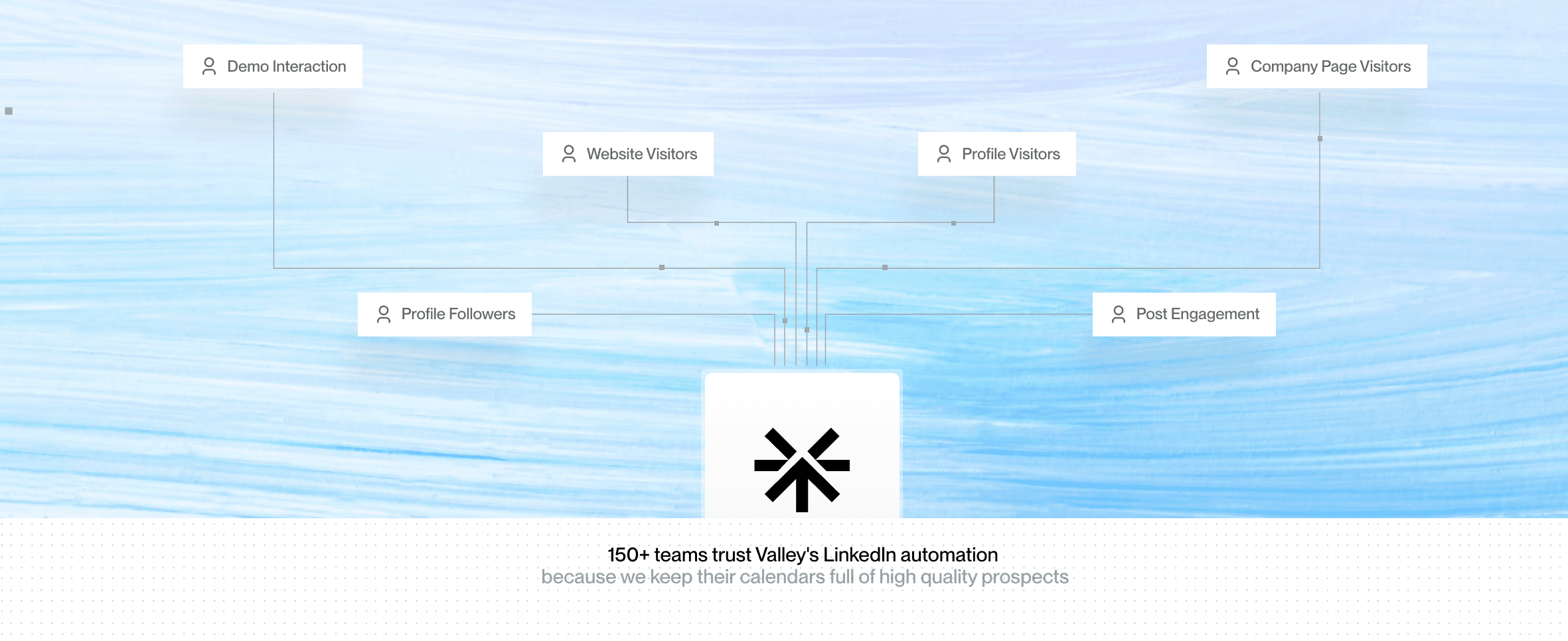
The automation handles everything time-consuming: continuous signal monitoring, automatic enrichment, ICP qualification scoring, deep research across 25+ sources, personalized message generation, and optimized send timing. Your team focuses exclusively on the high-value activities: reviewing messages for quality, responding to interested prospects, and progressing conversations toward meetings.
This transformation doesn't just save time, it fundamentally improves prospecting outcomes. When you research one prospect manually, you might spend 15-20 minutes gathering context. Valley researches hundreds of prospects simultaneously with greater depth, identifying pain points, trigger events, and relevant talking points your team would never discover through manual LinkedIn profile reviews.
► Book a demo and explore how Valley can support your use case

What Makes Valley's AI Sales Prospecting Different From Traditional Prospecting Tools?
Most prospecting tools fall into two categories: lead databases that provide contact information without context, or automation platforms that send messages at scale without intelligence. Valley combines the data richness of the first with the execution efficiency of the second, adding AI-powered research and personalization that neither category delivers.
Lead Database Limitations: Platforms like ZoomInfo and Apollo provide massive contact databases with firmographic data and verified emails. But they lack behavioral context. You can find a VP of Sales at a target company, but you have no idea if they're actively looking for solutions, what challenges they're facing, or why they'd care about your outreach today.
Automation Platform Limitations: Tools like Waalaxy and Expandi automate LinkedIn connection requests and messages, but they rely on basic merge tags for personalization: "Hi {{FirstName}}, I noticed you work at {{Company}}." This template-based approach generates volume without relevance, resulting in low response rates and high ignore rates.
Valley's Integrated Approach: Valley captures behavioral signals that indicate active interest, enriches prospects with comprehensive data, conducts AI-powered research to identify pain points and triggers, generates contextual messages referencing specific signals, and executes outreach at optimal times through LinkedIn's native interface.
The platform doesn't force you to choose between data quality, automation efficiency, and message personalization. It delivers all three by design, creating a prospecting workflow that scales without sacrificing relevance.
How Does Valley Prioritize Sales Leads Automatically?
Not all prospects deserve equal attention. A CEO at a Series B SaaS company who viewed your profile three times and engaged with two posts has dramatically higher conversion potential than someone who passively liked one post from a company outside your target market. Valley's lead prioritization engine automatically surfaces the prospects most likely to convert.
Multi-Factor Scoring System: Valley evaluates prospects across signal strength (3 profile views scores higher than 1), ICP fit (company size, industry, role, seniority all matching your criteria), engagement recency (activity this week beats activity last month), and signal diversity (multiple signal types indicate higher intent than single signals).
Best Fit / Okay Fit / Not a Fit Classification: Every prospect gets classified immediately after enrichment. "Best fit" prospects match your ICP perfectly and show strong signals—these deserve immediate outreach. "Okay fit" prospects partially match criteria or show weaker signals—these go into nurture sequences. "Not a fit" prospects get excluded automatically, preventing wasted effort.
Qualification Reasoning Transparency: Valley explains why each prospect qualifies and what makes them relevant. This transparency helps your team understand pipeline composition and refine targeting criteria based on which prospect types actually convert to meetings and deals.
Automatic Re-Prioritization: As prospects take additional actions—viewing your profile again, engaging with new content, visiting different website pages—Valley dynamically adjusts their priority scores. Someone who was "okay fit" yesterday might become "best fit" today after visiting your pricing page three times.
This intelligent prioritization ensures your team always works the highest-potential prospects first, maximizing meeting volume and pipeline quality from finite selling capacity.
How to Build Multi-Channel Prospecting Workflows With Valley?
While Valley specializes in LinkedIn-first warm outbound, most successful sales teams use multi-channel approaches. The platform integrates with your existing tools to create cohesive workflows that leverage LinkedIn's superior engagement rates while adding email, phone, and other channels strategically.
LinkedIn-First Strategy: Valley initiates contact on LinkedIn because warm outbound delivers 3-5x better response rates than cold email. The platform sends connection requests with personalized notes referencing the prospect's signal, follows up via LinkedIn message after connection acceptance, and continues multi-touch sequences entirely within LinkedIn until prospects respond or disengage.
Email as Secondary Channel: For prospects who don't respond on LinkedIn after 2-3 touches, Valley can trigger email sequences through Instantly integration. The email references the LinkedIn connection attempt: "I reached out on LinkedIn last week after seeing you engage with our content on warm outbound. Wanted to follow up via email in case LinkedIn isn't your preferred channel."
Phone Follow-Up for High-Intent Prospects: When prospects respond positively on LinkedIn but don't commit to a meeting immediately, your team can follow up with phone calls. Valley provides the complete context, which signals they showed, what they engaged with, conversation history, so calls feel like natural continuations rather than cold interruptions.
Retargeting Ad Integration: Valley identifies website visitors and post engagers who don't respond to outreach. Export these lists to run LinkedIn or Google retargeting ads keeping your brand top-of-mind while they continue evaluating solutions.
The key insight: LinkedIn warm outbound should lead your multi-channel motion because it achieves the highest response rates. Other channels amplify and reinforce, but Valley ensures you're starting conversations where prospects are most receptive.
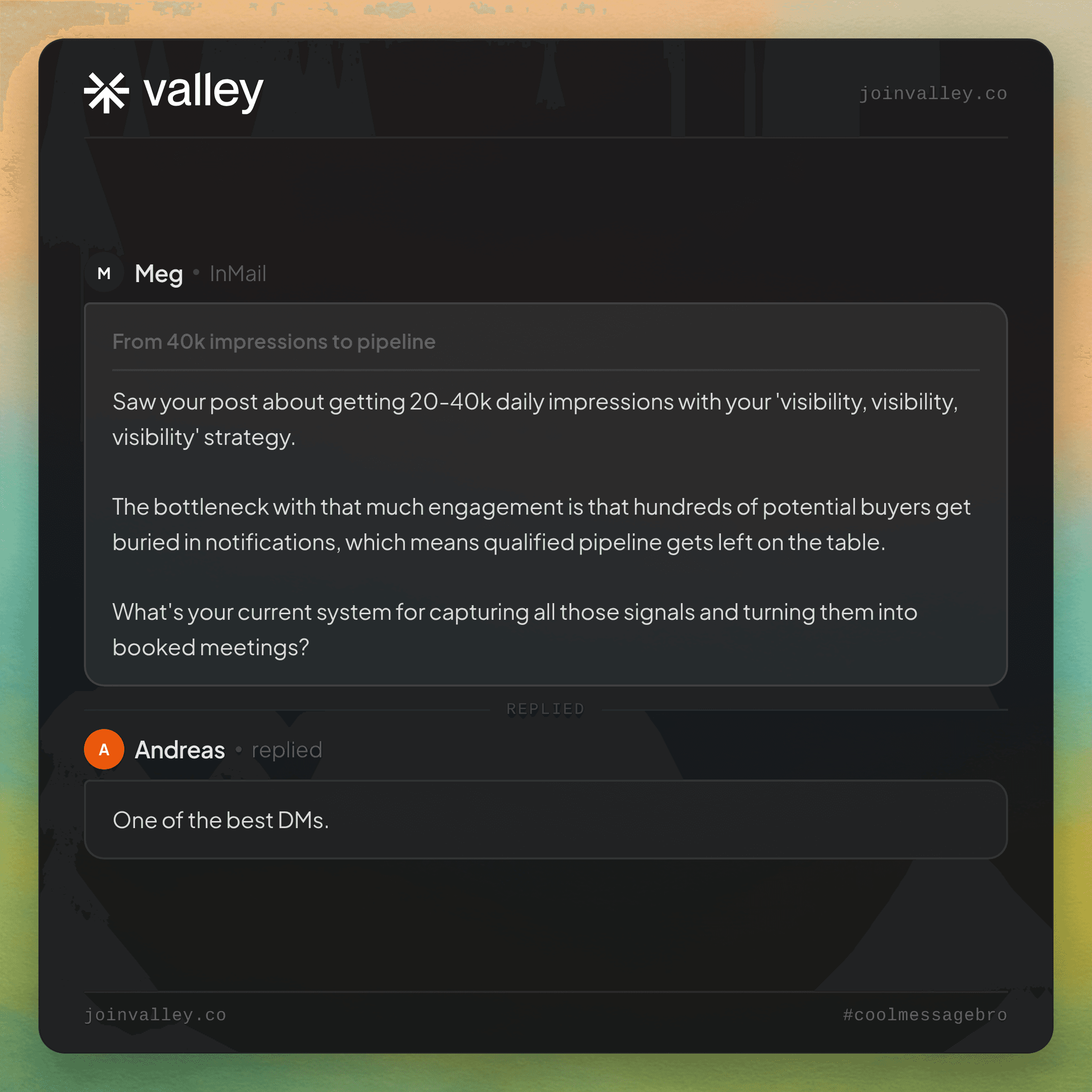
► Check Out More of Valley's Incredible Outreach: A compilation of real time messages and responses!

What B2B Industries See the Best Results From Valley's Prospecting Approach?
Valley's warm outbound methodology works exceptionally well for specific B2B segments where buyers actively use LinkedIn for research and professional development:
B2B SaaS Companies (Vertical and Horizontal): SaaS decision-makers live on LinkedIn. They follow industry thought leaders, engage with product content, research solutions through LinkedIn posts and profiles, and use the platform for professional networking. Valley's signal-based approach captures them during active evaluation phases.
Valley's strongest vertical SaaS segment includes companies selling to HR, finance, legal, compliance, and facilities buyers—roles that are hard to reach via traditional channels but highly active on LinkedIn for professional development and vendor research.
Professional Services Firms: Consulting firms, agencies, fractional executive services, and specialized service providers benefit enormously from warm outbound. Their buyers research providers extensively before initiating contact. Valley captures this research activity and starts conversations at the perfect moment.
High-Ticket B2B Services: Companies selling complex, expensive services (enterprise software implementation, managed services, strategic consulting) face long sales cycles where multiple stakeholders evaluate options thoroughly. Valley identifies buying committee members showing interest and engages them systematically.
Agencies Offering Lead Generation Services: Marketing and sales development agencies use Valley to deliver warm LinkedIn outbound as a service to their clients. The platform's multi-account management and white-label capabilities make it ideal for agency models.
Industries with Hard-to-Reach Buyers: Construction technology, healthcare IT, financial services, legal tech, and other sectors where buyers are skeptical of cold outreach see exceptional results. Warm signals provide the credibility needed to start conversations in these cautious markets.
The common thread: these industries have buyers who research on LinkedIn before engaging with sales. Valley systematically converts that research into pipeline.
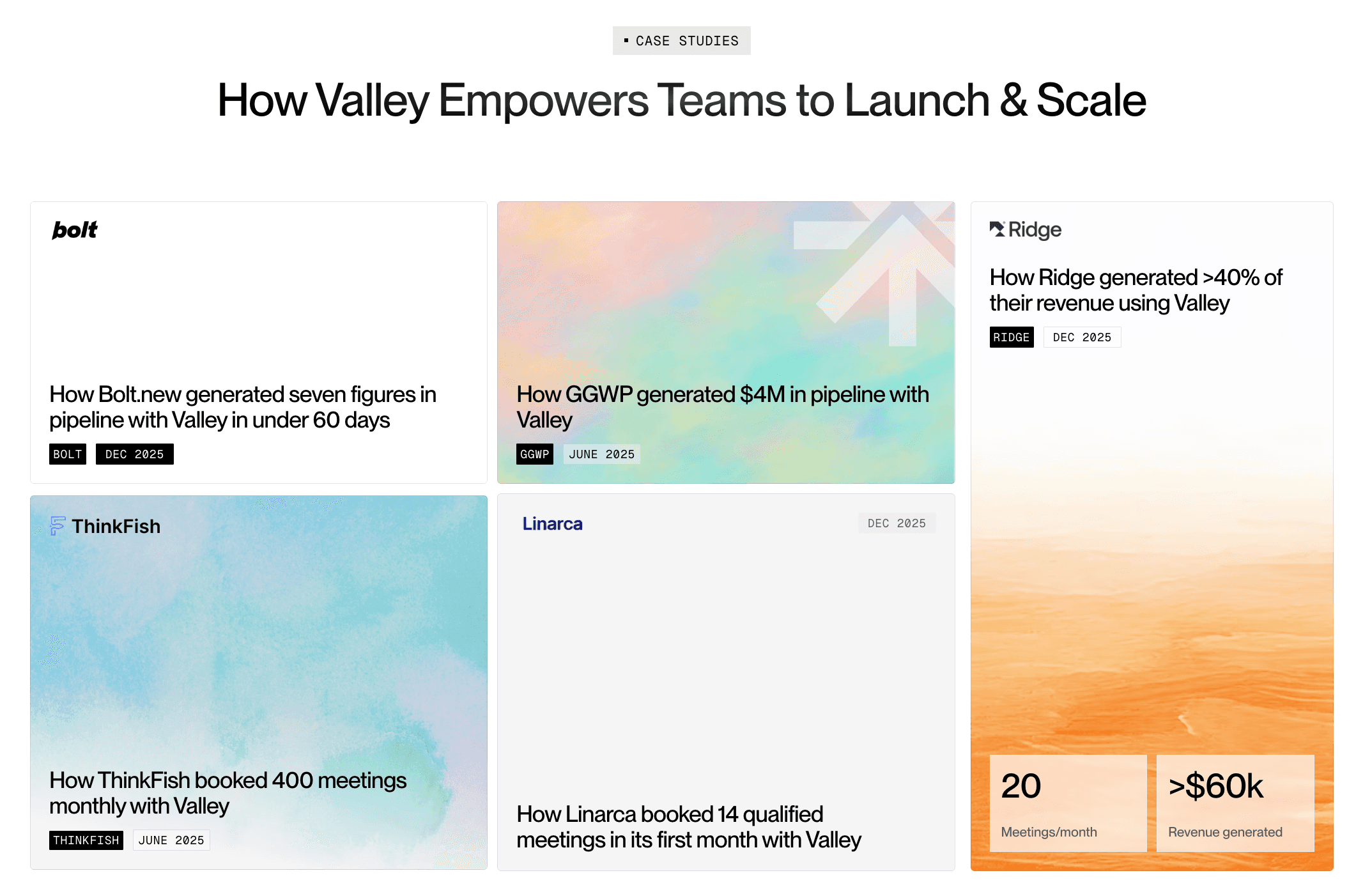
How Does Valley's AI Sales Prospecting Compare to Hiring SDRs?
The build-vs-buy decision for prospecting capability often comes down to hiring SDRs versus implementing technology. Valley provides compelling economics compared to traditional SDR hiring while delivering superior personalization and research depth.
Cost Comparison: An entry-level SDR costs $60,000-$80,000 in salary plus $20,000-$30,000 in benefits, training, tools, and overhead—roughly $100,000 all-in annually. Valley costs $4,800-$10,200 annually per seat depending on plan, representing 5-10% of SDR cost.
Ramp Time Comparison: New SDRs require 3-6 months to ramp to full productivity: learning your product, understanding your market, developing messaging, building process discipline. Valley delivers results within 72 hours of setup, with AI reaching full optimization in 30 days.
Consistency Comparison: SDR performance varies based on individual motivation, skill development, and external factors. Valley maintains consistent output: same research quality, same message personalization standards, same daily activity levels, regardless of day, week, or quarter.
Scale Comparison: Scaling SDR teams requires recruiting, hiring, onboarding, and managing additional headcount—each new SDR adding $100,000 in costs. Scaling Valley requires adding seats at fixed per-seat costs with zero additional management overhead.
Research Depth Comparison: Even excellent SDRs can research 10-15 prospects thoroughly per day. Valley researches hundreds of prospects daily with greater depth, analyzing 25+ data sources and generating insights human researchers would miss.
The strategic advantage: Valley allows small teams to execute prospecting motions that previously required multiple SDRs, freeing human capacity for higher-value activities like discovery calls, demos, and deal progression.

Related Blogs

FEATURED READ
5 min
Valley vs HeyReach: Which LinkedIn Outreach Tool Wins More Qualified Meetings?
Read
Read

FEATURED READ
5 min
Valley in 2026: Is the Price Worth the Pipeline?
Read
Read

FEATURED READ
5 min
Valley vs Dripify: Which LinkedIn Outreach Tool Actually Converts in 2026?
Read
Read

FEATURED READ
5 min
Valley vs. Hiring an SDR: The Real Cost and ROI Breakdown for 2026
Read
Read
Which channels does Valley support?
Valley supports LinkedIn outreach, including connection requests and InMails. Valley users safely send 1000-1200 messages per seat every month.
How safe is it and does Valley risk my LinkedIn account?
Do I have to commit to an Annual Plan like other AI SDRs?
How does Valley personalize messages?
Is Valley available in my country?

VALLEY MAGIC