How to Use Valley for Signal-Based Selling

Try Valley
Make LinkedIn your Greatest Revenue Channel ↓

Saniya Sood
Published:
What Is Signal-Based Selling and How Does Valley Enable It?
Signal-based selling represents a fundamental shift from demographic targeting to behavioral targeting. Instead of prospecting based on who someone is (job title, company size, industry), you prospect based on what they do, actions that reveal active interest, buying intent, and research behavior.
Traditional B2B prospecting builds lists from static criteria: "VP of Sales at 100-500 employee SaaS companies in North America." This approach captures fit but misses timing—you have no idea if they're actively looking for solutions now or perfectly satisfied with the status quo.
Signal-based selling flips this: "People who viewed my profile this week, engaged with content about LinkedIn outbound, or visited my pricing page." These behavioral signals indicate active interest happening right now, regardless of whether someone perfectly matches your demographic ICP.
Valley automates signal-based selling by continuously monitoring multiple signal sources, qualifying signal strength and relevance, enriching signals with context and research, converting signals into personalized outreach, and tracking which signals predict actual deals.
This approach aligns outreach with prospect buying journeys, engaging them when they're actively researching rather than interrupting with cold pitches when they're focused elsewhere.
► Book a demo and explore how Valley can support your use case

What LinkedIn Signals Does Valley Track and Why They Matter?
Valley monitors five primary LinkedIn signal categories, each indicating different levels and types of buying intent.
Profile Views (Research Signal):
What it indicates: Someone invested time researching your background, experience, company, or expertise. They're evaluating whether you're credible, relevant, or worth engaging.
Conversion likelihood: Medium to high (6-10% response rate)
Best for: Thought leaders, personal brand builders, consultants, founders
Timing: Respond within 24-48 hours while you're fresh in their mind
Valley's approach: Tracks view frequency (1x vs. 3x matters), notes timing relative to other events, and generates messages that naturally acknowledge the view without being creepy.
Post Engagement (Topical Interest Signal):
What it indicates: Prospect engaged with specific content topic you published. Likes signal passive interest, comments indicate active thinking about the topic, and shares suggest strong agreement or desire to spread the idea.
Conversion likelihood: High to very high (8-15% response rate for comments, 15-25% for shares)
Best for: Content creators, thought leaders, educators, companies with active LinkedIn presence
Timing: Engage within 24 hours of engagement for maximum relevance
Valley's approach: References the specific post and topic, acknowledges their contribution in comments, and connects post topic to your offering naturally.
Website Visits (Solution Research Signal):
What it indicates: Prospect visited your website to learn more about your company, products, pricing, or customers. Page-level detail reveals buying stage—pricing page visitors are further along than about page visitors.
Conversion likelihood: Very high (10-20% response rate, especially for pricing page visitors)
Best for: Companies driving traffic through content, ads, or SEO
Timing: Same-day outreach dramatically improves conversion
Valley's approach: De-anonymizes visitors, identifies decision-makers at visiting companies, and references their website exploration naturally.
Company Page Follows (Organizational Interest Signal):
What it indicates: Prospect wants ongoing updates about your company, product developments, and content. Signals sustained interest beyond one-time curiosity.
Conversion likelihood: Medium (6-8% response rate)
Best for: Companies posting regular updates, product launches, company news
Timing: Welcome new followers within 48 hours
Valley's approach: Thanks them for following, offers value, and transitions to conversation naturally.
Competitor Content Engagement (Competitive Evaluation Signal):
What it indicates: Prospect is actively researching solutions in your category. They're problem-aware, solution-aware, and likely creating vendor shortlists.
Conversion likelihood: Very high (12-20% response rate)
Best for: Companies with clear competitive differentiation, disruptive positioning
Timing: Engage immediately—they're actively evaluating now
Valley's approach: Acknowledges their research, positions your differentiation, and invites comparison rather than claiming superiority.
How to Build a Signal-Based Selling Strategy With Valley?
Effective signal-based selling requires strategic thinking about which signals matter most for your business and how to convert them systematically.
Step 1: Signal Source Audit
Identify which signals your business naturally generates:
High LinkedIn activity (frequent posting): Post engagement signals will dominate Strong personal brand: Profile view signals will be primary Website traffic from content/SEO: Website visitor signals available Industry thought leadership: All signal types active
Focus Valley configuration on your strongest signal sources.
Step 2: Signal Prioritization Framework
Not all signals convert equally. Prioritize based on your sales cycle and buyer journey:
Short sales cycle businesses: Prioritize high-intent signals (website visitors, competitor engagement) Long sales cycle businesses: Engage all signals early to build relationships over time High-touch sales: Emphasize quality signals (shares, repeat views) over volume Low-touch sales: Maximize volume across all signal types
Step 3: Signal Combination Strategies
Prospects showing multiple signals demonstrate highest intent:
Profile view + post engagement: Interested in you AND your ideas Website visit + competitor engagement: Active vendor evaluation including you Multiple post engagements over time: Sustained topical interest Profile view + website visit + post engagement: Maximum intent
Configure Valley to prioritize multi-signal prospects for immediate attention.
Step 4: Timing Optimization
Signal freshness dramatically impacts conversion:
Same-day outreach: 15-25% response rates 1-3 day outreach: 10-15% response rates 4-7 day outreach: 6-10% response rates 8+ day outreach: 3-6% response rates
Valley's real-time signal capture enables same-day outreach when configured for speed.
Step 5: Messaging Calibration by Signal
Different signals warrant different messaging approaches:
Profile viewers: "I noticed you checked out my profile—seemed like relevant timing" Post engagers: "Your comment on my post about [topic] resonated—you raised a great point" Website visitors: "Saw someone from [Company] was exploring our site yesterday" Company followers: "Thanks for following [Company]—wanted to reach out personally" Competitor engagers: "I saw your interest in [Competitor]'s approach to [topic]. We solve this differently through [differentiation]"
Valley's AI personalizes automatically based on signal type.
Step 6: Multi-Touch Sequencing
Single-touch outreach leaves opportunity on the table:
Touch 1: Acknowledge signal, provide immediate value Touch 2 (7 days later): Different angle, new insight Touch 3 (14 days later): Resource offer, case study, or introduction
Valley manages these sequences automatically with optimized spacing.
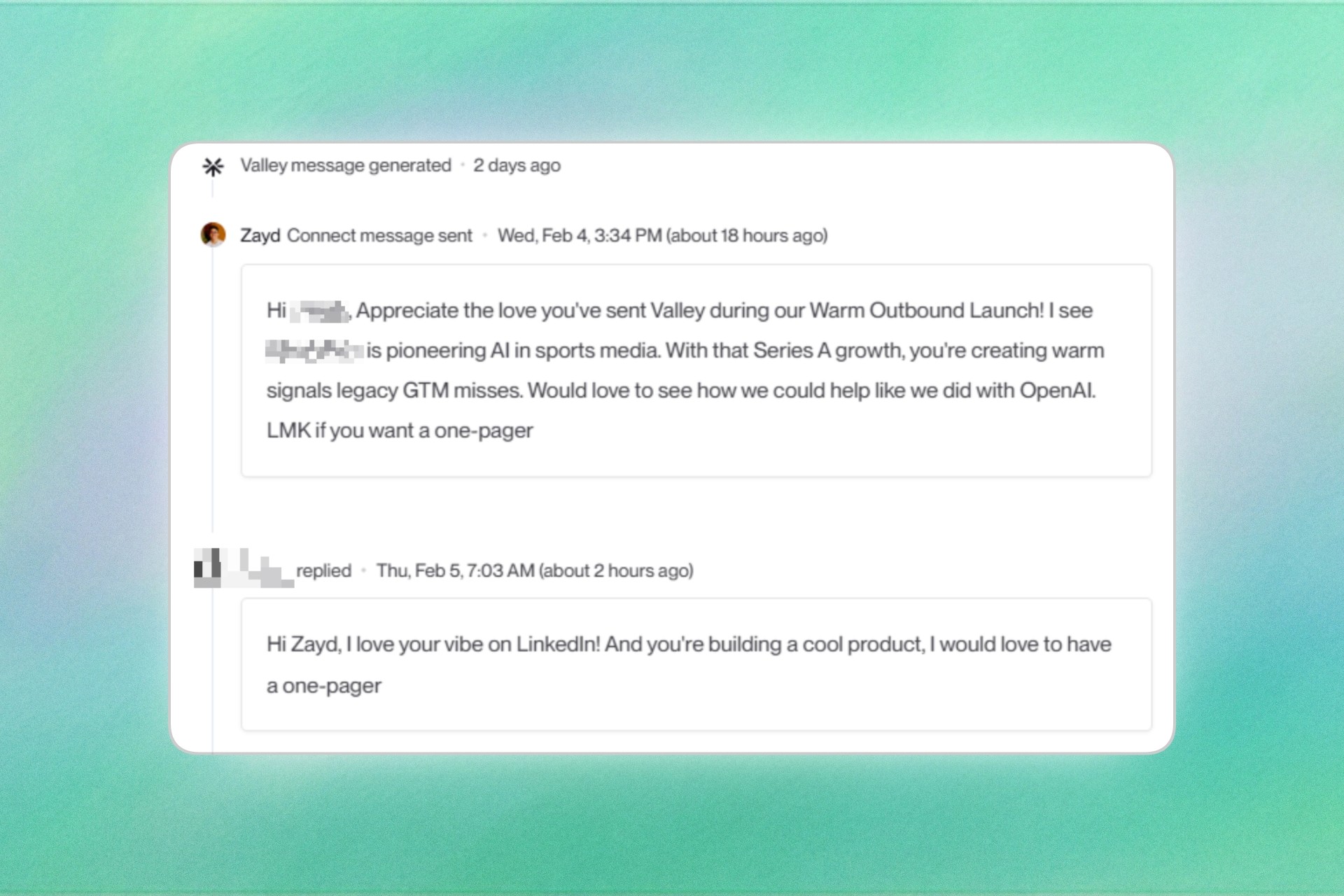
► Check Out More of Valley's Incredible Outreach: A compilation of real time messages and responses!

How Does Signal-Based Selling Improve Sales Efficiency?
Signal-based approaches deliver measurable efficiency gains compared to traditional demographic prospecting.
Response Rate Improvement:
Demographic cold prospecting: 1-2% response rate Signal-based warm outreach: 6-15% response rate
3-10x improvement in prospect engagement per message sent.
Time-to-Meeting Reduction:
Cold approach: 8-12 touches over 30-45 days to book meeting Signal-based approach: 2-4 touches over 7-14 days to book meeting
50-70% reduction in time from initial contact to booked meeting.
Qualification Rate:
Cold leads: 20-30% qualify as legitimate opportunities Signal-based leads: 60-70% qualify
Research effort focuses on prospects likely to matter rather than wasted on poor fits.
Sales Cycle Acceleration:
Prospects entering from signals are already:
Problem-aware (they're researching solutions)
Solution-aware (they're evaluating approaches)
Vendor-aware (they've researched you specifically)
This advances them 30-50% through the buying journey before first conversation, compressing overall sales cycles.
Capacity Multiplication:
Sales rep engaging 50 cold prospects monthly: ~10 responses, 2-3 meetings Same rep engaging 50 signal-based prospects monthly: ~40 responses, 10-15 meetings
4-5x more pipeline from same effort.
Cost Efficiency:
Cost per cold meeting: $300-$500 (including labor, tools, wasted effort) Cost per signal-based meeting: $50-$100 (higher conversion efficiency)
70-85% cost reduction per qualified meeting.
How to Measure Signal-Based Selling Effectiveness in Valley?
Tracking signal performance reveals which behaviors predict deals and deserve increased focus.
Signal Source Performance:
Track conversion metrics by signal type:
Profile viewers: X% response rate, Y% meeting rate, $Z average deal size Post engagers: X% response rate, Y% meeting rate, $Z average deal size Website visitors: X% response rate, Y% meeting rate, $Z average deal size
This analysis identifies which signals drive best ROI for your specific business.
Signal Strength Tiers:
Compare single-signal vs. multi-signal prospects:
One signal: X% conversion rate Two signals: Y% conversion rate (typically 2-3x higher) Three+ signals: Z% conversion rate (typically 4-6x higher)
Quantify the multi-signal premium to justify prioritization.
Signal Timing Analysis:
Measure how recency impacts conversion:
Same-day outreach: X% meeting rate 1-3 day delay: Y% meeting rate 4-7 day delay: Z% meeting rate
This data informs speed-to-contact targets and resource allocation.
Signal-to-Deal Attribution:
Track which signals appear in closed deals:
Percentage of deals involving profile view signals Percentage involving post engagement Percentage involving website visits Percentage involving multiple signals
This reveals which signals predict revenue, not just meetings.
Lead Velocity by Signal:
Measure time from signal to closed deal:
Average days: signal capture → first message Average days: first message → response Average days: response → meeting Average days: meeting → opportunity Average days: opportunity → close
Identify signal types with fastest velocity for volume scaling.
Signal Volume Trends:
Monitor signal generation over time:
Monthly profile view volume (growing with network and brand?) Monthly post engagement volume (content strategy working?) Monthly website visitor volume (traffic increasing?)
Growing signal volume indicates improving brand presence and market position.
How to Combine Signal-Based Selling With Traditional Prospecting?
Signal-based and demographic approaches complement rather than replace each other. Valley enables hybrid strategies.
The Waterfall Approach:
Tier 1: Signal-based warm outreach (highest priority, best conversion)
Valley monitors signals continuously
Immediate outreach to all qualified signal-based prospects
Best resources allocated here
Tier 2: ICP-fit targets without signals (secondary priority)
Manual prospecting for perfect-fit companies showing no signals yet
Lower-touch, lower-cost engagement
Lighter resource allocation
Tier 3: Market development (lowest priority)
Companies adjacent to ICP
Educational content and nurture
Minimal resource investment
This tiered approach ensures highest-return activities get priority while maintaining broader market coverage.
Signal-Accelerated ABM:
Account-based marketing targets specific companies regardless of signals. Valley enhances this:
Monitor target accounts for any signals (profile views, engagement, visits) When signals appear, accelerate engagement immediately Use signals to identify buying committee members showing interest Prioritize multi-signal accounts for resource allocation
Signals transform static ABM lists into dynamic prioritization.
Content-Driven Demand Generation:
Create content designed to generate signals:
Publish LinkedIn posts on high-intent topics Drive traffic to website through SEO, ads, syndication Monitor signal capture from content efforts Engage signal-based prospects with Valley
Content becomes lead generation engine when coupled with signal capture.
Multi-Channel Signal Aggregation:
Combine LinkedIn signals with other channels:
Email engagement signals (opens, clicks, replies) Website behavior beyond visitors (return visits, time on site) Event participation (webinar attendance, downloads) Sales engagement (call answers, voicemail responses)
Valley handles LinkedIn signals while integrating with tools tracking other channels.
Signal-Based Re-Engagement:
Use signals to re-engage dormant opportunities:
Closed-lost deals showing new signals (re-evaluating?) Unresponsive prospects suddenly engaging with content Long-term nurture leads finally visiting pricing page
Signals indicate timing changes that warrant renewed outreach.
Valley's signal-based selling transforms LinkedIn from passive networking platform into active revenue generation channel by systematically converting behavioral interest into qualified pipeline.
► What is Valley Warm Outbound?

Related Blogs

FEATURED READ
5 min
Valley vs HeyReach: Which LinkedIn Outreach Tool Wins More Qualified Meetings?
Read
Read

FEATURED READ
5 min
Valley in 2026: Is the Price Worth the Pipeline?
Read
Read

FEATURED READ
5 min
Valley vs Dripify: Which LinkedIn Outreach Tool Actually Converts in 2026?
Read
Read

FEATURED READ
5 min
Valley vs. Hiring an SDR: The Real Cost and ROI Breakdown for 2026
Read
Read
Which channels does Valley support?
Valley supports LinkedIn outreach, including connection requests and InMails. Valley users safely send 1000-1200 messages per seat every month.
How safe is it and does Valley risk my LinkedIn account?
Do I have to commit to an Annual Plan like other AI SDRs?
How does Valley personalize messages?
Is Valley available in my country?

VALLEY MAGIC