How Valley Automates Follow-Up Sequences on LinkedIn

Try Valley
Make LinkedIn your Greatest Revenue Channel ↓

Saniya Sood
Published:
Why Do Most LinkedIn Outreach Attempts Fail After One Message?
The data on single-touch outreach is sobering: only 30-40% of prospects even see your first LinkedIn message (busy inboxes, notifications missed), only 6-10% respond to that first message (even when they see it), 90%+ of potential conversations die after one attempt.
Sales professionals know multi-touch follow-up dramatically improves results, yet most LinkedIn automation tools and manual approaches struggle with systematic follow-up because: manual follow-up doesn't scale (tracking who to follow up with when), generic automated follow-up feels spammy (same message regardless of no-response reason), timing optimization requires experimentation most teams never do, and message fatigue risks from over-following-up damage relationships.
Valley solves this through intelligent, automated follow-up sequences that: track exactly who received initial messages and didn't respond, vary follow-up messaging to provide new value (not just "checking in"), optimize timing based on response data across thousands of campaigns, stop automatically when prospects engage or show disinterest, and maintain personalization quality throughout the sequence.
The Multi-Touch Reality:
Research across B2B sales shows:
Touch 1 (initial message): 6-10% response rate,
Touch 2 (first follow-up): 15-20% of remaining prospects respond,
Touch 3 (second follow-up): 10-15% of remaining respond,
Touch 4+: Diminishing returns, stop or pause.
Cumulative impact: Single touch reaches ~8% of prospects, three-touch sequence reaches ~30% of prospects—nearly 4x improvement.
► Book a demo and explore how Valley can support your use case
The math is clear: systematic follow-up multiplies results. Valley makes it executable.

How Does Valley Structure Multi-Touch LinkedIn Sequences?
Effective sequences balance persistence with respect, providing value in each touch rather than just repeating requests.
Standard Valley Sequence Framework:
Touch 1 - Initial Outreach (Day 0): Purpose: Establish relevance and value proposition Approach: Reference specific signal (profile view, post engagement, website visit), demonstrate research and context, provide immediate value or insight, soft CTA inviting conversation.
Example: "I noticed you viewed my profile this week and engaged with my post about LinkedIn outbound ROI. Based on your role at [Company], thought you might find our approach relevant. We help [companies like yours] achieve [specific outcome]. Worth exploring?"
Touch 2 - Value-Add Follow-Up (Day 5-7): Purpose: Provide additional value, different angle Approach: Don't reference the first message ("just following up" is weak), introduce new information or perspective, share resource or insight, maintain soft CTA.
Example: "I recently published a framework on [topic relevant to their role] that several [similar roles] found useful. Thought it might be valuable for your work at [Company]. Want me to send it over?"
Touch 3 - Final Touch (Day 12-14): Purpose: Last attempt, acknowledge timing may be off Approach: Permission-based close ("is this relevant or should I stop?"), offer different engagement option (resource instead of meeting), show understanding that timing might not be right, make it easy to disengage.
Example: "I've reached out a couple times about [topic]. If timing isn't right or it's not relevant for [Company], no problem—let me know and I'll stop. Otherwise, happy to share [specific resource] that might be useful. Your call."
Total Timeline: 14 days, 3 touches—balanced persistence without becoming annoying.
Sequence Variations by Signal Type:
Not all signals warrant identical sequences:
High-Intent Signals (Pricing Page Visitors, 3+ Profile Views): Faster cadence: Day 0, Day 3, Day 7 (9-day total) More direct CTAs: "Want to schedule 15 minutes this week?" Higher urgency: "Seemed like you were actively researching solutions"
Medium-Intent Signals (Post Engagement, Single Profile View): Standard cadence: Day 0, Day 7, Day 14 (14-day total) Balanced CTAs: "Worth a conversation?" or "Want me to send the framework?"
Lower-Intent Signals (Company Page Follows, Single Likes): Slower cadence: Day 0, Day 10, Day 21 (21-day total) Softer CTAs: "Thought this might be useful" or "Let me know if you want to discuss"
Valley adjusts sequence timing based on signal strength automatically.
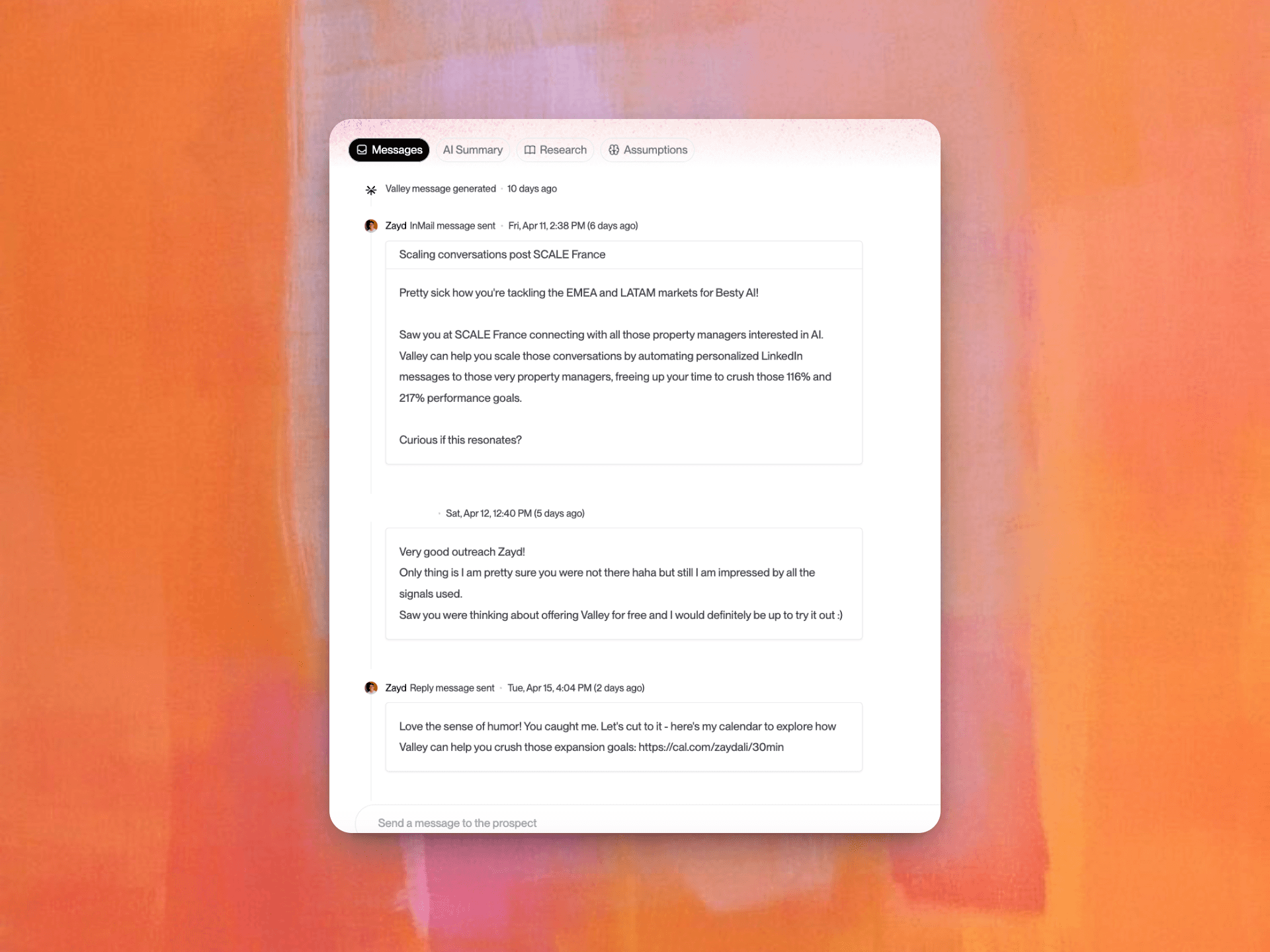
► Check Out More of Valley's Incredible Outreach: A compilation of real time messages and responses!
How Does Valley Personalize Each Touch in the Sequence?
Generic "just checking in" follow-ups waste the opportunity sequences provide. Valley maintains personalization throughout.
Changing the Angle Between Touches:
Each message should provide new value or perspective:
Touch 1 Focus: Signal acknowledgment + initial value proposition "Saw you engaged with my post about [topic]. Here's how we help teams with this..."
Touch 2 Focus: Different value delivery mechanism "Thought you'd find this case study relevant [Company similar to theirs] saw [specific result]..."
Touch 3 Focus: Easy out + alternative engagement "If timing's not right, no worries. FYI we're hosting a webinar on [topic] next week if you'd rather engage that way: [link]"
This variation prevents message fatigue and provides multiple entry points.
Referencing Previous Touches Strategically:
Touch 2 and 3 can acknowledge previous outreach without being needy:
Weak approach: "I sent a message last week but didn't hear back..."
Strong approach: "I know I've reached out about [topic]—wanted to share one more resource that's specifically relevant to [their situation]..."
Acknowledge without apologizing or creating guilt.
Using New Research in Follow-Ups:
Valley's continuous research updates inform later touches:
Touch 1: Based on static research (role, company, initial signal)
Touch 2: Incorporates new information discovered since Touch 1
New blog post they published
Recent company announcement
Additional signal (they visited website since first message)
LinkedIn activity (new post they published or engaged with)
Example Touch 2: "Since I last reached out, I saw [Company] announced [news]. That probably shifts priorities around [relevant area]. Our approach to [topic] might be even more relevant now. Thoughts?"
Seasonal and Timing References:
Later touches can reference timing naturally:
Touch 2 (sent mid-month): "As you're likely planning for next quarter, thought you might want to see how [similar companies] approach [challenge]..."
Touch 3 (sent near month-end): "I know month-end is busy, so I'll keep this brief. If [topic] is on your radar for next quarter, happy to chat then."

How Does Valley Optimize Follow-Up Timing?
The gap between touches dramatically affects response rates. Too fast feels pushy. Too slow, context is lost.
The Timing Research:
Valley data across thousands of sequences shows optimal patterns:
Touch 1 → Touch 2 Gap: 3-4 days: Too fast (prospect hasn't had time to consider) 5-7 days: Optimal (enough time passed, context still fresh) 8-10 days: Acceptable (still relevant) 11+ days: Too slow (initial context fading)
Touch 2 → Touch 3 Gap: 5-7 days: Optimal (consistent cadence maintained) 8-10 days: Acceptable (allows more consideration time) 11-14 days: Maximum (any longer, give up or restart)
Why These Timeframes Work:
Business cycle alignment: 5-7 days = typical week (weekend separates messages naturally), allows prospects to deal with more urgent priorities, creates rhythm without overwhelming.
Psychological spacing: Frequent enough to show genuine interest, spaced enough to avoid harassment, respects that prospects are busy with other priorities.
Adaptive Timing Based on Response Patterns:
Valley can adjust timing based on prospect behavior:
If prospect views your profile or website between touches: Shorten next touch gap (shows continued interest)
If prospect goes completely dark (no LinkedIn activity): Extend next touch gap (they're busy, give more space)
If prospect engages with your new content: Send immediate follow-up referencing that engagement
Day-of-Week Timing:
Beyond touch gaps, specific send days matter:
Best days for initial messages: Tuesday-Thursday (avoiding Monday chaos and Friday check-out)
Best days for follow-ups: Tuesday-Wednesday (mid-week attention optimal)
Avoid: Monday mornings (inbox overload), Friday afternoons (weekend mindset)
Valley schedules sequences to hit optimal days when possible.
Time-of-Day Optimization:
Valley sends messages during high-engagement windows: 8-10 AM: Morning inbox check (high visibility), 12-1 PM: Lunch LinkedIn browsing, 5-6 PM: Evening commute check.
Avoids: Late night/early morning (seems automated), Mid-afternoon (buried quickly).
When Should Valley Sequences Stop Automatically?
Knowing when to stop outreach is as important as knowing when to follow up. Valley includes automatic stop conditions.
Positive Response (Success Case):
Sequence stops immediately when prospect: replies with any message (positive, neutral, or questions), accepts connection request (for sequences starting with pending requests), books meeting via calendar link, engages meaningfully (long comment on your post since sequence started).
Action: Valley marks prospect as "Converted" and exits sequence, moves to response management workflow, alerts rep to engage in conversation.
Explicit Opt-Out (Respect Request):
Sequence stops immediately when prospect: replies "not interested" or "stop contacting me", LinkedIn reports message as spam, explicitly opts out via any communication, indicates wrong person/role/company.
Action: Valley adds to DNC list organization-wide, removes from all campaigns, flags for rep review (ensure legitimate opt-out vs. temporary timing issue).
Negative Engagement Patterns (Implicit Disinterest):
Sequence pauses or stops when prospect: hasn't opened any messages in sequence (all three unread), disconnected on LinkedIn after first message (clear rejection), blocked sender (ultimate rejection signal), shows zero LinkedIn activity for 30+ days (account dormant).
Action: Valley pauses sequence, flags for manual review, suggests removing or extending timing.
Sequence Completion (End of Planned Touches):
After final touch (typically Touch 3), sequence concludes: Prospect marked as "Sequence Completed - No Response", added to long-term nurture pool (passive content engagement), eligible for new campaign after 90-120 days, no further automated outreach unless re-triggered by new signal.
Manual Stop by Rep:
Reps can stop sequences manually when: they identify prospect is wrong fit (ICP changed, prospect left company, etc.), prospect engages offline (call, email, met at event), company policy change (added to partner list, competitor identified), rep wants to handle differently (strategic account requiring custom approach).
How Does Valley Prevent Over-Following-Up and Prospect Fatigue?
The line between persistent and annoying is thin. Valley's safeguards prevent crossing it.
Cross-Campaign Deduplication:
If prospect is in multiple sequences, Valley prevents overlap: Only one active sequence per prospect at a time, if new signal triggers new campaign, Valley pauses old sequence, rep chooses which campaign to prioritize.
Example: Prospect in Day 7 of profile viewer sequence, then visits website (high-intent signal). Valley alerts: "Prospect already in sequence. Pause old sequence and start high-intent sequence? Or continue existing?"
Frequency Capping:
Workspace-level rules prevent message spam: Maximum 3 messages per prospect per 30 days (across all campaigns), minimum 5-day gap between any messages to same prospect, automatic pause if prospect shows zero engagement across multiple campaigns.
These caps prevent Valley from becoming spray-and-pray tool.
Engagement Decay Tracking:
Valley tracks prospect engagement over time: Initial engagement (signal that started outreach), subsequent engagement (any LinkedIn activity from them), response patterns (are they generally responsive or silent?).
If prospect consistently ignores all outreach across multiple campaigns and months: Valley suggests removing from active prospecting, adding to passive content audience instead, long-term nurture only.
Message Quality Monitoring:
If sequences generate negative responses ("stop contacting me", reports as spam), Valley: alerts workspace admin, pauses similar sequences for review, suggests message/targeting refinement, tracks sentiment to prevent pattern of negative reactions.
Respect Indicators:
Valley monitors subtle disinterest signals: prospect views messages but never responds (read receipts show they're seeing content), prospect disconnects after message (clear rejection), prospect reports as spam (ultimate negative), prospect blocks sender (relationship dead).
Automatic sequence adjustment or termination based on these signals.
► Here's the Valley Warm Outbound Launch Video which I spent way too much money on.
What Results Improve With Valley's Multi-Touch Sequences vs. Single Touch?
Data from Valley users shows dramatic improvement from systematic follow-up.
Response Rate Improvement:
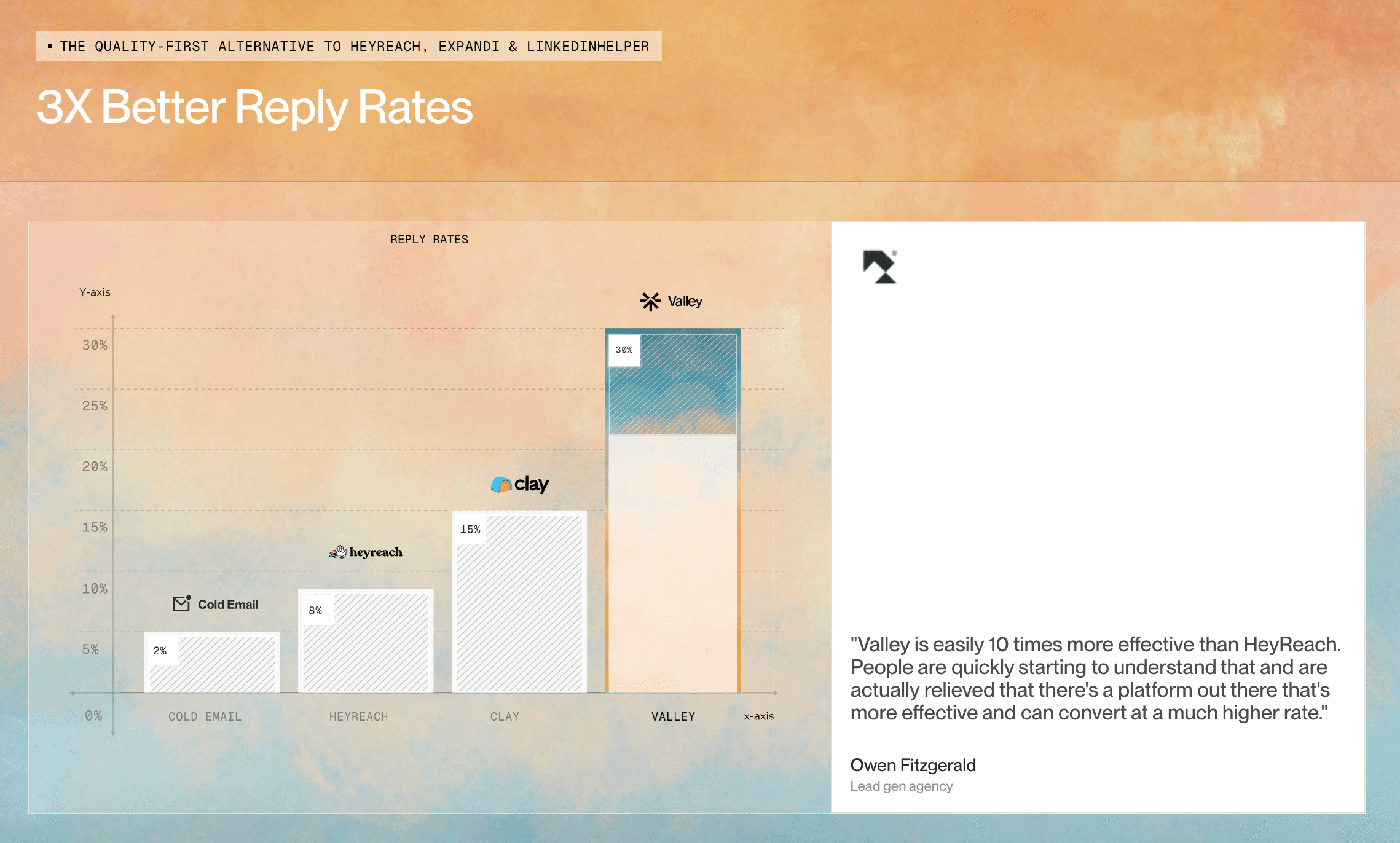
Single touch outreach: 6-10% response rate Two-touch sequence: 12-18% response rate (80-100% improvement) Three-touch sequence: 18-25% response rate (200-300% improvement)
Majority of responses (60-70%) come from Touch 2 and Touch 3, not Touch 1.
Meeting Booking Rate:
Single touch: 1.5-2.5% meeting booking rate Three-touch sequence: 4-6% meeting booking rate (150-200% improvement)
Time to Response:
Interesting pattern: Touch 1 responses: Average 2-3 days (fast responders), Touch 2 responses: Average 1-2 days (touch reminded them), Touch 3 responses: Average < 24 hours (urgency of final touch).
Pipeline Impact:
For equivalent outreach volume: Single touch to 300 prospects: ~24 responses, ~6 meetings, ~$30K pipeline.
Three-touch sequence to 100 prospects: ~22 responses, ~5 meetings, ~$25K pipeline.
Insight: Three-touch sequences achieve 85% of the results with 33% of the prospect volume—dramatically higher efficiency per prospect.
Quality of Responses:
Multi-touch sequences generate higher-quality responses: Touch 2-3 responses show more thought ("I've been thinking about your message..."), demonstrate legitimate interest (not just politeness), convert to meetings at higher rate (50% vs. 35% for Touch 1), close deals at similar or better rates.
Negative Response Rate:
Concern: Does more touching generate more "stop contacting me" responses?
Data: Single touch: 0.5-1% explicit "not interested", three-touch sequence: 1-2% explicit "not interested".
Yes, slightly higher negative rate, but dramatically higher positive rate makes the trade-off worthwhile.
Valley's automated follow-up transforms LinkedIn outreach from single-shot attempts into systematic, persistent engagement that respects prospects while maximizing conversion: the difference between reaching 8% of your addressable market and reaching 25%.

Related Blogs

FEATURED READ
5 min
Valley vs HeyReach: Which LinkedIn Outreach Tool Wins More Qualified Meetings?
Read
Read

FEATURED READ
5 min
Valley in 2026: Is the Price Worth the Pipeline?
Read
Read

FEATURED READ
5 min
Valley vs Dripify: Which LinkedIn Outreach Tool Actually Converts in 2026?
Read
Read

FEATURED READ
5 min
Valley vs. Hiring an SDR: The Real Cost and ROI Breakdown for 2026
Read
Read
Which channels does Valley support?
Valley supports LinkedIn outreach, including connection requests and InMails. Valley users safely send 1000-1200 messages per seat every month.
How safe is it and does Valley risk my LinkedIn account?
Do I have to commit to an Annual Plan like other AI SDRs?
How does Valley personalize messages?
Is Valley available in my country?

VALLEY MAGIC