
Try Valley
Put your outbound workflow to work.

Saniya Sood
Published:
Updated:
Published February 26, 2026 · Updated August 31, 2026
The most critical moment in any sales conversation happens when prospects recognize you understand their challenges. This recognition “you get my problem” builds trust and opens the door to solution discussions. Without accurate pain point identification, even perfect product-market fit fails to convert because conversations stay superficial.
Traditional pain point discovery relies on: asking prospects directly (“What challenges are you facing?”), making assumptions based on role stereotypes (“All VPs of Sales care about pipeline”), using generic industry research (“Companies in fintech struggle with compliance”), or hoping prospects volunteer their problems unprompted.
These approaches produce mixed results. Prospects don’t always articulate pain points clearly, they may not recognize underlying issues, lack time to explain comprehensively, feel uncomfortable admitting challenges, or default to surface symptoms rather than root causes.
Valley’s AI research addresses this by: analyzing role-specific challenges across hundreds of documented patterns, correlating company stage with typical pain points at that maturity level, identifying trigger events that create or amplify specific challenges, synthesizing multiple data sources to infer unstated pain points, and generating specific, relevant hypotheses for each prospect.
This research-driven approach enables reps to demonstrate understanding before prospects explain their situation, accelerating trust and credibility.
► Book a demo (teams of 5+)and explore how Valley can support your use case

Different roles face fundamentally different challenges. Valley's pain point identification begins with precise role-based mapping built from extensive analysis.
Role Pain Point Database:
Valley maintains documented pain points for hundreds of B2B roles across functional areas. Examples:
VP of Sales Pain Points:
Inconsistent pipeline generation across rep team
Inability to forecast accurately due to pipeline quality issues
Difficulty scaling team without degrading performance
Sales process inefficiencies extending cycle times
Lack of visibility into early-stage pipeline health
Territory planning and quota distribution challenges
Sales and marketing alignment gaps
CRM adoption and data quality problems
Head of Marketing Pain Points:
Attribution challenges connecting marketing spend to revenue
Content ROI measurement difficulties
Lead quality complaints from sales team
Marketing qualified lead (MQL) to sales qualified lead (SQL) conversion gaps
Channel optimization across multiple platforms
Brand awareness measurement in competitive markets
Budget justification without clear contribution metrics
Marketing technology stack complexity and integration issues
Director of Operations Pain Points:
Process documentation gaps creating inconsistency
Manual workflows consuming excessive time
System integration challenges between tools
Scalability concerns as company grows
Resource allocation inefficiencies
Data silos preventing holistic visibility
Change management resistance to new processes
Tool sprawl and duplicate functionality
Valley references these role-specific patterns during prospect research, identifying which pain points likely affect each prospect based on their position.
Seniority-Level Refinement:
Pain points vary by seniority even within same function:
C-Level (Strategic Focus):
Board-level reporting and accountability
Long-term strategic planning
Resource allocation across departments
Organizational structure and talent strategy
Market positioning and competitive response
Shareholder or investor management
VP-Level (Execution Focus):
Department performance and KPI achievement
Team building and talent development
Cross-functional collaboration
Budget management and ROI justification
Process optimization and efficiency
Technology stack decisions
Director-Level (Tactical Focus):
Day-to-day team management
Project execution and deliverables
Tool utilization and adoption
Performance coaching
Reporting and analytics
Workflow optimization
Manager-Level (Operational Focus):
Individual contributor productivity
Task prioritization and capacity planning
Quality control and consistency
Training and enablement
Immediate problem-solving
Tool proficiency
Valley adjusts pain point emphasis based on prospect seniority, ensuring relevant conversations.
How Does Valley Correlate Company Stage With Pain Points?
A VP of Sales at a 10-person seed-stage startup faces entirely different challenges than a VP of Sales at a 500-person Series C company. Valley analyzes company maturity to identify stage-specific pain points.
Seed Stage (0-20 employees, Pre-revenue to $1M ARR):
Primary pain points across roles:
Product-market fit validation uncertainty
Founder-led sales scaling challenges
First sales hire integration struggles
Minimal process documentation
Resource constraints forcing tool choices
Inability to afford specialized roles
Rapid priority shifts and pivots
For VP Sales at seed company, Valley emphasizes:
"You're probably still defining repeatable sales process"
"Balancing founder involvement with building scalable team"
"Choosing tools that work now and scale later"
Series A (20-50 employees, $1M-$5M ARR):
Primary pain points:
Scaling beyond founder sales motion
Building repeatable processes that work
Hiring fast enough to meet growth targets
Balancing rapid experimentation with consistency
Tool proliferation creating integration nightmares
Metrics definition and tracking challenges
For VP Sales at Series A, Valley emphasizes:
"Transitioning from scrappy to systematic"
"Building SDR function that actually works"
"Proving ROI on new tools and headcount"
Series B (50-150 employees, $5M-$20M ARR):
Primary pain points:
Process standardization across growing team
Maintaining culture during rapid hiring
Specialization creating new coordination challenges
Predictable pipeline generation at scale
Sales and marketing alignment breakdowns
Technology stack complexity management
For VP Sales at Series B, Valley emphasizes:
"Maintaining velocity while adding structure"
"Coordinating specialized teams (SDRs, AEs, SEs)"
"Predictable forecasting with larger numbers"
Series C+ (150+ employees, $20M+ ARR):
Primary pain points:
Enterprise sales motion complexity
Geographic expansion coordination
Product line proliferation challenges
Sales efficiency optimization (not just growth)
Competitive pressures in maturing market
Board and investor reporting expectations
Talent retention and development at scale
For VP Sales at Series C+, Valley emphasizes:
"Optimizing efficiency ratios and cost of sale"
"Managing complex product portfolio"
"Competitive differentiation as market matures"
Valley identifies company stage through: employee count from LinkedIn company page, funding data from Crunchbase and public announcements, revenue estimates from business databases, job posting volume and growth trajectory, and public statements about company milestones.
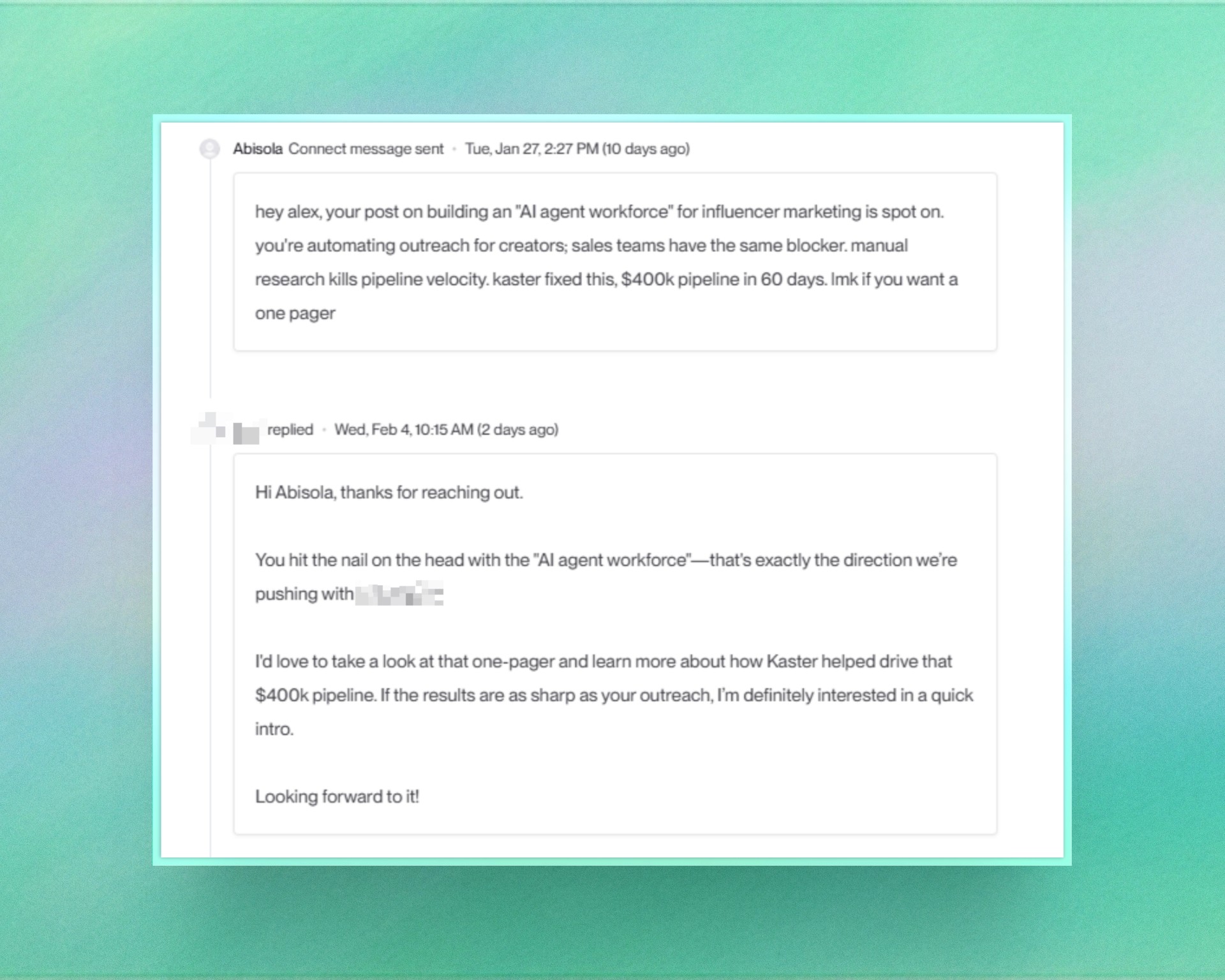
► Check Out More of Valley's Incredible Outreach: A compilation of real time messages and responses!
How Does Valley Identify Trigger Events That Create or Amplify Pain Points?
Timing matters enormously in sales. The same prospect who ignored outreach three months ago might be actively seeking solutions today because circumstances changed. Valley identifies these trigger events.
Funding Announcements (Growth Urgency):
When companies raise funding, specific pain points intensify:
Hiring pressure (need to deploy capital, build team fast)
Scaling challenges (previous processes don't work at new scale)
Board expectations (demonstrate progress toward milestones)
Tool evaluation (budget available for infrastructure)
Market expansion (new geographies or segments require new approaches)
Valley detects funding from: news mentions, Crunchbase updates, LinkedIn company page announcements, and PR releases.
When messaging VP Sales at recently funded company: "I saw [Company] recently raised [$X]. That typically creates pressure to scale the team and hit aggressive growth targets. How are you approaching building out your sales infrastructure to support that?"
Executive Hires (Priority Shifts):
New leaders bring new initiatives and pain points:
New CRO hire: likely reevaluating entire GTM stack and process
New CMO hire: probably changing marketing strategy and tooling
New VP Sales: often brings new methodologies and vendor preferences
New Head of Ops: typically standardizes processes and consolidates tools
Valley monitors LinkedIn for executive job changes at target companies.
When messaging new CRO: "I noticed you recently joined [Company] as CRO. Typically that first 90 days involves evaluating GTM infrastructure. How are you approaching that assessment?"
Expansion Announcements (Operational Challenges):
Company growth creates operational pain:
New office opening: coordination and consistency challenges
International expansion: localization and remote management
Product line addition: go-to-market complexity increases
Market segment entry: new buyer personas and messaging needed
Valley finds expansion news through: company blog posts, LinkedIn updates, job postings in new locations, and news articles.
Competitive Events (Market Pressure):
When competitors make moves, prospects feel pressure:
Competitor funding announcement (fear of being outspent)
Competitor product launch (need to match capabilities)
Competitor customer win (lost deal motivates change)
Industry consolidation (need to remain competitive)
Valley tracks competitor activity relevant to your market.
Regulatory Changes (Compliance Pressure):
New regulations create urgent pain points in affected industries:
GDPR in Europe affecting data handling
CCPA in California creating compliance requirements
Industry-specific regulations (healthcare, financial services)
Security standards becoming mandatory
Valley correlates prospect industry with relevant regulatory developments.

The most sophisticated pain point identification comes from connecting disparate data points that individually seem insignificant but collectively reveal challenges.
Technology Stack Analysis:
Valley examines tools prospects use to infer pain points:
Using basic/outdated tools in critical areas: If VP Sales uses generic spreadsheets instead of modern sales engagement platform: Inferred pain point: “Likely struggling with sales team efficiency and lack of automation”
Using too many tools (over 15 in martech stack): Inferred pain point: “Probably experiencing integration challenges, data silos, and excessive cost”
Missing critical tool categories: No sales intelligence platform: “Likely relying on manual prospect research, wasting rep time” No revenue analytics tool: “Probably struggling with forecasting accuracy and pipeline visibility”
Hiring Pattern Analysis:
Job postings reveal organizational priorities and gaps:
Hiring multiple SDRs simultaneously: Inferred pain point: “Pipeline generation struggling to keep pace with growth targets”
Hiring Operations roles (Sales Ops, Revenue Ops): Inferred pain point: “Processes breaking down, need systematization”
Hiring enablement roles: Inferred pain point: “Onboarding and training challenges with growing team”
Content Analysis:
LinkedIn posts and content engagement reveal concerns:
Executive posting about specific challenges: CEO writes about: “The hardest part of scaling is maintaining culture” → Company experiencing growth pain
Engaging with content about specific topics: VP Sales engaging with posts about pipeline generation, forecasting, CRM adoption → These are active pain points
Company blog topics: Blog posts about: “How we’re rebuilding our sales process” → Process challenges currently being addressed
Review Site Feedback:
G2, Capterra, and similar sites show pain points through tools they review:
Reviewing competitor tools: Actively evaluating solutions in your category → Pain point exists, timing is now
Negative reviews of current tools: Complaining about features or support → Dissatisfaction, potential switching opportunity
Seeking specific capabilities: Looking for “better reporting” or “easier integrations” → Specific pain points articulated
Valley’s Synthesis:
Valley’s AI combines these inputs: Role (VP Sales) + Stage (Series B) + Trigger (Recent funding) + Tech Stack (Missing sales intelligence) + Hiring (3 SDR openings) + Content (Engaging with pipeline generation content).
Synthesized pain point hypothesis: “You’re likely facing pressure to scale pipeline generation quickly after your recent funding round. With several SDR openings and current manual research processes, you’re probably concerned about maintaining quality while hitting volume targets. The lack of sales intelligence automation is creating bottlenecks.”
This specific, researched hypothesis demonstrates understanding before prospect explains their situation.
How Accurate Is Valley’s AI Pain Point Identification?
No AI achieves 100% accuracy predicting prospect challenges. Valley’s approach aims for useful accuracy that improves conversation quality even when not perfect.
Accuracy Measurement:
Valley tracks pain point accuracy through: prospect confirmation rate (how often prospects agree with hypothesized pain points), conversation relevance scores (reps rate if research was useful), meeting conversion rates (better pain point accuracy → more meetings), and sales cycle velocity (accurate pain points accelerate deals).
Current Performance Benchmarks:
Based on Valley usage data: 70-80% of role-based pain points resonate with prospects (recognized as actual challenges), 60-70% of company stage pain points prove relevant, 80-90% of trigger event pain points are timely and accurate, 50-60% of inferred pain points (from synthesis) prove correct.
When Valley Gets It Wrong:
Common inaccuracy scenarios:
Outlier companies: Company doesn’t follow typical patterns for their stage/role. Example: Series B company with exceptional process maturity beyond their stage.
Recent role changes: Prospect just started role, previous role pain points don’t apply yet.
Unique situations: Merger, acquisition, major pivot, crisis → creates non-standard pain points.
Industry-specific nuances: Some verticals have unique challenges not captured in general role patterns.
Graceful Failure:
Even when pain point hypotheses are wrong, they provide conversation value: Opens dialogue about actual pain points (“That’s not our biggest challenge, but we do struggle with X”), Demonstrates research effort and preparation, Shows understanding of role even if specifics miss, Provides opportunity to learn and refine.
Better to hypothesize incorrectly than ask generic: “So, what keeps you up at night?”
How to Use Valley’s Pain Point Research in Conversations?
Research only creates value when sales reps apply it effectively in actual conversations with prospects.
Opening with Pain Point Hypothesis:
Instead of: “Tell me about your challenges”
Try: “Based on your role and [Company’s] recent [trigger event], I imagine you’re probably dealing with [specific pain point hypothesis]. Is that resonating or am I off base?”
This frames you as expert understanding their world rather than consultant gathering information from scratch.
Pain Point Layering:
Start broad, then go specific based on response:
Layer 1 (Broad): “Most [role titles] at [company stage] companies struggle with [general pain point category]. Is that true for you?”
Layer 2 (Specific): If they confirm: “Where specifically does that show up? Is it more [specific manifestation A] or [specific manifestation B]?”
Layer 3 (Quantification): “How much is that costing you in [time/money/opportunity]?”
Layer 4 (Solution Urgency): “What happens if you don’t solve this in the next [timeframe]?”
This layering reaches real pain depth quickly.
Pain Point Validation:
Test Valley’s hypotheses explicitly: “I did some research before reaching out and noticed [data point suggesting pain point]. Am I reading that correctly?”
This shows preparation while remaining humble about accuracy.
Connecting Pain to Value:
Once pain point confirmed, connect to your solution: “We help [companies like theirs] address [confirmed pain point] by [your approach]. Specifically, we’ve seen [measurable outcome].”
Pain Point Documentation:
Log confirmed pain points back into Valley: Which research pain points proved accurate, Which inferred points were wrong, What unexpected pain points emerged, How prospects describe challenges in their words.
This feedback improves Valley’s future research for similar prospects.
Valley’s AI pain point identification transforms prospect conversations from discovery interrogations into informed dialogues where sales reps demonstrate expertise, build credibility faster, and reach valuable conversations sooner.
