How Valley Turns LinkedIn Signals Into Meetings

Try Valley
Make LinkedIn your Greatest Revenue Channel ↓

Saniya Sood
Published:
What's the Complete Journey From Signal to Booked Meeting?
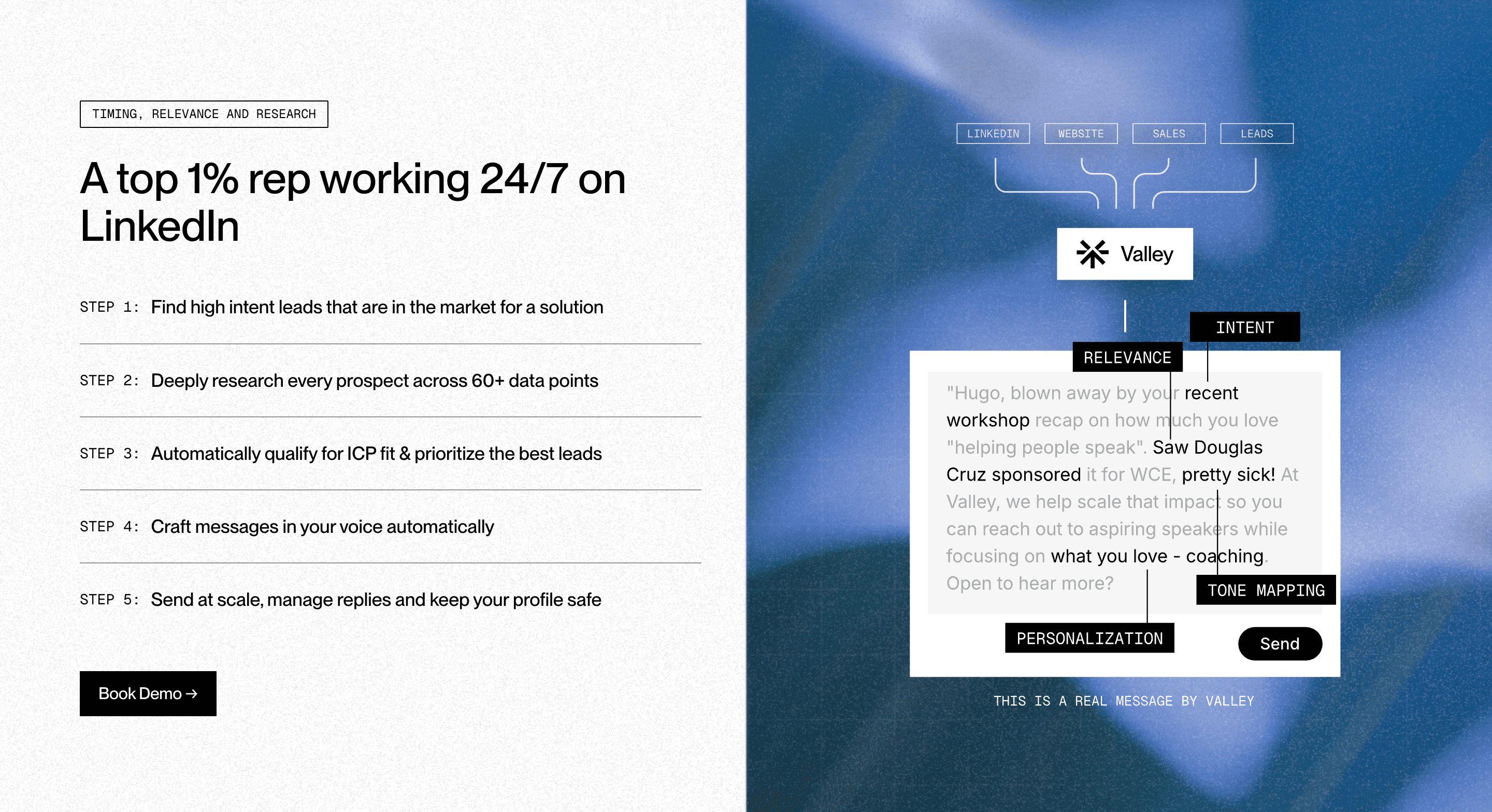
Understanding how Valley converts passive LinkedIn signals into calendar-scheduled meetings requires mapping the full end-to-end workflow that happens automatically in the background.
The 8-Step Signal-to-Meeting Process:
Step 1: Signal Capture (Real-Time)
Valley monitors LinkedIn 24/7 for behavioral signals indicating interest: profile viewer notification arrives → Valley captures within minutes, post engagement happens → Valley logs immediately, website visitor lands on site → Valley identifies company in real-time, company page follow occurs → Valley records the action, competitor content engagement → Valley tracks within hours.
This continuous monitoring ensures no signal goes unnoticed.
Step 2: Instant Enrichment (30-60 Seconds)
When signal captured, Valley immediately enriches: pulls full LinkedIn profile data (name, title, company, location, experience), matches to business databases (company size, industry, revenue, funding), identifies email and phone when available (for multi-channel option), appends technology stack data (tools they use), searches recent news (funding, expansion, executive changes).
Enrichment completes before human ever sees the prospect.
Step 3: ICP Qualification (10-20 Seconds)
Valley scores prospect against your ICP criteria: company size match (within target range?), industry relevance (in target verticals?), role and seniority (decision-maker level?), geographic fit (in target markets?), technology indicators (using compatible or competitive tools?).
Output: "Best Fit" (score 80-100), "Okay Fit" (50-79), or "Not a Fit" (< 50).
Only qualified prospects proceed to outreach.
Step 4: Deep AI Research (2-5 Minutes)
Valley's 7-LLM architecture analyzes 25+ sources: role-specific pain points (what challenges does this person typically face?), company stage analysis (seed vs. growth vs. mature challenges), trigger events (recent changes creating urgency?), competitive context (using competitive tools?), content interests (what topics do they engage with?), conversation starters (specific personalization points).
This research would take human 15-20 minutes. Valley completes in minutes automatically.
Step 5: Personalized Message Generation (30-60 Seconds)
AI generates customized message in your voice: references the specific signal that triggered outreach, incorporates relevant research insights, matches your configured tone and style, includes appropriate CTA based on signal type, stays within optimal length (60-100 words typically).
Message appears in approval queue for your review.
Step 6: Human Approval or Auto-Send (Variable)
Depending on configuration: manual approval mode: rep reviews and approves/edits each message (typical during training), selective approval: only best-fit prospects require review (post-training optimization), autopilot mode: AI sends automatically after confidence threshold met (mature usage).
Step 7: Outreach Execution (Immediate)
Once approved, Valley sends via optimal method: connection request for 2nd/3rd degree connections (free method), InMail for beyond 3rd degree closed profiles (uses credits), free InMail for open profiles (Valley's exclusive detection), direct message if already connected (existing relationship).
Message delivers to prospect's LinkedIn inbox.
Step 8: Response Monitoring & Meeting Booking (Ongoing)
Valley tracks responses in real-time: positive response → alerts rep immediately for engagement, meeting request → calendar link provided automatically, questions → rep responds with context from research, negative response → adds to DNC, stops sequence, no response → triggers Touch 2 in sequence after 5-7 days.
When prospect books meeting: Calendar integration captures the booking, meeting appears on rep's calendar, Valley logs conversion for attribution, prospect exits sequence (success), CRM updated with meeting activity (if integrated).
Total Timeline: Signal to Meeting
Fastest case: Same-day website visitor signal → outreach within hours → immediate response → meeting booked same day (6-12 hours total).
Typical case: Profile viewer signal → outreach next day → response after 2-3 days → meeting scheduled for following week (7-14 days total).
Slower case: Post engagement → outreach day after → no initial response → Touch 2 after week → response → meeting booked (14-21 days).
Average across all signals: 10-12 days from signal capture to meeting completion.
► Book a demo and explore how Valley can support your use case

How Does Valley's Calendar Integration Work for Meeting Booking?
Frictionless meeting scheduling dramatically improves conversion from interested response to booked meeting. Valley's calendar integration removes scheduling back-and-forth.
Calendar Link Configuration:
Connect your calendar to Valley (Google Calendar, Office 365, Outlook): authorize one-time access via OAuth (secure, no password storage), set availability preferences (meeting hours, buffer time, max per day), define meeting types (15-min intro, 30-min discovery, 60-min deep-dive), customize booking pages (company branding, meeting descriptions).
Dynamic Calendar Links in Messages:
Valley inserts calendar links contextually: initial message (high-intent signals only): "Here's my calendar if you'd like to schedule: [link]", Touch 2 follow-up (if positive engagement shown): "Let's find time to discuss. Grab a slot here: [link]", response to positive reply: "Great! Here's my calendar to schedule: [link]".
Links are unique per prospect, tracking who books what.
Meeting Type Intelligence:
Valley suggests appropriate meeting length based on: signal strength (high-intent → full 30-min discovery), prospect seniority (C-level → respect their time, offer 15-min), stage of conversation (initial contact → shorter, deep interest → longer).
Configuration example: Pricing page visitors → auto-suggest 30-min demo slot, profile viewers → offer 15-min intro call, executive prospects → 15-min option with 30-min alternative.
Automated Confirmation & Reminders:
When prospect books meeting: instant confirmation email sent (Valley + calendar integration), meeting added to both calendars automatically, reminder sent 24 hours before (reduce no-shows), reminder sent 1 hour before (further reduce no-shows), prospect receives joining instructions (Zoom link, phone number, etc.).
No-Show Handling:
If prospect doesn't join: Valley auto-sends follow-up: "Looks like we missed each other for our scheduled call. Want to reschedule? Here's my calendar: [link]", tracks no-show rate by signal source (which signals have highest show rates?), rep can manually reschedule or pause engagement.
Show Rate Data:
Valley users report: overall show rate: 70-80% (industry standard 60-70%), high-intent signal meetings (pricing page, 3+ profile views): 80-85% show rate, medium-intent signals (post engagement, single profile view): 70-75% show rate, lower-intent signals (company follows, single likes): 60-70% show rate.
Reminder system improves show rates ~10-15% vs. no reminders.
What Factors Most Impact Signal-to-Meeting Conversion Rates?
Not all signals convert equally. Understanding conversion drivers helps optimize Valley configuration for maximum meetings.
Signal Quality (Biggest Factor):
Conversion rates by signal type: pricing page visitors: 15-25% book meetings (very high intent), 3+ profile viewers: 12-18% (sustained interest), post commenters: 10-16% (active engagement), post sharers: 10-15% (endorsement signal), website visitors (general): 8-12% (moderate intent), 2-time profile viewers: 6-10% (some interest), single profile viewers: 4-6% (casual research), single post likes: 2-4% (passive acknowledgment), company page follows: 2-3% (low intent).
Prioritize high-intent signals for best conversion.
Response Speed (Critical Factor):
Time from signal to first outreach: same-day outreach: 12-20% meeting rate, next-day outreach: 8-14% meeting rate, 2-3 day delay: 6-10% meeting rate, week+ delay: 3-5% meeting rate (approaching cold outreach levels).
Speed matters enormously—especially for website visitors and repeat profile viewers where intent is time-sensitive.
Personalization Quality (Meaningful Impact):
Generic outreach: 4-6% meeting rate ("I saw you viewed my profile. Want to connect?"), moderate personalization: 8-12% meeting rate ("I noticed you viewed my profile and engaged with content about LinkedIn outbound..."), deep personalization: 15-22% meeting rate ("I saw you viewed my profile 3 times this week, engaged with my post about ROI measurement, and someone from [Company] visited our pricing page. Seems like relevant timing given your recent [trigger event]...").
Valley's AI research enables deep personalization at scale.
ICP Fit (Qualification Factor):
Conversion by ICP score: best fit (80-100 score): 18-25% meeting rate, good fit (60-79 score): 10-15% meeting rate, okay fit (40-59 score): 5-8% meeting rate, poor fit (<40 score): 2-3% meeting rate.
Tight ICP qualification dramatically improves conversion efficiency.
Follow-Up Persistence (Multiplier):
Single-touch campaigns: 6-8% meeting rate, two-touch sequences: 10-14% meeting rate (70-100% improvement), three-touch sequences: 14-20% meeting rate (150-250% improvement).
Systematic follow-up multiplies results.
Sender Credibility (Baseline Factor):
Prospects convert better when sender has: complete LinkedIn profile (professional photo, detailed experience), active LinkedIn presence (regular posting, engagement), established network (500+ connections), relevant expertise (profile matches what you're selling), recommendations and endorsements (social proof).
Invest in LinkedIn profile optimization before scaling Valley.
► Check Out More of Valley's Incredible Outreach: A compilation of real time messages and responses!

How to Diagnose and Fix Low Meeting Conversion Rates?
When Valley generates responses but meetings don't materialize, systematic diagnosis identifies the bottleneck.
Diagnostic Framework:
Problem 1: Low Response Rates (<5%)
Symptoms: Prospects contacted but not replying
Likely causes: Poor signal quality (targeting wrong people), weak personalization (generic messaging), ICP misalignment (wrong prospects entirely), message timing (sending at poor times).
Fixes: Tighten ICP criteria (focus on best-fit only), improve AI training (better personalization), test message variations (A/B test approaches), optimize send timing (shift to peak engagement windows).
Problem 2: Responses But No Meeting Bookings
Symptoms: 10%+ response rate but <30% convert to meetings
Likely causes: Weak CTAs (not asking for meeting clearly), response handling delay (slow to reply to interested prospects), friction in scheduling (no calendar link, requires back-and-forth), qualification issues (attracting curious non-buyers).
Fixes: Strengthen CTAs (clear calendar links in responses), set response time SLAs (reply within 4 hours max), embed calendar links prominently, re-qualify prospects in conversation before pushing meeting.
Problem 3: Meetings Booked But High No-Show Rates
Symptoms: >30% no-show rate
Likely causes: Too much time between booking and meeting (people forget), poor reminder system (no nudges before meeting), low prospect qualification (not serious buyers), wrong meeting length (asking for too much time).
Fixes: Reduce booking-to-meeting gap (offer slots within 3-5 days), enable automated reminders (24hr + 1hr before), qualify harder before booking, offer shorter initial meetings (15 min vs 30 min).
Problem 4: Good Metrics But Low Absolute Volume
Symptoms: 15%+ response, 30%+ meeting conversion, but only 5 meetings/month
Likely causes: Insufficient signal volume (not enough prospects in funnel), overly narrow ICP (missing viable prospects), underutilization (not running enough campaigns), low LinkedIn presence (not generating signals).
Fixes: Expand signal sources (more campaign types), broaden ICP slightly (capture more prospects), increase content frequency (more signals generated), add team members (more seats = more signals).
Optimization Process:
Weekly review: Track response rates, meeting booking rates, show rates by signal source and campaign.
Monthly optimization: Identify underperforming campaigns, test improvements, double down on winners, cut or fix losers.
Quarterly strategy: Reassess ICP based on what actually converts, refine messaging based on response data, adjust signal prioritization based on conversion rates.
What Meeting Booking Best Practices Maximize Valley's Results?
Beyond Valley's automation, sales team practices determine ultimate conversion success.
Response Time Discipline:
When Valley alerts you to positive response: respond within 4 hours (same business day minimum), have calendar link ready (don't make them wait for availability), personalize response using Valley's research context, propose specific meeting time if unclear from their reply.
Example: Prospect replies "This sounds interesting, want to learn more."
Poor response (next day): "Great! Let's schedule time. What works for you?"
Strong response (within 2 hours): "Excellent—based on [research point], I think you'll find [specific aspect] particularly relevant to [Company]'s situation. I have slots tomorrow at 2 PM or Thursday at 10 AM if either works: [calendar link]"
Meeting Confirmation Quality:
When meeting books: send immediate personalized confirmation (not just auto-calendar invite), preview what you'll discuss (set expectations, show preparation), send relevant resource ahead of time (case study, framework, one-pager), confirm you'll respect their time (start/end on schedule).
This preparation increases show rates and meeting quality.
Pre-Meeting Research:
Before each meeting, review Valley's research: refresh on signal that triggered outreach (what interested them?), review their company's recent news (anything new since initial outreach?), prepare 3-4 relevant questions (based on role and challenges), identify conversation pathways (discovery, demo, or consultation?).
Valley research provides foundation—rep adds recent developments.
Meeting Structure:
Effective discovery meetings from Valley-sourced prospects: Context confirmation (1-2 min): "You engaged with my post about [topic] and visited our pricing page. What specifically caught your attention?", Situation understanding (5-7 min): "Tell me about how you're currently approaching [challenge]...", Solution exploration (5-7 min): "Based on what you've shared, here's how we help teams in similar situations...", Next steps (1-2 min): "Does this seem relevant? If so, I'd suggest [specific next step]."
Total: 15-20 minutes for intro meetings, respect their time.
Post-Meeting Follow-Up:
After meeting concludes: send recap within 2 hours (key points discussed, agreed next steps), share promised resources immediately (don't make them wait), schedule follow-up meeting before leaving current meeting (maintain momentum), log detailed notes in CRM (for team visibility and attribution).
Meeting Quality Metrics:
Track not just meeting volume but meeting quality: qualified opportunity rate (% of meetings that become real opps): target 60-70%, proposal rate (% of meetings leading to proposals): target 40-50%, close rate (% of meetings that ultimately close): target 25-35%, average deal size from Valley meetings: compare to other sources.
Quality matters as much as quantity.
Valley transforms LinkedIn from passive professional network into active meeting generation engine, systematically capturing signals, qualifying prospects, personalizing outreach, and converting interested responses into calendar-scheduled meetings that drive pipeline and revenue.
► Here's the Valley Warm Outbound Launch Video which I spent way too much money on.

Related Blogs

FEATURED READ
5 min
Valley vs HeyReach: Which LinkedIn Outreach Tool Wins More Qualified Meetings?
Read
Read

FEATURED READ
5 min
Valley in 2026: Is the Price Worth the Pipeline?
Read
Read

FEATURED READ
5 min
Valley vs Dripify: Which LinkedIn Outreach Tool Actually Converts in 2026?
Read
Read

FEATURED READ
5 min
Valley vs. Hiring an SDR: The Real Cost and ROI Breakdown for 2026
Read
Read
Which channels does Valley support?
Valley supports LinkedIn outreach, including connection requests and InMails. Valley users safely send 1000-1200 messages per seat every month.
How safe is it and does Valley risk my LinkedIn account?
Do I have to commit to an Annual Plan like other AI SDRs?
How does Valley personalize messages?
Is Valley available in my country?

VALLEY MAGIC