
Try Valley
Put your outbound workflow to work.

Zayd Ali
Published:
Updated:
Published June 6, 2026 · Updated August 31, 2026
A few weeks ago I got a no after a call I thought had gone perfectly.
The prospect was engaged, asking smart questions, taking notes. We ended with a clear next step. I sent the follow-up within the hour. They ghosted for two weeks and came back with a polite, vague pass.
I spent days trying to figure out what I’d missed. An objection I didn’t handle? A competitor who got there first? Wrong timing?
Eventually I found out through a mutual contact that they had made up their mind halfway through the demo. Something I said about our implementation process set off an alarm that never got resolved. By the time I was wrapping up the call feeling great about it, they had already moved on mentally.
That gap, between when a prospect decides and when they tell you, is one of the least talked-about problems in sales.
The Decision Happens Earlier Than You Think
Most sellers are trained to think of the close as the end of the conversation. That is not how buyers actually work.
Research on how buyers make decisions consistently shows that the emotional verdict arrives long before the rational justification does. People decide based on a feeling and then spend the rest of the conversation finding reasons to support it.
By the time your prospect is asking about implementation timelines or contract terms, many of them have already landed somewhere.
The problem is that the signals are subtle. A prospect who has mentally checked out does not usually tell you. They keep engaging. They ask follow-up questions. They take your materials. They schedule a second call. They are doing the polite version of a yes that eventually becomes a quiet no.
btw, get Enabled in your inbox each week
My favorite finds of the week:

Give your sales team
an unfair advantage.
After hundreds of sales conversations across two agencies and Valley, here is what to watch for.
A Shift in Question Type
Early in a call, engaged prospects ask expansive questions. They are trying to understand possibility. When the questions get narrow and procedural, the prospect is either deeply interested or has already decided and is looking for a reason to confirm it.
Hedged Language
When someone who was saying “we” starts saying “I” or “the team would need to,” they are mentally stepping back. They have stopped imagining themselves as the buyer.
The Fake Enthusiasm Close
“This looks really interesting, send me a follow-up.” Said at the end of almost every call where the prospect wants to end the conversation without conflict. Not always a death sentence, but often one.
💡 LinkedIn Tip of the Week
Your connection acceptance rate affects your Social Selling Index (SSI). High SSI means better algorithm treatment. Protect your acceptance rate by only sending requests to people likely to accept.
What You Can Actually Do About It
The goal is to surface the real conversation earlier, so you are not performing for someone who has already left.
Name the Moment Midway Through
Halfway through a demo, ask something like: “Based on what you have seen so far, is this directionally what you were hoping for?”
That question forces a genuine response. If the answer is warm, keep going. If it is hesitant, you have just learned something that would have cost two more weeks of follow-up to find out.
Build Objections Into the Conversation Early
Stop treating objections as something that shows up at the end.
“What would make this a no for you?” asked early enough actually builds trust. It signals that you are not afraid of the hard question. It also surfaces the thing that might be silently killing the deal while you are busy presenting features.
Stop Talking After You Ask a Question
Most sellers rush to fill silence. The silence after a real question is usually where the honest answer lives. Ask it and wait.
(Insert image: simple diagram showing the three intervention points: mid-demo check-in, early objection surfacing, and silence after a direct question)
🎁 Gift Resource
2026 Guide to LinkedIn Outreach with InMail changes and safety checklist: claim it here

Give your sales team
an unfair advantage.
Sometimes you do everything right and still lose the deal because the decision happened before you even got the meeting.
The prospect’s last vendor left them with a bad experience. Their budget conversation went sideways the week before. Their internal champion moved to a new role.
You cannot control any of that. What you can control is how quickly you get to the real conversation, so you stop investing in deals that are not actually alive.
The goal is not to win every deal. It is to find out which ones are real before spending weeks on the ones that were never going to close.
See more of Valley’s outreach examples: coolmessagebro.com
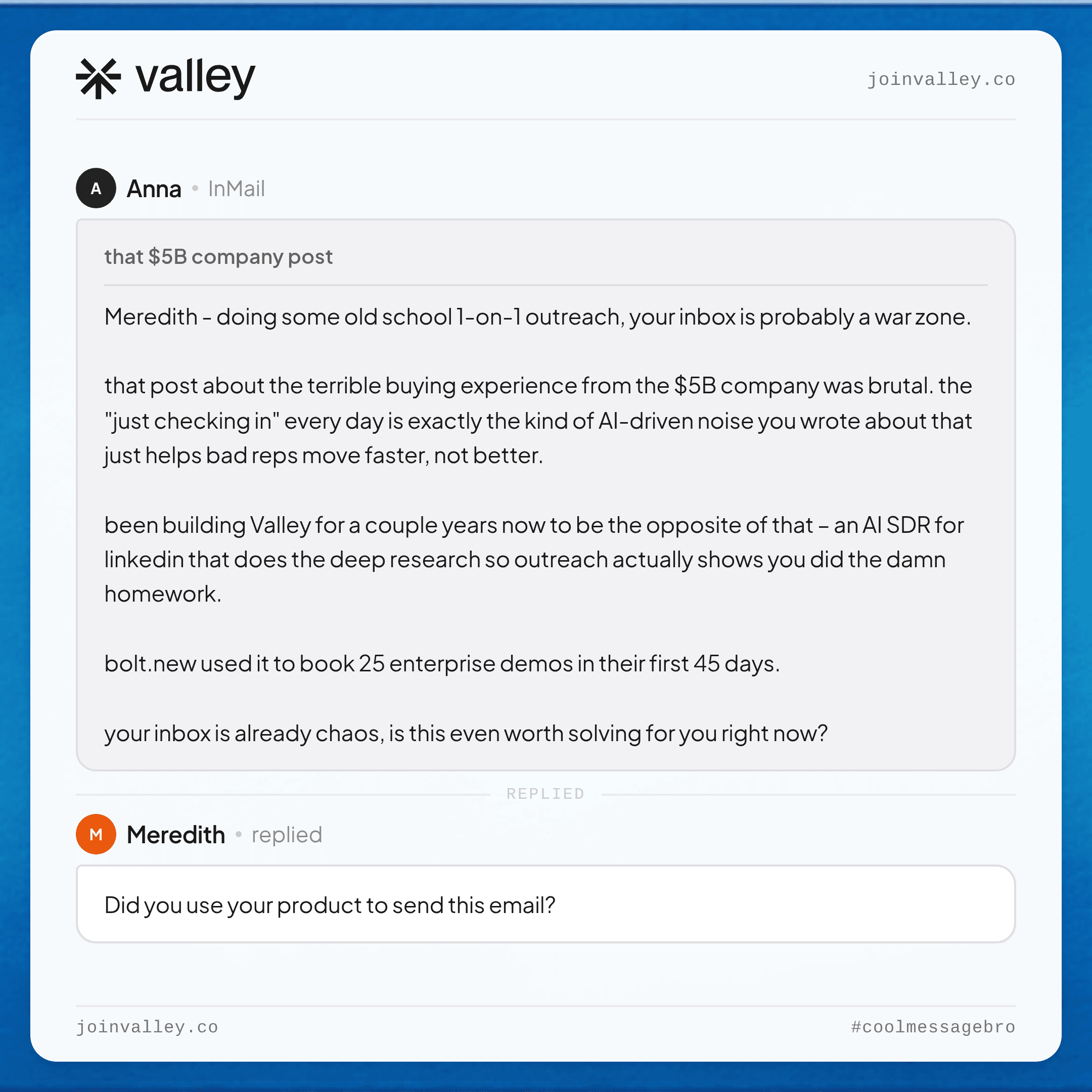
Generate more demos using LinkedIn: Book here
Become a Valley partner and earn 20% recurring commission: Join the affiliate program
► Book a demo: see how Valley would find, research and message your buyers
Frequently Asked Questions
Why do prospects keep engaging after they have already decided not to buy? Most buyers avoid direct conflict, especially in professional settings. After mentally deciding against a purchase, prospects often continue asking questions, taking materials, and scheduling follow-up calls out of politeness. They are performing a soft yes while building toward a quiet no. This is why the gap between the actual decision and the formal rejection can be weeks long.
What are the early signs a prospect has mentally checked out of a sales conversation? Three reliable signals: a shift from expansive, possibility-oriented questions to narrow, procedural ones; a language shift from “we” to “I” or “the team would need to,” which indicates the prospect has mentally stepped out of the buyer role; and the fake enthusiasm close (“this looks really interesting, send me a follow-up”) used to end a conversation without direct conflict.
How do you surface a prospect’s real objections earlier in the sales process? Ask “what would make this a no for you?” early in the conversation rather than waiting for objections to surface at the end. This builds trust by signaling you are not afraid of the hard question, and it draws out the concern that might otherwise silently kill the deal while you keep presenting features. The earlier you surface a real objection, the more time you have to address it.
What is the mid-demo check-in question and why does it work? Asking “based on what you have seen so far, is this directionally what you were hoping for?” midway through a demo forces a genuine response rather than polite engagement. A warm answer confirms you are on track. A hesitant answer surfaces a problem you can address in real time rather than discovering it two weeks later through a ghosted follow-up.
What should you do when you lose a deal you thought was going well? Try to understand what signal you missed rather than attributing it entirely to timing or competition. Common causes include an unresolved concern from the implementation or onboarding discussion, a budget or internal politics shift that happened before the meeting, or a lost internal champion. Focus on identifying the gap between the prospect’s emotional decision point and the moment you realized it, and look for earlier intervention points in future conversations.
Related: how Valley works.
See also: Why Your Sales Team Should Run Like a Research Lab: The 100-Prospect Experiment · Best AI LinkedIn Chrome Extension for Sales & LinkedIn Prospect Outreach · Valley vs. Expandi: preparing the prospect and executing the sequence


