SaaS Conversion Rate Optimization: What D2C Marketers Know That B2B Don"t

Try Valley
Make LinkedIn your Greatest Revenue Channel ↓

Saniya
Published:
Updated:
SaaS Conversion Rate Optimization: What D2C Marketers Know That B2B Don't
Published May 6, 2026 · Updated August 31, 2026
Expedia deleted one form field and made $12 million more per year.
That field was "Company Name." Users were entering their bank's name, causing address mismatches.
One field. $12M.
Your SaaS signup page still asks for your blood type.
► Book a demo (teams of 5+)and explore how Valley can support your use case
The Gap Between D2C and B2B SaaS Conversion Thinking
D2C marketers are 10 years ahead of B2B marketers. They've been obsessing over consumer psychology, running millions of A/B tests, and optimizing every pixel of every checkout flow since 2010.
B2B SaaS? Most teams are still running signup pages designed in 2018 and wondering why nobody converts.
If you put a D2C growth lead from Allbirds in a room with your SaaS funnel, here's what they'd fix in the first week.
Signup Flow
Reduce form fields from 11 to 4. HubSpot analyzed 40,000 landing pages and found this single change increases conversion 120%.
Add Google or social login. This lifts signups 20 - 40%. The password field has the highest abandonment rate of any form element.
Stop forcing account creation. 24 - 26% of users leave when required to create an account before experiencing value. When ASOS moved to guest checkout, cart abandonment dropped 50%.
Think about your own signup page right now. How many fields? If it's more than 5, you're leaving money on the table.
Pricing Page
Pre-select a "Most Popular" plan. This increases conversion 18 - 20%. The default effect is powerful enough that opt-out organ donation countries have roughly double the donor rates of opt-in countries. Your pricing page should have a default.
Switch to first-person CTAs. "Start my free trial" outperforms "Start your free trial" by 90%. Same words, different frame.
Microcopy
Three lines. 17 - 25% lift. This is the lowest-effort, highest-ROI change on the entire list:
"No credit card required" addresses cost fear
"Cancel anytime" addresses lock-in fear
"Takes less than 1 minute" addresses time fear
Together, these three lines lift trial completions 17 - 25%.
Sticky CTAs on mobile (pinning the signup button to the bottom of the screen) beat every control tested. Minimum 8% lift. One test recorded a 252.9% increase in order completion.
Onboarding
The baseline is brutal. Average SaaS activation rate is 37.5%. The median is 25%. Three out of four signups never reach the aha moment.
Start your progress bar at 20% complete. Account created equals automatic progress. This alone increases completion speed by 20%.
Every extra minute in time-to-first-value lowers conversion roughly 3%. Canva gets users creating in 10 seconds. Notion delivers value in 60. What's your number?
(Insert image: onboarding progress bar starting at 20% vs. 0%, showing the psychological difference in perceived momentum)
Recovery
Welcome emails get 4 - 5x higher open rates than any other email you'll send. Revenue per recipient averages $2.35. If your welcome email is a generic "thanks for signing up," you're wasting your single best touchpoint.
Abandoned trial emails recover 10.7% of lost revenue. Send the first one at 30 - 60 minutes after abandonment. Not the next day.
Annual billing reduces monthly churn from roughly 10% down to 2.5%. But frame it correctly: "Save 2 months free" feels like a gift. "Save 17%" feels like math. Same offer. Completely different emotional response.
We're testing the annual billing reframe at Valley right now. Reply if you want to know how it's going.


How These Stack
Each of these changes individually gives you 5 - 25%. Stack 10 - 15 of them and you're looking at 2 - 5x total conversion improvement across your funnel.
That's the difference between a 2% trial-to-paid rate and a 10% one.
Area | Change | Estimated Lift |
|---|---|---|
Signup | Reduce fields to 4 | +120% |
Signup | Add social login | +20 - 40% |
Pricing | Pre-select default plan | +18 - 20% |
Pricing | First-person CTA | +90% |
Microcopy | 3 fear-removing lines | +17 - 25% |
Microcopy | Sticky mobile CTA | +8 - 252% |
Onboarding | Progress bar starts at 20% | +20% completion speed |
Recovery | Abandoned trial email (30 - 60 min) | +10.7% revenue recovery |
Recovery | Annual billing reframe | Churn: 10% to 2.5% |
How Valley Fits In
Getting more users to convert is one side of the equation. Getting the right users into the top of your funnel is the other.
Valley is an AI-powered LinkedIn outreach engine that identifies warm prospects (profile viewers, post engagers, website visitors, competitor signals), qualifies them against your ICP, and sends personalized outreach automatically. Real campaigns average 3x better results than standard outreach.
Better top-of-funnel quality means every conversion optimization you implement works harder on the right people.
(I'll also show you our real campaigns averaging 3x better results than regular outreach.)
Frequently Asked Questions
How many form fields should a SaaS signup page have?
Research across 40,000 landing pages by HubSpot found that reducing form fields from 11 to 4 increases conversion by 120%. As a rule, keep it to 4 fields or fewer and offer Google or social login to reduce password friction further.
Does adding "No credit card required" actually improve conversions?
Yes. Microcopy addressing the three core fears (cost, lock-in, and time) lifts trial completions by 17 - 25%. "No credit card required" removes cost fear, "Cancel anytime" removes lock-in fear, and "Takes less than 1 minute" removes time fear. All three together have the highest ROI of any single copy change on the page. The counter-model is worth knowing too: card-required trials convert the visitors who do start at roughly three times the rate of opt-in trials - Valley itself runs a 7-day card-required trial for exactly that reason. The microcopy trade-off depends on which failure you can afford.
What is the average SaaS activation rate?
The average SaaS activation rate is 37.5% and the median is 25%. That means 3 out of 4 users who sign up never reach the aha moment. Reducing time-to-first-value is the highest-leverage onboarding investment most SaaS teams can make.
Why does starting a progress bar at 20% help onboarding completion?
It's the goal gradient effect: people work harder the closer they feel to completing something. Starting a progress bar at 20% (triggered by account creation) makes users feel they've already begun, which increases completion speed by 20% in tested implementations.
How should SaaS companies frame annual billing?
Frame it as "Save 2 months free" rather than "Save 17%." The first feels like a concrete gift; the second feels like arithmetic. The underlying offer is identical, but the emotional framing drives significantly higher annual plan adoption. Annual billing also reduces monthly churn from roughly 10% to 2.5%.
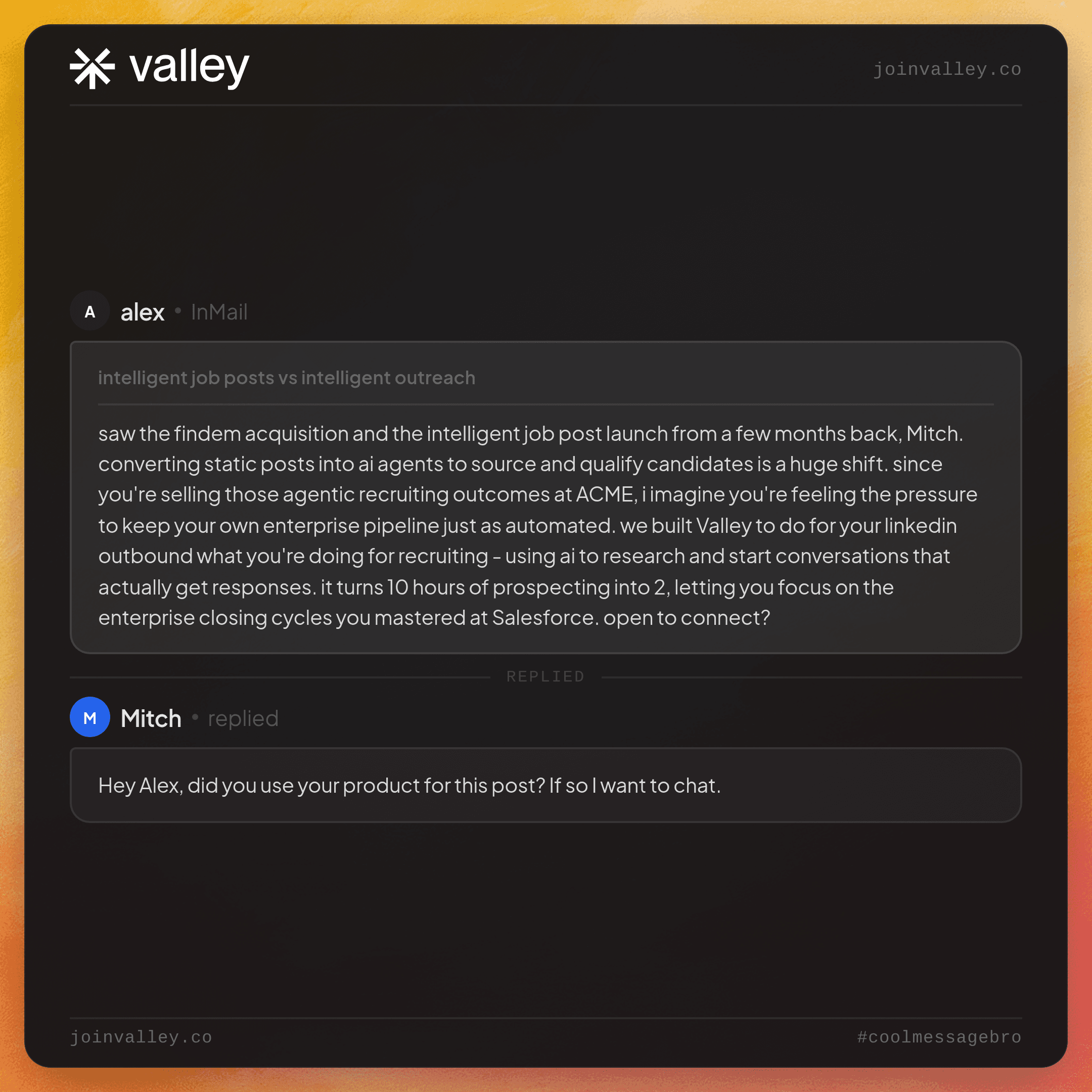
See more of Valley's outreach examples: coolmessagebro.com
Generate more demos using LinkedIn: Apply here
Become a Valley partner and earn 20% recurring commission: Join the affiliate program
Check if Valley is a fit for your company: Take the assessment

Related Blogs

FEATURED READ
5 min
ZoomInfo Pricing Explained (2026): What It Actually Costs
Read
Read

FEATURED READ
5 min
Apollo Pricing and Credits Explained (2026): What You Actually Pay
Read
Read

FEATURED READ
5 min
Clay Pricing and Credits Explained (2026): The Post-March Math
Read
Read

FEATURED READ
5 min
LinkedIn Sales Navigator Cost Explained (2026): Every Tier, Real Numbers
Read
Read
Which channels does Valley support?
Valley supports LinkedIn outreach, including connection requests and InMails. Valley users safely send 1000-1200 messages per seat every month.
How safe is it and does Valley risk my LinkedIn account?
Do I have to commit to an Annual Plan like other AI SDRs?
How does Valley personalize messages?
Is Valley available in my country?

VALLEY MAGIC