
Try Valley
Put your outbound workflow to work.

Zayd Ali
Published:
Updated:
Published April 18, 2026 · Updated August 31, 2026
It feels a little world’s smallest violin to talk about how hard the weeks after you get to $1M ARR are, but the challenges that come after are so different.
The stakes are just…higher.
There are entire podcasts dedicated to The Journey. There are twitter threads and newsletter breakdowns (guilty), but when the chaos settles, the reality is that you’re just left to sit with the problems that didn’t disappear like you thought they would. Those problems just mutated, and the things that got you to $1M start actively working against you. Half of the skills you honed as a scrappy 0 to 1 founder, end up becoming liabilities.
After living this transition, I wanted to share what actually changes once you cross that line, because almost nothing I read prepared me for it.
Zayd’s Picks
My favorite finds of the week
Key to a valuable lead magnet people can’t refuse (link)
Tools to generate 200+ demo calls every month (link)
5 important learnings from the founder of Default (link)
2 must-dos to revive your open rate (link)
Don’t sell through users to get buyers (link)
Habits that lead to PMF with founder-led sales (link)
► A playbook needs an engine; Valley is free for 7 days, every feature on

Give your sales team
an unfair advantage.
1. Your "Do Everything" Instinct Becomes a Bottleneck
Pre-$1M, the founder who touches everything is an asset. You're in the sales calls, the product decisions, the customer onboarding, the marketing copy. Your involvement is what ensures quality and speed.
Post-$1M, that same instinct becomes the thing that slows everything down. The company has more customers, more support tickets, more partnership requests, more inbound leads, and more product complexity than any one person can meaningfully touch.
I wrote about this in the Anti-Playbook; how I spent October 2024 trying to "operate" instead of doing what I'm actually good at, which is selling, but the deeper lesson is that crossing $1M forces you to choose what you're going to stop doing (no, “delegating” doesn’t count because that still means you're managing it - I tried it - “tried” being the operative word). Some things need to happen without your involvement entirely.
For me, that meant letting someone else own operations completely. The quality dipped for a few weeks while they found their footing which was uncomfortable, but it was ultimately so necessary.
2. Your Early Hires Hit Their Ceiling
This is the one nobody wants to talk about because it feels like a betrayal. The people who got you to $1M, the ones who worked insane hours, wore twelve hats, and were there when the company was just an idea…may not be the people who get you to $5M.
Sometimes the job literally changes and they just aren’t the best fit for the new one. It SUCKS. I don’t think I will ever fully get used to the feeling, and I am so grateful to everyone that has been a part of the journey so far, but the skills needed to take a product from 0 to 50 customers are fundamentally different from the skills needed to take it from 50 to 500. One requires scrappiness and improvisation. The other requires systems and repeatability.
At Valley, every time we let someone go during this transition, a key metric improved. The hardest part is just getting to that realization and making the decision fast enough. There will never be a good time. It will always slow down a project, delay a launch, or kill momentum. Your intuition will always say "they're good enough and we need the extra hands." That intuition is almost always wrong.
💡 LinkedIn Hack of the Week:
Someone viewing your profile is a buying signal. Reach out within 24 hours with a message referencing something specific about THEM (not "I saw you viewed my profile").
3. Your Sales Process Needs to Survive Without You in the Room
Pre-$1M, founder-led sales is your superpower. You know the product better than anyone. You understand objections intuitively. You can close deals on vibes and conviction.
Post-$1M, you need other people to close deals, and those people can't run on vibes. They need a process, not a You.
What do we say in the first 5 minutes that earns 20 more minutes?
What are the 3 objections that kill deals, and what's our response to each?
What's the clear next step we propose every single time?
If you can't write those answers down in a way that someone else can execute, you haven't built a sales process. You've built a dependency on yourself.
4. Customer Success Goes from Nice-to-Have to Make-or-Break
When you have 20 customers, you can personally ensure each one gets value. You know their names. You check in proactively. Problems get solved before they escalate.
When you have 100+ customers, you can't do that. This is where churn accelerates if you don't have a real system in place.
The companies that navigate this well invest in customer success before they think they need it. The companies that struggle wait until churn becomes painful, then scramble to hire someone while simultaneously trying to save accounts.
At Valley, one of the questions we kept hearing from prospects was "Will this get my LinkedIn account banned?" That fear was driving churn more than anything else. The fix meant building onboarding and support systems that addressed the fear before it became a cancellation reason.
🎁 Gift from Zayd:
The Ultimate LinkedIn Hook Writing Guide: A Complete System for High-Performing Content: Claim Here
5. The Founder Identity Crisis
This is the one that hit me hardest, and I don't think enough people talk about it.
Pre-$1M, your identity as a founder is wrapped up in doing. You're the one closing deals, making product decisions, writing copy, fielding support tickets. You feel useful because you're everywhere.
Post-$1M, the highest-use thing you can do is often…nothing visible. Setting direction. Removing blockers. Making the one or two decisions per week that actually matter.
That doesn't feel productive. It doesn't feel like "enough." And if you're not careful, you'll start inserting yourself back into processes just to feel busy (which is exactly what I did in October 2024, and it nearly sank us).
The transition from "doer" to "decision-maker" is more of a psychological challenge than a tactical one. Nobody prepares you for the day when the best thing you can do for your company is step back.

Give your sales team
an unfair advantage.
If you’re approaching or just crossing $1M, here’s what I’d do now that I didn’t do then:
Audit your time for one week. Track every hour. How much is spent on things only you can do vs. things you’re doing because you always have? The ratio should be at least 60/40 in favor of “only me” work. If it’s not, you’re the bottleneck.
Have the honest conversation with each team member. Not a performance review. A role-evolution conversation. “The company is changing. Here’s what the next 6 months require. Are you excited about that, or does it feel like a different job than what you signed up for?” Sometimes the answer reveals what a performance review never would.
Document your sales process before you try to hand it off. Record your next 10 sales calls. Transcribe them. Find the patterns. Write down the 5 things you do instinctively that someone else would need to be taught explicitly.
Build customer success infrastructure at 60% of capacity, not 100%. If you wait until you need it, you’re already behind. The support systems should feel slightly over-resourced. They won’t be for long.
Give yourself permission to feel weird about it. The transition is uncomfortable. Your role is changing. Your relationship to the company is changing. That’s normal. The founders who pretend it’s fine are the ones who quietly burn out or sabotage their own company by refusing to evolve.
Crossing $1M is a milestone worth celebrating. Just know that the celebration is brief, and the next set of problems is already at the door.
The good news is that these are better problems to have.
How can we work together 🏔️
See more of Valley’s messaging examples, feel free to roast them: https://coolmessagebro.com/
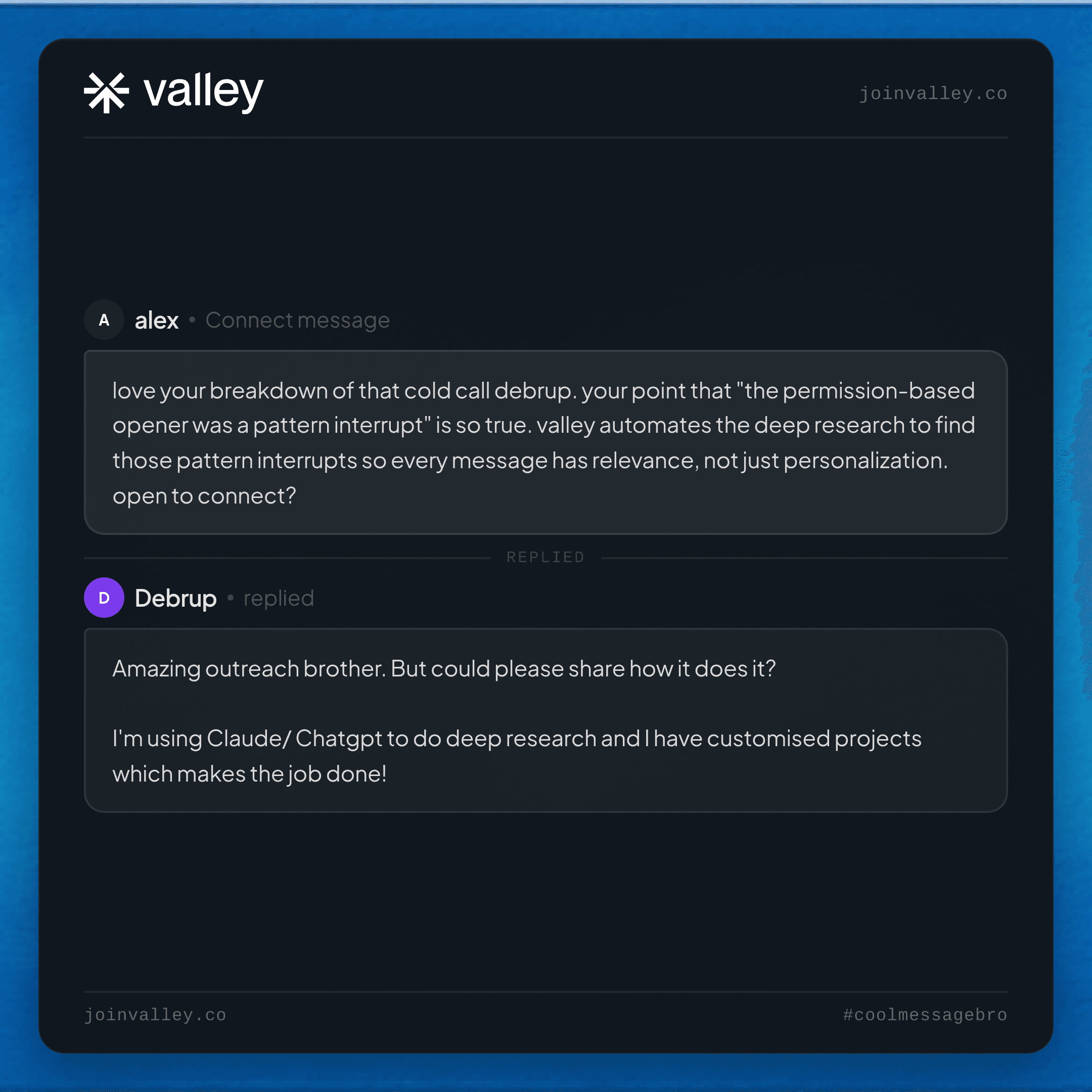
Generate more demos for your company using LinkedIn: https://meetings.hubspot.com/zayd-from-valley/tryvalley
Become a Valley partner and get 20% recurring commission for every user you bring in: https://withvalley.notion.site/valley-affiliate-partner-program
Related: how Valley works.
► This system works best with signals attached: Valley supplies them, free for 7 days
See also: The 7-Day Rule That Saved My First Company from Failing · Valley vs. Dripify: full prospect research or sequence-first outreach? · Email or LinkedIn First? Building the Multi-Channel Outbound Cadence (2026)


