Try Valley
Put your outbound workflow to work.

Valley editorial team
Published:
Updated:
By the Valley editorial team · Reviewed September 14, 2026
Valley publishes this comparison, based on current vendor documentation and editorial buying analysis. Workflow examples are evaluation guides; no hands-on comparative testing is claimed.
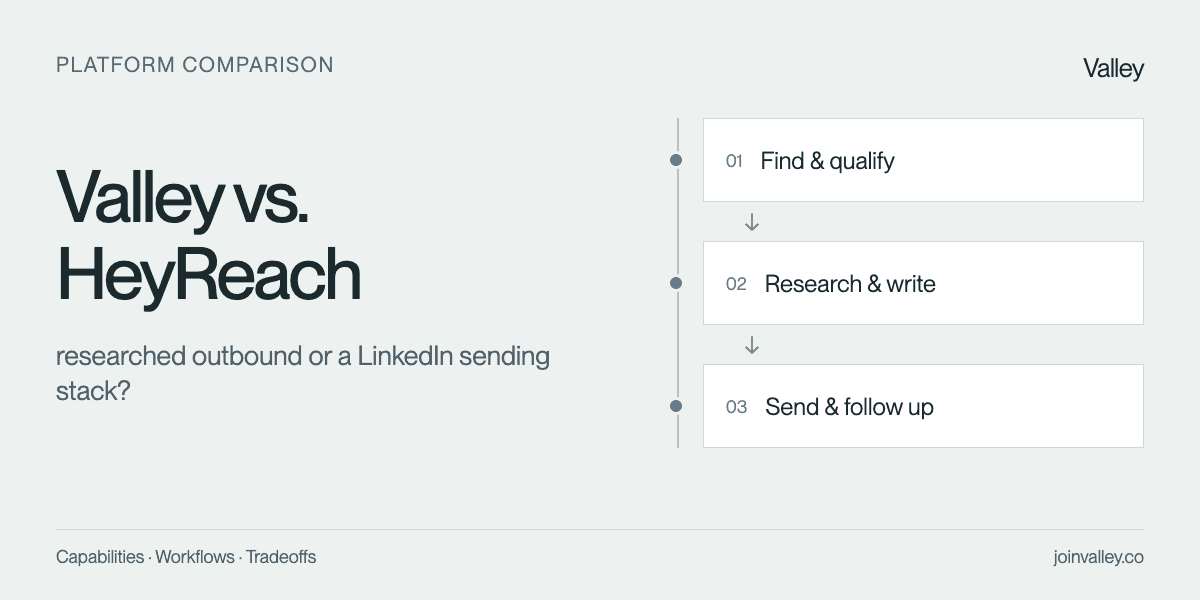
Choose Valley when preparing a qualified audience and a relevant message is the work you need help finishing. Choose HeyReach when you already have that preparation covered and need to operate LinkedIn outreach across multiple senders or client accounts.
The purchase begins before the connection request
A founder with one LinkedIn account and an agency with twenty client accounts are buying different things. The founder needs to decide whom to contact, why that person fits, and what is worth saying. The agency may already have researchers, a data workflow and approved copy; it needs reliable execution and ownership of replies. Count the handoffs in your own process before comparing subscription totals.
HeyReach documents sender rotation, a unified LinkedIn inbox and connections to email platforms. Those are useful capabilities, especially when another system owns targeting. Valley's proposition is the connected preparation-to-conversation workflow. The practical question is whether keeping research, writing and execution together removes meaningful weekly work for your team. Neither architecture establishes a higher reply rate on its own.
Under a stricter workflow definition, sending is HeyReach’s strongest native layer. Its documented signal, qualification and research workflows receive intelligence from other tools. An external AI agent connected through MCP can prepare copy or react to events, but that does not establish a native system that learns the seller’s writing style or revises targeting from campaign outcomes.
Product basis: HeyReach official documentation and Valley product workflow.
Seven stages, with specific capability requirements
Built in means the narrowed capability is documented. Partial coverage means related functionality without the full required depth, or conflicting documentation. External and manual steps remain explicit. Not established means an evidence gap; not available yet is reserved for a documented future feature. The Valley column describes its workflow, while each competitor assessment states the specific documented mechanism.
Stage and requirement | Valley workflow | HeyReach |
|---|---|---|
Live buying signals + discovery Find prospects using multiple current buying-event types; a static contact database or one social trigger alone is insufficient. | Buying signals inform prospect discovery. | Requires another tool: Signals and discovery arrive from Clay, RB2B or other upstream tools. Source |
ICP qualification Evaluate a prospect against configured ICP criteria before outreach; distinguish fit assessment from engagement-only branching. | Fit assessment before campaign enrollment. | Requires another tool: Documented qualification happens upstream before HeyReach receives the lead. Source |
Sourced prospect research Produce substantive prospect-specific open-web findings with inspectable supporting sources; profile fields and generic enrichment alone are insufficient. | Prospect context and supporting sources. | Requires another tool: Research and enrichment are supplied by a connected intelligence layer. Source |
Learned writing style Generate outreach from stored writing examples, style documents, sent-mail history, or learned edits; variables, generic AI copy and acoustic voice cloning alone are insufficient. | Drafts informed by your voice and research. | Requires another tool: External AI agents can create custom messages; native learned written style is not established. Source |
Automated email + LinkedIn Execute both email and LinkedIn outreach automatically within the product; show the two channel dependencies separately. | LinkedIn plus email; email is optional on Starter. | Requires another tool: LinkedIn sending is native; email execution needs a connected sender. Email: Requires another tool. LinkedIn: Built in. Source |
Reply management Provide a native workspace or agent for triaging and responding to inbound prospect replies; report the covered channels. | Campaign replies with prospect context. | Built in: Unified Inbox manages replies across connected LinkedIn accounts. Source |
Outcome-driven improvement Use observed campaign outcomes to update future targeting or messaging automatically; analytics, manual A/B decisions and instruction edits alone are partial. | Campaign results and feedback inform future targeting and messages. | Partial coverage: Reports and API events support operator or external-agent improvement; native outcome learning is not established. Source |
Three differences to weigh
Research and enrichment are supplied by a connected intelligence layer.
External AI agents can create custom messages; native learned written style is not established.
LinkedIn sending is native; email execution needs a connected sender.
A concrete workflow to evaluate
Consider a consultancy approaching operations leaders who recently discussed an implementation problem. In Valley, use that signal to assess fit, inspect supporting context and review a message before activating follow-ups. For a HeyReach evaluation, prepare the same audience in your chosen research tool, carry the approved context into custom fields, and coordinate email through the connected sender. Inspect what happens when a person replies on LinkedIn while an email is queued.
Pricing and packaging
HeyReach Growth lists $79 per sender/month, or $71 per month billed quarterly ($213). Its email workflow uses connected tools, so budget for those subscriptions and research separately. Official pricing / purchase information. Checked September 14, 2026.
Valley is priced per seat: Starter $199/month or $149/month billed quarterly ($447); Plus $299/month or $249/month billed quarterly ($747); Growth $499/month or $419/month billed quarterly ($1,257). Plus includes 1,000 emails/month, priority Slack support and an onboarding call. Those are optional add-ons on Starter. Growth includes everything in Plus and $300 in additional monthly credits. Compare Valley plans.
Compare the same seat count, term and usable workload. Keep prospect discovery, enrichment, email sends, domains, mailboxes and operator time as separate line items. Credits from different products are not interchangeable. Ask what happens at the allowance limit before committing.
Setup and switching
For a switch, export exclusions, contacted profiles, active follow-up states and conversation owners first. Start with one sender and a fresh audience. An agency should additionally check client separation and the effort to assign replies across accounts before replacing an established sending setup.

Customer context
Bolt.new: seven-figure pipeline in under 60 days. Read the Valley customer story for its audience, offer and operating process.
Buyer questions
Is HeyReach only useful for large agencies?
No. A single sender with an effective research process may prefer a focused LinkedIn tool. Valley becomes more compelling when that sender also needs help with qualification, research and message preparation.
How should we make the final decision?
Take a small, fixed audience and one approved offer into both demonstrations. Inspect source accuracy, exclusions, message usefulness, reply ownership and the time spent correcting work. Choose the workflow your team can run consistently at an acceptable total cost.
Continue with Valley vs. Competition, the related buyer report, or start a Valley evaluation.
Sources and review notes
Reviewed September 14, 2026. Send corrections through the contact options on this site with the vendor, claim and supporting documentation.
Download the readable Markdown edition · Download the sourced workflow dataset
