
Try Valley
Put your outbound workflow to work.

Saniya
Published:
Updated:
Published June 27, 2026 · Updated August 31, 2026
A post I put up recently got more traction than I expected.
It was simple: 0 to $1M ARR, zero ads, zero sponsorships, three systems. I said I’d give the whole thing away, and I meant it.
This is that newsletter.
None of what follows is complicated. The systems themselves are straightforward. The hard part is resisting the temptation to scale the wrong things prematurely, which is a mistake I have made and which cost time that cannot be recovered.
So the systems and the notes on sequencing are both here.
Get Enabled in your inbox each week.
My Fav Picks:
Tell your growth team to execute this checklist within 6 months (link)
Leverage free trial sign-ups and shatter company records (link)
How to grow your startup (with AI, agents, and vibe) (link)
Why you should use videos in tech sales (link)
SaaS SEO crash course (link)
► Ideas are cheap, meetings aren’t: test Valley free for 7 days

The first system is outbound, which should surprise no one given what Valley does. The part that matters is how it was run, because it was not volume-based from the start.
Early on, the ICP was narrow to the point of feeling uncomfortably small. Founders and sales leaders at companies in the 0 to $1M ARR range where the founding team was still running outbound themselves. The person with the actual problem, in the season where that problem is most painful.
Every message went out with real research behind it. What the prospect had been posting about, what their company had been doing publicly, what competitive moves had happened in their space recently.
The acceptance rates on LinkedIn outbound that came out of this were well above the platform average, because the messages read like they came from someone paying attention rather than a system running a sequence.
Valley now enables this at scale, which is the product doing what the product was built to do. In the early days it was manual. The lesson holds either way.
Intent-led outbound with real research converts at a fundamentally different rate than volume-based spray. The math only works if you believe quality beats quantity, and the only way to believe that is to see the data.
💡 LinkedIn Tip of the Week
Adding a video to your Featured section increases profile dwell time, which signals to LinkedIn that your profile is engaging and boosts your SSI score.
System Two: LinkedIn Content as a Warm Pipeline
The second system is LinkedIn content, but the specific mechanism worth discussing is how content functions as a pipeline engine rather than a vanity metric.
Posting consistently for 24 months generated 40 million impressions and eventually thousands of followers. Those numbers matter less than what they enabled: a warm audience of people who already knew who Valley was and what it was for before they ever received an outreach message.
When a Valley outreach message lands in someone’s inbox who has seen the content, the dynamic is completely different. The prospect is evaluating whether now is the right time to do something they have already been thinking about.
The content strategy was designed for impact over vanity from the start. Meme-type posts got likes from people who were not buyers and were not in the US where Valley operates. Those posts were deprioritized quickly.
Transparency-driven content, data, real numbers from inside the business, honest takes on what was working and what was not: that content built an audience of people who were actually in the ICP.
The key insight: the content strategy and the outbound strategy have to be aligned. Content that builds the wrong audience creates noise in the outbound motion.
🎁 Free Resource
Complete guide to LinkedIn optimization for cold outreach: claim it free.
System Three: Warm Intros, Done Correctly
The third system is one founders underestimate because it feels like cheating. Warm intros almost always get a meeting. The failure mode is asking for the intro directly without doing the work first.
A better approach: go to the LinkedIn profile of the person you want an intro from, look at their first-degree connections, find someone who fits your ICP and shares a meaningful number of mutual connections with the person you are asking.
Now, rather than asking for a favor into the void, you are asking for a connection that makes logical sense and that your contact can make with genuine confidence.
The people in your circle willing to make those intros are there. Investors, advisors, former coworkers, people who have seen your work. There are at least ten of them. The systematic version of this, running it consistently rather than only when pipeline feels thin, is what makes it a system rather than a lucky break.

All three systems feed each other:
Content makes outbound warmer. Outbound surfaces who to ask for intros. Intros bring in customers who generate case studies that fuel more content.
The machine feeds itself, as long as the flywheel is actually spinning.
See more of Valley’s outreach examples: coolmessagebro.com
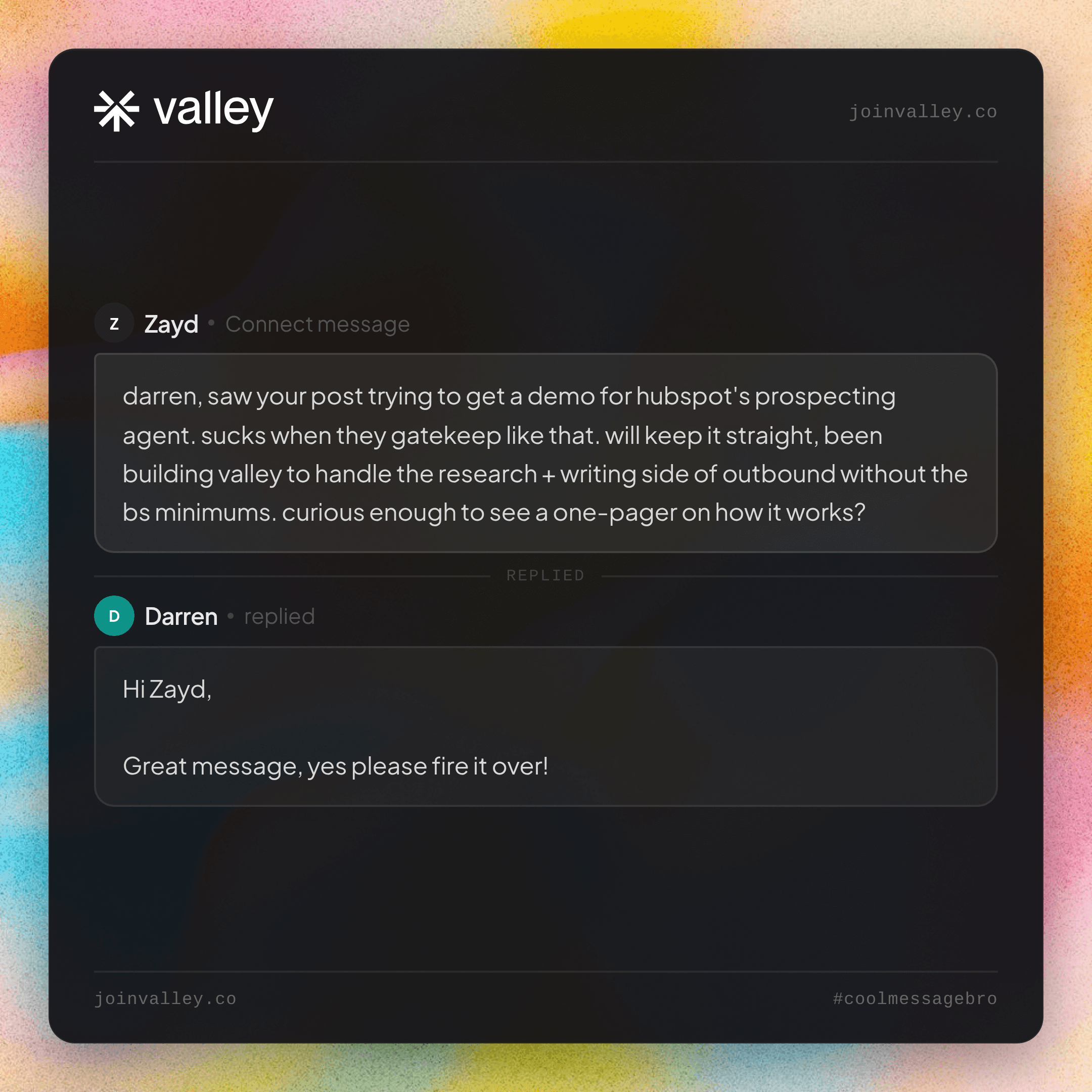
Generate more demos using LinkedIn: Book here
Become a Valley partner and earn 20% recurring commission: Join the affiliate program
Frequently Asked Questions
How did Valley reach $1M ARR without running any ads?
Three systems running together: intent-led outbound on LinkedIn targeting a very narrow ICP, consistent LinkedIn content that built a warm audience of in-ICP prospects over 24 months, and systematic warm intros from investors, advisors, and former coworkers. Each system reinforced the others rather than operating independently.
What does intent-led outbound mean and why does it convert better?
Intent-led outbound means every message is backed by specific research on the prospect: what they have been posting about, what their company has been doing, what competitive dynamics exist in their space. Messages written this way read like they came from someone paying attention rather than a sequence tool. Acceptance and reply rates are significantly higher than volume-based outreach because they are relevant by design.
How do you use LinkedIn content as a pipeline engine rather than a vanity metric?
By aligning content strategy with outbound strategy. Content that resonates with your exact ICP (transparency posts, real data, honest takes on the business) builds a warm audience who already knows you before any outreach message lands. Content designed for broad engagement (memes, generic growth takes) may get likes but builds the wrong audience and creates noise in the outbound motion.
What is the right way to ask for warm intros?
Do the research first. Go to the LinkedIn profile of the person you want an intro from, find first-degree connections who fit your ICP and share mutual connections with your ask. Request intros that make logical sense and that your contact can make with genuine confidence. Run this consistently as a system rather than only when pipeline is thin.
What is the right sequencing for these three systems?
Start with intent-led outbound to generate initial revenue and customer data. Use that data to sharpen your ICP and content strategy. Build LinkedIn content consistently to warm future outbound audiences. Add warm intros systematically once you have early customers who can provide credibility. Each layer makes the next one more effective.
► Your ICP is on LinkedIn right now: reach them during a free 7-day Valley trial


