
Try Valley
Put your outbound workflow to work.

Saniya Sood
Published:
Updated:
Published June 2, 2026 · Updated August 31, 2026
There is a real distinction between an AI that fills fields and an AI that writes. The first produces messages that announce themselves as automated in the first clause. The second produces messages a prospect cannot distinguish from one you wrote by hand. That distinction is the entire game.
Direct answer: Yes. An AI LinkedIn message writer that works does not use templates, it researches each prospect individually (recent posts, company news, role context, the signal that triggered outreach) and writes a fresh message in your configured voice. Valley does this: it learns your tone from examples and dos/don’ts, then generates messages that, per customers, “sound like a real human” rather than AI.
► Book a demo (teams of 5+)and explore how Valley can support your use case
Why Template-Based AI Outreach Fails
A template is a message written for an average prospect. Inserting a name and a company does not change that, the structure, the reasoning, and the reason for reaching out are identical for everyone in the campaign. Prospects recognize this instantly, not because they run detection software, but because the message contains nothing that required the sender to think about them specifically.
The tells are structural and unmistakable: “I noticed you work at {Company}.” “I came across your post about {Recent Post Title}.” “Hope this finds you well.” These phrasings appear in dozens of messages a decision-maker receives weekly. They trigger deletion before the second line.
Pulling a recent post title and dropping it into a template is not personalization either. It demonstrates that software scraped a field, not that a person understood why the post was written or how your offer connects to it. The reader can feel the difference between a referenced fact and an understood context.
Read here: Why B2B Teams Are Switching To Valley from HeyReach After the 2026 Ban
What Real AI Personalization Requires
The evaluation criterion is simple: would the prospect believe a person wrote this? Meeting that bar requires research before writing, not field-filling during sending.
Genuine AI personalization runs a research pass on each prospect first. It reads their recent LinkedIn activity to understand what they care about right now. It checks company news and role context to understand their situation. It factors in the signal that triggered the outreach, did they view your profile, engage with a post, visit your site? Only then does it write, synthesizing that research into a message that references something specific and earns a reply.
This is the mechanism behind warm outbound on LinkedIn done correctly. The warmth comes from the signal; the credibility comes from the research; the scale comes from automation. Remove any one and the system fails, signal without research produces generic timing, research without voice produces robotic accuracy, voice without signal produces well-written cold spam.
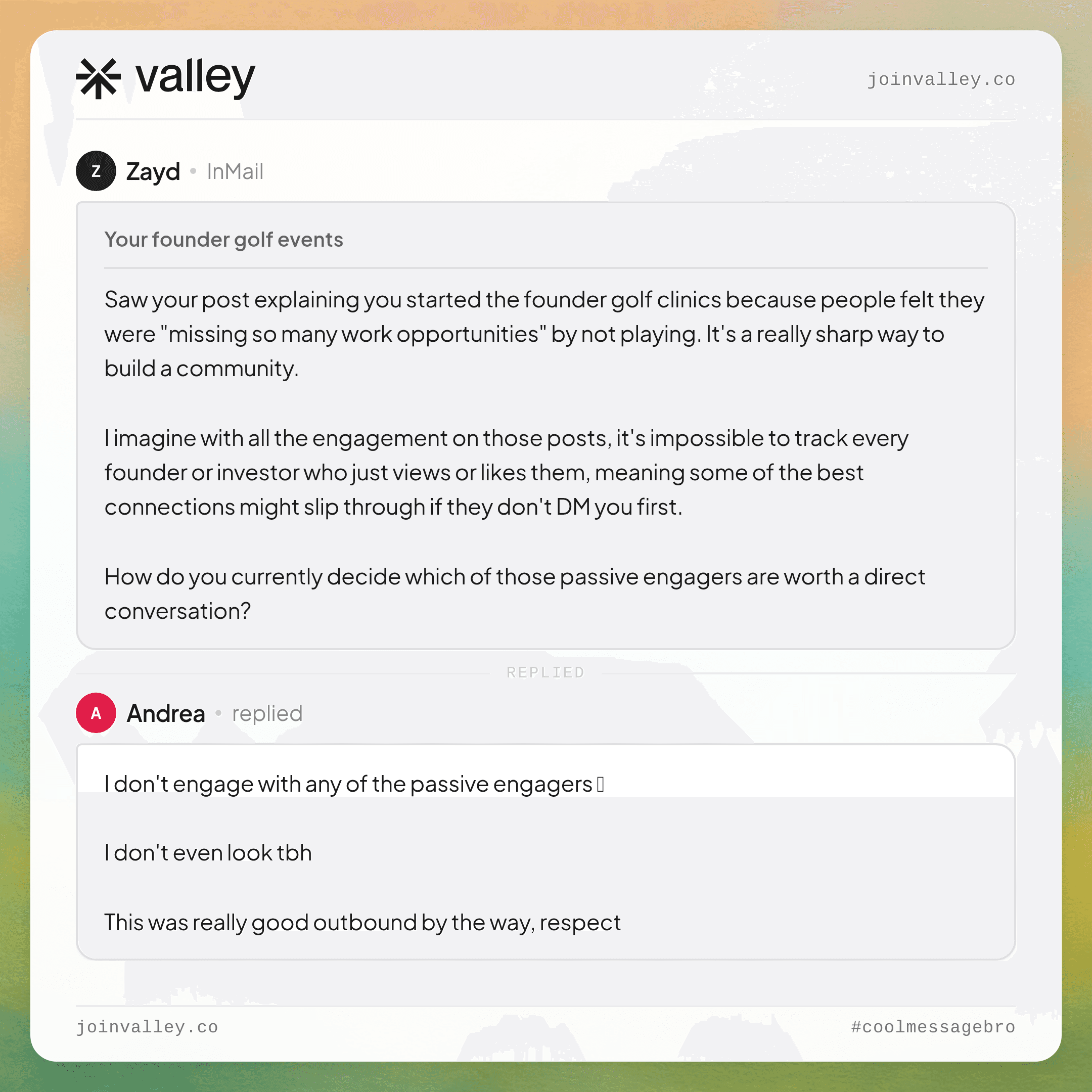
► Check Out Valley’s Incredible Outreach: A compilation of real time messages and responses!
► Turn this into pipeline: Valley is free for 7 days. One good reply pays for the week.

Give your sales team
an unfair advantage.
Valley separates the two jobs most tools collapse: writing in your voice and personalizing to the prospect. It does both.
Voice configuration. You set tone (formal, conversational, technical), give explicit dos and don'ts, and upload examples of messages you have written that performed well. Valley trains on these so generated output carries your cadence, your phrasing, your level of directness, not a generic professional default.
Per-prospect research. For each prospect, Valley pulls from multiple sources, recent posts, company developments, funding activity, role context, and the triggering signal, and builds a research brief. The message is generated from that brief, so the specifics are real and current.
Human-in-the-loop approval. Every message is queued for your review. You approve, edit a line, or reject with feedback, and the model learns.
Lukas Gelžinis at Salesforge described the trajectory precisely: "Valley generates good enough messaging 40% of the time straight away. With minimal training, I get that close to 80%."
He added that the core value is
"that the messages sound like me. It saves me quite some brain power to just pre-approve messages and edit little tidbits."
Personalization method: Template AI tools Variable fields, Valley Per-prospect research brief.
Voice matching: Template AI tools Generic professional default, Valley Trained on your examples + dos/don'ts.
Reads as AI?: Template AI tools Yes, in first line, Valley No, per customer feedback.
Improves over time?: Template AI tools No, Valley Yes, learns from approvals/edits.
Triggered by interest signals?: Template AI tools No, Valley Yes, profile views, post engagement, visits.
Messages a Customer "Steals" for Manual Outreach
The clearest signal that an AI message writer works is when an experienced operator borrows its output.
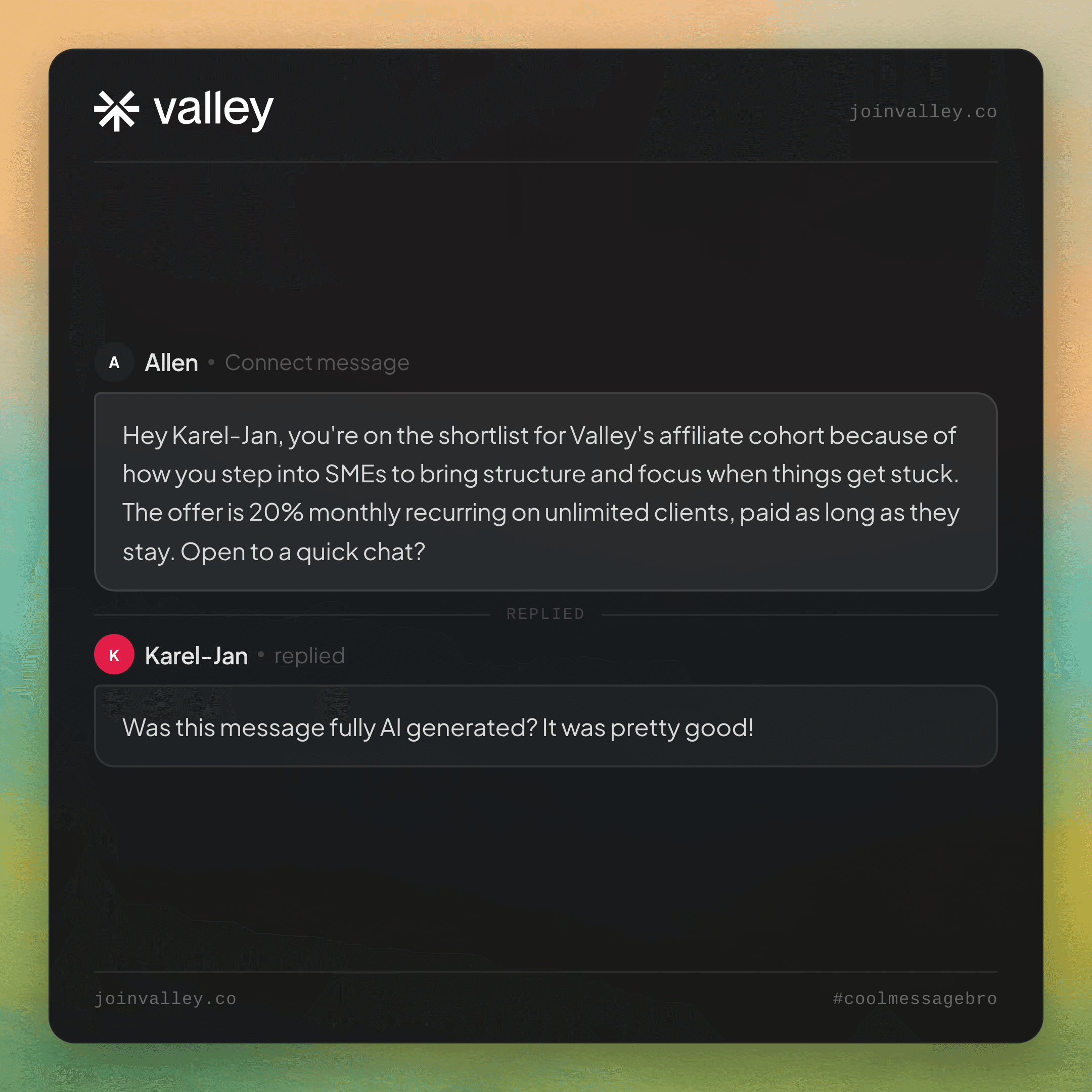
Angelene Perez-Vento at Growth Protocol said exactly that: "I have seen really, really nicely crafted messages that I steal for my own manual outreach too. The messaging is not nearly as personal [with other tools] and it doesn't sound like AI wrote it."
When the AI's drafts are good enough to lift into your own hand-written outreach, the voice-cloning problem is solved.
► What does good outreach actually look like? Real Valley messages, real replies

Give your sales team
an unfair advantage.
If you have rejected AI outreach because every tool produced template sludge with your prospect’s name pasted in, see what research-first generation looks like. Valley learns your voice, researches each prospect, and drafts messages you would be willing to put your name on, with you approving every one before it sends.
► Book a demo (teams of 5+) with the Valley team

Frequently Asked Questions
Can AI write LinkedIn messages that don’t sound like AI?
Yes, when the AI researches each prospect individually and writes in a configured voice rather than filling template fields. Valley customers report its messages “sound like a real human” and are good enough to reuse in manual outreach.
How does Valley clone my writing style?
You configure tone, provide dos and don’ts, and upload examples of your best-performing messages. Valley trains on these so generated messages carry your phrasing and cadence, then improves further as you approve or edit drafts.
What’s the difference between personalization and variable substitution?
Variable substitution inserts a name or company into a fixed template. True personalization researches the prospect and writes a unique message referencing specifics. Only the latter consistently earns replies.
Do I review messages before they send?
Yes. Valley queues every generated message for approval. You approve, edit, or reject with feedback, and nothing goes out without your sign-off.
How long until the AI matches my voice well?
Most users see 40 to 60% usable drafts immediately, rising toward 80% after about 30 days of training the model on approvals and edits.
Related: how Valley works.


