AI SDR Pricing in 2026: How Much Do They Cost & What's the ROI?


Valley
Published:
Updated:
Published January 30, 2026 · Updated August 31, 2026
TL;DR: AI SDR pricing in 2026 spans three orders of magnitude - roughly $400-$3,000/month for self-serve platforms, $5,000-$15,000/month for enterprise "digital worker" contracts, against $104,000-$110,000 fully-loaded for a human SDR. The buying rule: price the outcome, not the seat - cost per qualified meeting is the only number that compares honestly across models.
Pricing model | Typical band | Watch for |
|---|---|---|
Flat subscription | $149-$500/mo | what is actually included flat |
Per-user/tiered | $400-$3,000/mo | seat multiplication |
Usage/credit-based | varies | the meter, always the meter |
Enterprise contract | $5,000-$15,000/mo | annual lock-in, supervision hours |
Where we sit, disclosed: Valley is the flat-price end at $149/mo billed quarterly - full breakdown. The extremes compared: Valley vs 11x ($60K-class contracts) and whether AI SDRs replace humans at all.
AI SDR pricing can feel confusing when every platform promises better results at wildly different costs. For buyers, it’s hard to know what you actually need versus what you’re overpaying for.
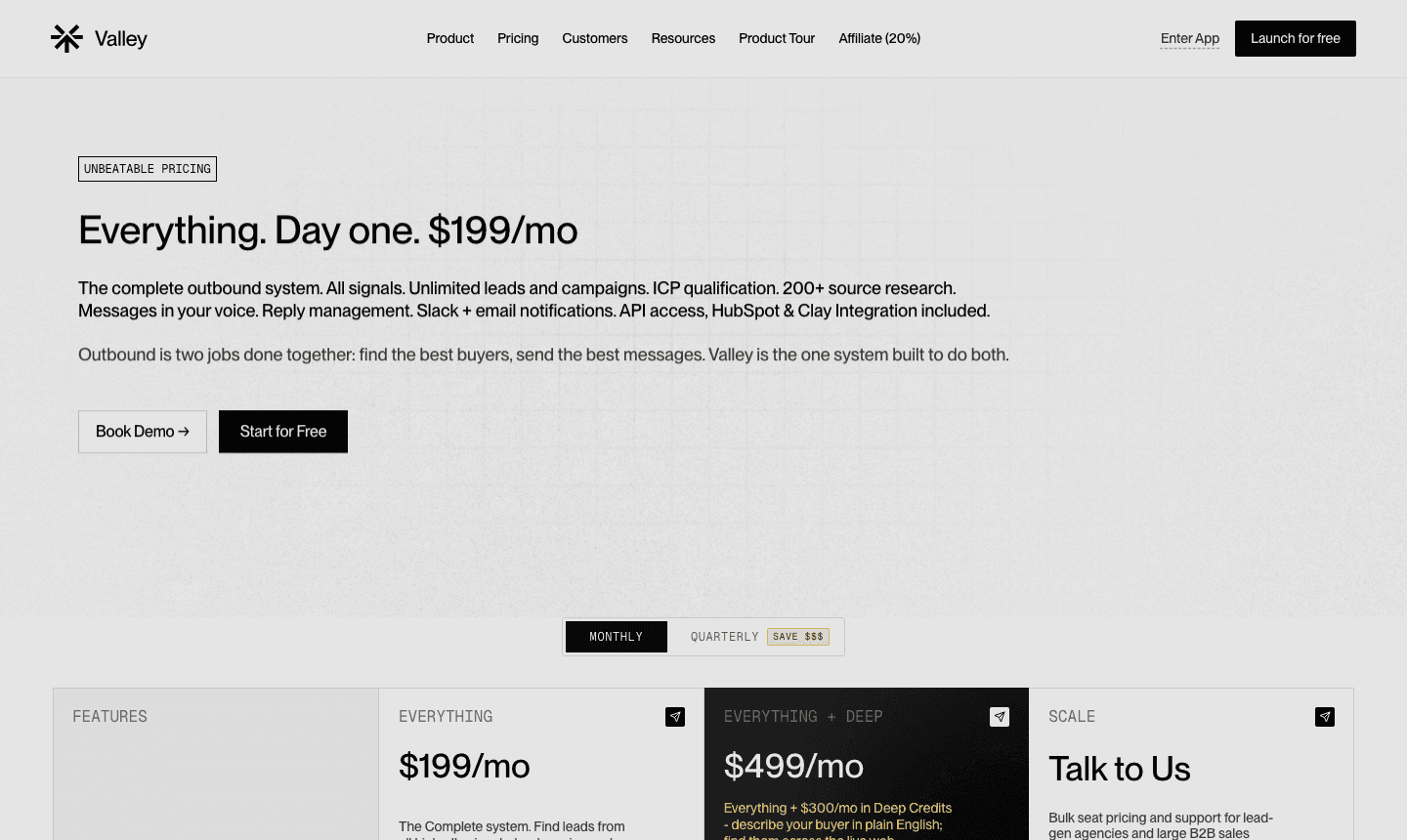
That uncertainty is exactly where Valley focuses its approach, balancing automation, safety, and personalization without forcing teams into bloated pricing tiers.
In this guide, you’ll learn what drives AI SDR pricing, what plans typically include, and how to evaluate cost versus real sales impact before you commit.
What Influences AI SDR Pricing?
Your price tag depends on the features you need, the tech’s sophistication, and whether it plays nicely with your current tools. Most platforms have their own pricing models based on these factors.
Core Features Impacting Cost
The features bundled with your AI SDR package will be charged directly to your monthly bill. Basic plans usually handle automated email sending and some simple follow-ups.
Mid-tier options add multi-channel outreach - think email, LinkedIn, phone calls. Premium tiers? Now you’re looking at advanced personalization, A/B testing, and those fancy analytics dashboards.
Some platforms tack on extra charges for things like custom AI training on your brand voice or industry templates. If your AI SDR can schedule meetings right onto your calendar without a human stepping in, expect to pay more than for tools that just qualify leads.
The number of contacts you can reach per month really matters. Higher limits mean higher bills. Some vendors keep things simple with unlimited contacts at a flat rate, while others scale pricing up as your outreach volume grows.
AI Technology and Automation Levels
More advanced AI doesn’t come cheap. Basic AI SDRs follow simple rules and templates to send messages. The fancier ones use machine learning to write emails that sound like an actual person and adapt as prospects reply.
The more autonomy your AI SDR has, the more you’ll pay. Fully autonomous tools that handle everything from first hello to booking a meeting cost more than those needing human oversight at every step.
AI that learns from your past conversations and keeps getting better? That’s premium territory. These tools analyze which messages work and automatically tweak their approach.
You’ll get consistency, too, as AI SDRs don’t get tired or forget to follow up. They keep your outreach on schedule, no matter what.
Integration With Existing Systems
Your AI SDR needs to sync with your CRM, email platform, and other sales tools. Custom integrations, though, will cost extra. If you’re using niche tools or need the AI SDR to juggle several systems at once, expect to pay more for setup and ongoing maintenance.
API access can bump up pricing. Some vendors charge for unlimited API calls or real-time syncing, while limited access is cheaper but can slow things down.
Native integrations just work better than third-party connectors. They reduce errors and keep your data in sync without you having to mess with it.
Popular AI SDR Pricing Models
Most AI SDR platforms go with one of three structures:
Subscriptions (monthly or annual)
Per-user fees with feature tiers
Usage-based charges tied to activity like emails or calls
Each model hits your budget differently, depending on your team size and the amount of outreach you’re doing.
Subscription-Based Pricing
Subscriptions charge a flat fee: monthly, quarterly, or yearly. Annual subscriptions usually work out cheaper per month than paying month-to-month.
Some vendors want you to lock in for a year, while others let you test the waters with quarterly options. Subscription pricing is best if your outreach needs don’t swing wildly.
You pay the same whether you send 1,000 emails or 10,000 in a month. That’s great for companies with consistent sales activity.
Per-User and Tiered Pricing
Per-user pricing is, well, just what it sounds like; you pay based on how many people use the platform. Tiered pricing means you get different features at different price points.
Basic tiers usually get you email automation and standard analytics. Higher tiers unlock features such as multi-channel outreach, smarter AI, and deeper integrations.
As your team grows or you want more features, you pay more. This model can get pricey as you scale, but at least you only pay for what you’re actually using. Smaller teams can start cheaply and upgrade as they go.
Usage-Based Pricing
Usage-based pricing charges you based on what you do: emails sent, calls made, meetings booked, that sort of thing. It ties your costs directly to your activity.
Some platforms charge per lead contacted or per conversation. Others use credits, where different actions burn through your balance at different rates.
This gives you control: you can ramp up when you need and scale down when things are slow. Just be aware that costs can swing month to month if your outreach volume fluctuates.
Comparing AI SDR Platform Costs
AI SDR platforms can run anywhere from $100 to $5,000 per month. The price depends on features, automation, and team size.
Entry-Level vs. Enterprise Plans
Entry-level AI SDRs start around $100 to $400 a month. They’re good for basic email automation and light prospecting.
Mid-tier options hit $1,000 to $2,500 per month. You’ll get more advanced features, like multi-channel outreach, better personalization, and higher contact limits. These are solid for growing teams.
Enterprise plans start at $3,000 and can go north of $5,000 a month. You get unlimited contacts, priority support, custom integrations, and a dedicated team. These plans make sense for bigger teams with complicated sales processes.
Hidden Fees and Additional Expenses
Setup and onboarding fees can sneak in, sometimes adding $500 to $2,000 to your first bill. Some platforms charge extra for importing data, configuring workflows, or training your team.
Integration costs can pile up, too. You might pay more to connect your AI SDR with your CRM or other tools, or get hit with limits on free integrations if you’re on a lower-tier plan.
Watch out for usage-based charges. Fees tied to email volume, calls, data enrichment, or AI credits can double your bill during busy times.
Cost Comparison of Top Providers
Most AI SDR platforms land between $1,000 and $5,000 monthly. That’s still less than hiring a human SDR, who’ll cost you $60,000 a year plus benefits and training.
Budget options under $500 a month usually skip true AI features. You get basic automation, but not the smart personalization or decision-making that makes AI SDRs so useful. You save up front, but might not get the results you’re hoping for.
Premium platforms charging $3,000 and up deliver better accuracy and faster responses. Some boast accuracy rates over 90% and handle complex sales chats. The ROI tends to improve when the AI actually books qualified meetings and pushes prospects through your pipeline.
Value and ROI Considerations
Sticker price is only part of the story. The real question? How much value do you get for what you spend, and does the investment actually make sense for your team?
Assessing Potential Savings
A human SDR usually costs $50,000 to $80,000 per year, just in salary. Add health insurance, retirement, paid time off, training - it stacks up fast.
AI SDRs cut out most of those recurring costs. You pay a subscription, usually $500 to $5,000 a month, depending on the platform. That’s $6,000 to $60,000 a year, often less than one human SDR’s full compensation.
Cost comparison:
Human SDR: $65,000 - $110,000 per year (with benefits)
AI SDR: $6,000 - $60,000 per year
Potential savings: $5,000 - $104,000 annually
Scaling is almost instant. If you need to reach 1,000 prospects this month and 5,000 the next, your AI SDR just rolls with it.
Calculating Return on Investment
ROI starts with measuring what you get for your spend. Track how many qualified meetings your AI SDR books and figure out your cost per meeting.
Say your AI SDR costs $2,000 a month and books 20 qualified meetings; that’s $100 per meeting. Compare that to your human SDR’s cost per meeting by dividing their monthly pay by the number of meetings booked.
Many companies find AI SDRs deliver meetings at 40 - 60% lower cost. But don’t stop there, look at conversion rates through your whole funnel.
An AI SDR that books more meetings but achieves lower conversion rates might not actually deliver better ROI. Check how many meetings turn into opportunities and then into closed deals.
Key metrics to keep an eye on:
Cost per qualified meeting
Meeting-to-opportunity conversion rate
Opportunity-to-close rate
Average deal size
Time from first contact to closed deal
Payback period matters, too. Most companies achieve positive ROI within 3 to 6 months.
Factoring in Customer Support
Support can make or break your results. Some AI SDR platforms include a dedicated account manager, training, and ongoing help. Others? You might just get a help email.
Good support helps you get up to speed and see results faster. Your team needs to know how to set up campaigns, read analytics, and tweak messaging. Without that, you might not get the returns you’re hoping for.
Ask vendors about their support before you buy. Do they help with onboarding? Can you talk to a real person when you’re stuck? How fast do they answer?
Premium support usually costs more, but it might pay for itself by keeping things running smoothly.
Picking the Right AI SDR Solution for Your Budget
Finding an AI SDR that fits your budget is all about matching what you actually need with what you’re willing to spend.
Aligning Features With Business Needs
Map out your sales process and figure out where AI can help most. If your team struggles with inbound leads, look for platforms that nail lead qualification and routing.
Outbound-focused teams should prioritize strong personalization and multi-channel outreach. Don’t pay for bells and whistles you won’t use.
A lot of platforms bundle in advanced analytics, CRM integrations, and automation that sound cool but might not matter for your current needs. A startup with 50 leads a month doesn’t need the same toolkit as a big enterprise.
Calculate your expected ROI before you sign anything. Compare the cost of an AI SDR (usually $999 to $3,000+ monthly) to hiring a human SDR at $50,000 to $80,000 a year plus benefits. Think about how many leads the AI can handle and whether it’ll help you avoid hiring more people.
Negotiating Pricing and Contracts
Most AI SDR vendors push for annual contracts, but some offer quarterly or month-to-month deals. Quarterly options let you test the platform and see if it works before committing long-term.
If you’re planning to scale, ask about volume discounts. Some vendors adjust pricing based on lead volume, emails sent, or user count. Make sure you know what triggers a price hike as you grow.
Request a pilot period or a money-back guarantee. It’s a safety net if things don’t pan out. Check the fine print on cancellation and whether unused credits carry over.
Making Sense Of AI SDR Pricing Before You Buy
AI SDR pricing can look simple on the surface, but hidden limits, add-ons, and rigid contracts often drive costs higher than expected. The real challenge is paying for outcomes, not unused features.
A platform like Valley helps teams control costs while scaling outreach safely and consistently. When pricing aligns with real usage and results, automation becomes an advantage instead of a risk.
Before you commit, compare plans carefully, estimate ROI, and choose a solution that fits your sales motion today and as you grow. Book a demo (teams of 5+) to see the value clearly.
Frequently Asked Questions
What Does AI SDR Pricing Usually Include?
AI SDR pricing typically covers outreach automation, lead qualification, and basic analytics. Higher tiers often add personalization, multi-channel messaging, and CRM integrations.
How Much Should I Expect To Pay For AI SDR Software?
Most teams spend between $500 and $5,000 per month, depending on features, usage limits, and automation depth. Entry plans cost less but offer fewer controls.
Why Does AI SDR Pricing Vary So Much Between Platforms?
Pricing changes based on automation level, AI sophistication, contact volume, and integrations. Fully autonomous tools with learning models cost more than rule-based systems.
Is AI SDR Pricing Cheaper Than Hiring Human SDRs?
In most cases, yes. AI SDR tools usually cost less annually than a single SDR salary and remove expenses like benefits, onboarding, and turnover.
Are There Hidden Costs In AI SDR Pricing?
Some platforms charge extra for onboarding, integrations, usage overages, or advanced AI features. Always review limits and contract terms before signing.
How Do I Know If An AI SDR Is Worth The Price?
Compare cost per qualified meeting and downstream revenue impact. Strong ROI comes from consistent bookings, clean data, and time saved for your sales team.
Can AI SDR Pricing Scale As My Team Grows?
Most platforms scale through higher contact limits, feature tiers, or usage-based pricing. The best options let you grow without sudden pricing jumps.
Should I Choose Monthly Or Annual AI SDR Pricing?
Monthly or quarterly plans reduce risk when testing. Annual plans often lower monthly costs but make sense only after proving ROI.
Valley is an AI outbound platform that finds the people most likely to buy from you - from live buying signals, natural-language search, or your own lists - qualifies them against your ICP, researches each one, and sends personalized messages across email and LinkedIn that get 15-45% reply rates, against a category average of about 2%.
Related Blogs

FEATURED READ
5 min
ZoomInfo Pricing Explained (2026): What It Actually Costs
Read
Read

FEATURED READ
5 min
Apollo Pricing and Credits Explained (2026): What You Actually Pay
Read
Read

FEATURED READ
5 min
Clay Pricing and Credits Explained (2026): The Post-March Math
Read
Read

FEATURED READ
5 min
LinkedIn Sales Navigator Cost Explained (2026): Every Tier, Real Numbers
Read
Read
Which channels does Valley support?
Valley supports LinkedIn outreach, including connection requests and InMails. Valley users safely send 1000-1200 messages per seat every month.
How safe is it and does Valley risk my LinkedIn account?
Do I have to commit to an Annual Plan like other AI SDRs?
How does Valley personalize messages?
Is Valley available in my country?

VALLEY MAGIC