LinkedIn Outbound Stack Cost: The Real Price of Clay + PhantomBuster + HeyReach in 2026

Try Valley
Make LinkedIn your Greatest Revenue Channel ↓

Saniya
Published:
Updated:
LinkedIn Outbound Stack Cost: The Real Price of Clay + PhantomBuster + HeyReach in 2026
Published May 7, 2026 · Updated August 31, 2026
Your LinkedIn outbound stack looks affordable on the surface.
$159 for PhantomBuster. $79 for HeyReach. Maybe $270 for Trigify.
You mentally add those up, land somewhere around $500 per month, and move on.
Then Clay's March 2026 pricing overhaul hits.
You discover your Growth plan's 6,000 base Data Credits evaporates somewhere around the first 200 leads. You top up. At a 30 - 50% premium. Halfway through the month.
The month you needed it most.
This is not a hypothetical.
It is what the verified credit consumption math shows when you try to replicate serious LinkedIn warm outbound research across 1,000 - 1,200 prospects per month.
This runs that math in full - tool by tool, credit by credit, hour by hour - so you know what your DIY stack actually costs before you discover it on the bill.
What Does a LinkedIn Outbound Stack Actually Cost Per Month?
The verified software cost of a realistic DIY LinkedIn outbound stack for 1,000 - 1,200 prospects per month is $709 - $914 per month at standard billing rates, rising to $1,000 - $1,800 per month when Clay credit consumption realistically scales to Valley-equivalent research depth. This is before accounting for GTM engineer labor at market rates of $75 - $150 per hour.
The stack most B2B teams run looks like one of two configurations:
Stack A: Trigify + Clay + Claude Pro + HeyReach
Trigify Growth (40K credits): $270/month
Clay Growth (base, monthly billing): $495/month
Claude Pro: $20/month
HeyReach Growth (1 seat): $79/month
Total: $864/month
Stack B: PhantomBuster + Clay + ChatGPT Plus + HeyReach
PhantomBuster Pro: $159/month
Clay Growth (base, monthly billing): $495/month
ChatGPT Plus: $20/month
HeyReach Growth (1 seat): $79/month
Total: $753/month
Both stacks cost roughly twice what most teams think they are paying.
And both assume Clay's base allocation is sufficient - which, for serious LinkedIn outbound research, it is not.
► The cheapest test in this category is Valley's 7-day free trial: full product, zero spend

The Clay Credit Problem: Why the Math Gets Worse Fast
Clay's March 11, 2026 pricing overhaul replaced three legacy plans with two self-serve tiers plus a separate "Actions" meter.
The Growth plan gives you 6,000 Data Credits and 40,000 Actions per month. That sounds like a lot. It is not.
Here is the verified per-lead credit consumption for a workflow that attempts to replicate deep LinkedIn prospect research across 1,200 prospects:
Step | Lead Volume | Data Credits/Lead | Actions/Lead | Total Data Credits | Total Actions |
|---|---|---|---|---|---|
Firmographic enrichment (company size, industry, funding) | 3,000 | ~3 | 1 | 9,000 | 3,000 |
ICP qualification AI prompt (Claygent) | 3,000 | ~3 | 1 | 9,000 | 3,000 |
Email waterfall + validation | 1,500 | ~5 | 2 | 7,500 | 3,000 |
Deep AI research (multi-step, token-priced model) | 1,200 | 10 - 15 | 2 - 3 | 12,000 - 18,000 | 2,400 - 3,600 |
Two additional AI research prompts | 1,200 | ~6 | 2 | 7,200 | 2,400 |
Message generation (BYOK = 0 Data Credits) | 1,200 | 0 | 1 | 0 | 1,200 |
Push to HeyReach via webhook | 1,200 | 0 | 1 | 0 | 1,200 |
Total | ~44,700 - 50,700 | ~16,200 - 17,400 |
Clay Growth's base 6,000 Data Credits covers roughly 8% of what this workflow actually consumes.
To close the gap, you either aggressively use BYOK API keys (which reduces the credit burden but adds prompt-engineering complexity) or you top up - at 30 - 50% premium over plan rates.
Realistically: a team running 1,000 - 1,200 prospects per month with genuine research depth is spending $495 - $700 per month on Clay alone with aggressive BYOK management, or $700 - $1,500+ without it.
Clay's own community acknowledges the credit system has been called "opaque" and "hard to forecast" by users across G2, Reddit, and Lindy reviews.
The Hidden Labor Tax: 18 - 33 Hours You Are Not Counting
Software subscriptions are the visible cost. The invisible cost is the GTM engineer hours required to wire these tools together and keep them running.
First-time setup of a Trigify/PhantomBuster + Clay + HeyReach stack:
Signal source configuration (Trigify scraper schedules, PhantomBuster phantom setup): 3 - 6 hours
Clay table architecture (ICP scoring logic, lookup tables, disqualification filters): 5 - 8 hours
Waterfall enrichment (Hunter/Prospeo/Dropcontact ordering + BYOK keys): 2 - 3 hours
Claygent prompt engineering (research prompts, tone-cloning, message draft, tested across 50 - 100 sample rows): 4 - 8 hours
HeyReach campaign + webhook ingestion from Clay: 2 - 4 hours
End-to-end QA and credit-burn testing: 2 - 4 hours
Total first-time setup: 18 - 33 hours
Ongoing weekly maintenance runs 2 - 5 hours: monitoring credit burn, fixing broken Phantoms when LinkedIn changes its DOM structure (a documented recurring problem in PhantomBuster Capterra reviews), tuning prompts when output quality degrades, and triaging duplicate leads across the stack's four separate data flows.
At $75 - $150 per hour fully loaded for a GTM engineer, first-time setup costs $1,350 - $5,000. Two months of ongoing maintenance at four hours per week adds $2,400 - $6,000. The software sticker price stops being the relevant number very quickly.
► Check Out Valley's Incredible Outreach: A compilation of real time messages and responses!
The Full TCO Comparison: DIY Stack vs. Single Platform
Dimension | Stack A (Trigify + Clay + Claude + HeyReach) | Stack B (PhantomBuster + Clay + ChatGPT + HeyReach) | |
|---|---|---|---|
Monthly software cost (base) | $864 | $753 | From $347 (Base) |
Monthly software cost (realistic Clay credit consumption) | $1,000 - $1,800 | $1,000 - $1,800 | From $347 (fixed) |
Premium over Valley | +$400 - $1,450/month | +$300 - $1,450/month | - |
First-time setup | 18 - 33 hours | 18 - 33 hours | Hours, not weeks |
Ongoing weekly maintenance | 2 - 5 hours | 2 - 5 hours | Near-zero (managed) |
Skills required | GTM engineer + Clay expert + prompt engineer | GTM engineer + Clay expert + prompt engineer | Sales or marketing user |
Research depth | ~5 - 15 data points/prospect (credit-constrained) | Same | 60+ data points/prospect |
Credit predictability | Volatile - top-ups at 30 - 50% premium | Same volatility | Flat monthly fee |
LinkedIn account risk | HeyReach: cloud-proxy; LinkedIn banned HeyReach's company page March 2026 | Same HeyReach risk; PhantomBuster cookie-based scraping flagged in Q1 2026 | Zero documented restrictions |
Time-to-first-message | Days to weeks | Days to weeks | Same day |
Why the Research Depth Gap Matters More Than the Price Gap
The cost gap is decisive on its own: $395 - $999 per month versus $700 - $1,800 per month for equivalent functionality. But the quality gap compounds the cost argument.
Valley conducts 60+ data points of research per qualified prospect using a multi-LLM architecture - recent LinkedIn posts, company news, podcast appearances, funding events, job changes, hiring patterns, tech stack indicators, and more. The output is a message that references the specific signal that triggered the lead, written in the sender's tone, reviewed by a human before it sends.
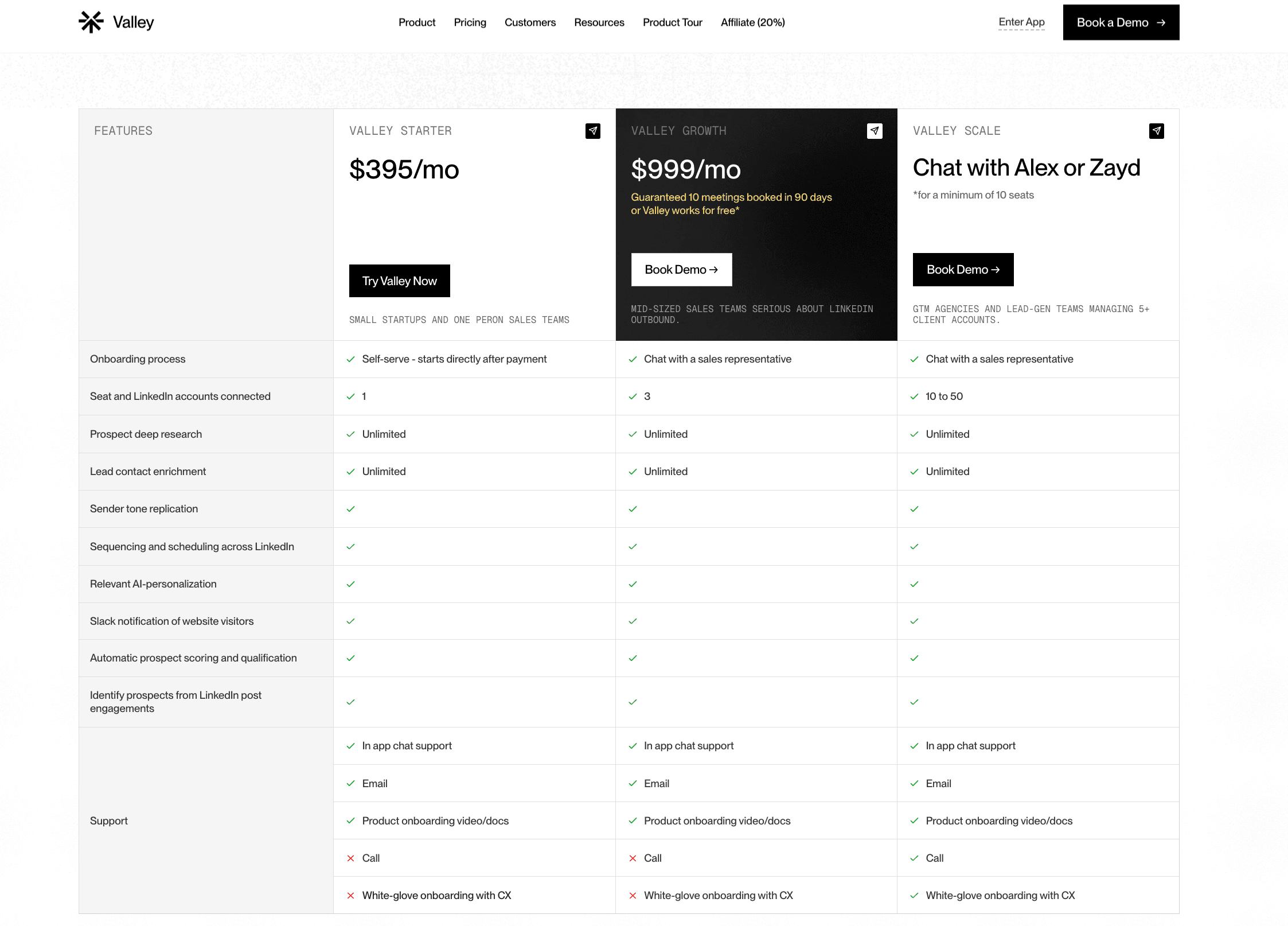
A DIY Clay build with Growth-tier base credits realistically extracts 5 - 15 data points per prospect before the credit budget runs out. Most teams ship with one variable insertion - name, company, job title - and call it personalized. It is not.
Valley's own published benchmarking describes complex stacks as producing 1 - 2% conversion rates versus warm outbound's 6 - 10% reply rates and 15 - 45% conversion benchmarks.
That reply rate gap, measured over a year at 1,200 prospects per month, is the difference between 14 - 24 replies per month and 72 - 120 replies per month.
At any reasonable conversion rate from reply to meeting, that is the difference between a pipeline and an activity report.
Keep exploring: Valley pricing, explained.

When the DIY Stack Still Makes Sense
The DIY stack is not always wrong. There are scenarios where it wins:
You have a dedicated GTM engineer who enjoys building this.
If your team has someone who actively wants to maintain Clay workflows, the quality ceiling can be raised, at the cost of their time.
Your use case requires enrichment sources Valley does not cover.
Clay's 50+ data source waterfall for contact enrichment, phone numbers, and firmographic depth has no equivalent in a managed platform. Teams with complex territory models or ABM lists with 50+ data points per account need Clay for the enrichment layer.
You are enriching for channels beyond LinkedIn.
If email is your primary outreach channel and LinkedIn is supplementary, a Clay-centric stack with a separate email tool may be the right architecture. Valley is LinkedIn-first.
For these use cases, the recommendation is not to abandon Clay - it is to use Clay for enrichment and Valley for signal capture, ICP qualification, research, and outreach execution. The combination covers the full workflow without the DIY coordination overhead for the LinkedIn layer.
Proof: What Eliminating Stack Overhead Produces
ButteredToast replaced their multi-tool outreach stack with Valley's warm outbound on LinkedIn and generated $1 million in pipeline with 5x the output of their previous approach.
The improvement came from eliminating the latency and failure points between tools - signals acted on in hours instead of days, personalization from live research instead of stale CSV enrichment.
SaanSerif generated $480,000 in pipeline within 30 days using Valley's integrated signal-to-outreach workflow, without the credit volatility and prompt-engineering overhead of a four-tool DIY build.
Both results reflect the same dynamic: when the research, personalization, qualification, and outreach happen in one connected system rather than across four separate subscriptions, the signal-to-meeting time compresses dramatically.
That time compression is what produces pipeline - not the sophistication of the tool architecture.
The Honest Bottom Line
The DIY stack premium is real: $300 - $1,450 per month above Valley's cost, plus $1,350 - $5,000 in one-time setup labor, plus $600 - $3,000 per month in ongoing GTM maintenance time.
The research depth gap is real: 5 - 15 data points per prospect versus 60+ data points per prospect, limited by Clay's credit budget.
The safety risk is real: HeyReach's company page and founder profile were removed by LinkedIn in March 2026. PhantomBuster's cookie-based architecture was flagged in the same Q1 2026 enforcement wave. Valley has zero documented restrictions across its customer base.
If you are evaluating whether to keep building on the DIY stack or move to a single platform for LinkedIn warm outbound, the math is the math.
Book a demo (teams of 5+) and see how the cost and quality comparison plays out for your specific prospect volume and ICP. Setup takes under 24 hours. The first meeting comparison is yours to make.
Frequently Asked Questions
Q: Is Clay included in Valley, or do I still need it?
For the LinkedIn outreach workflow - signal capture, ICP qualification, deep prospect research, message generation, and outreach execution - Valley covers everything. Clay remains the better choice for building large enriched contact databases from 50+ data sources. Many teams use Clay for proactive list enrichment and Valley for warm signal capture and execution.
Q: What happens to my Clay credit budget when I run deep research?
At 1,000 - 1,200 prospects per month with Valley-equivalent research depth, verified credit consumption math shows 44,700 - 50,700 Data Credits needed. Clay Growth's base provides 6,000. The gap is closed with BYOK API keys (which reduces but does not eliminate credit consumption) or credit top-ups at a 30 - 50% premium. Most teams running serious outbound at this volume land at $495 - $700+ per month on Clay alone.
Q: Why is HeyReach still in this stack comparison if LinkedIn banned its page?
HeyReach continues to operate and its customer automations were reportedly unaffected by the March 2026 company-page removal. However, the removal confirmed that LinkedIn views its cloud-proxy architecture as policy-violating. That structural risk - to user accounts, not HeyReach's company page - is what the Q1 2026 Northlight.ai data captures: roughly 40% of accounts on cloud-proxy tools received some restriction between January and March 2026.
Q: How does Valley price compared to this full stack?
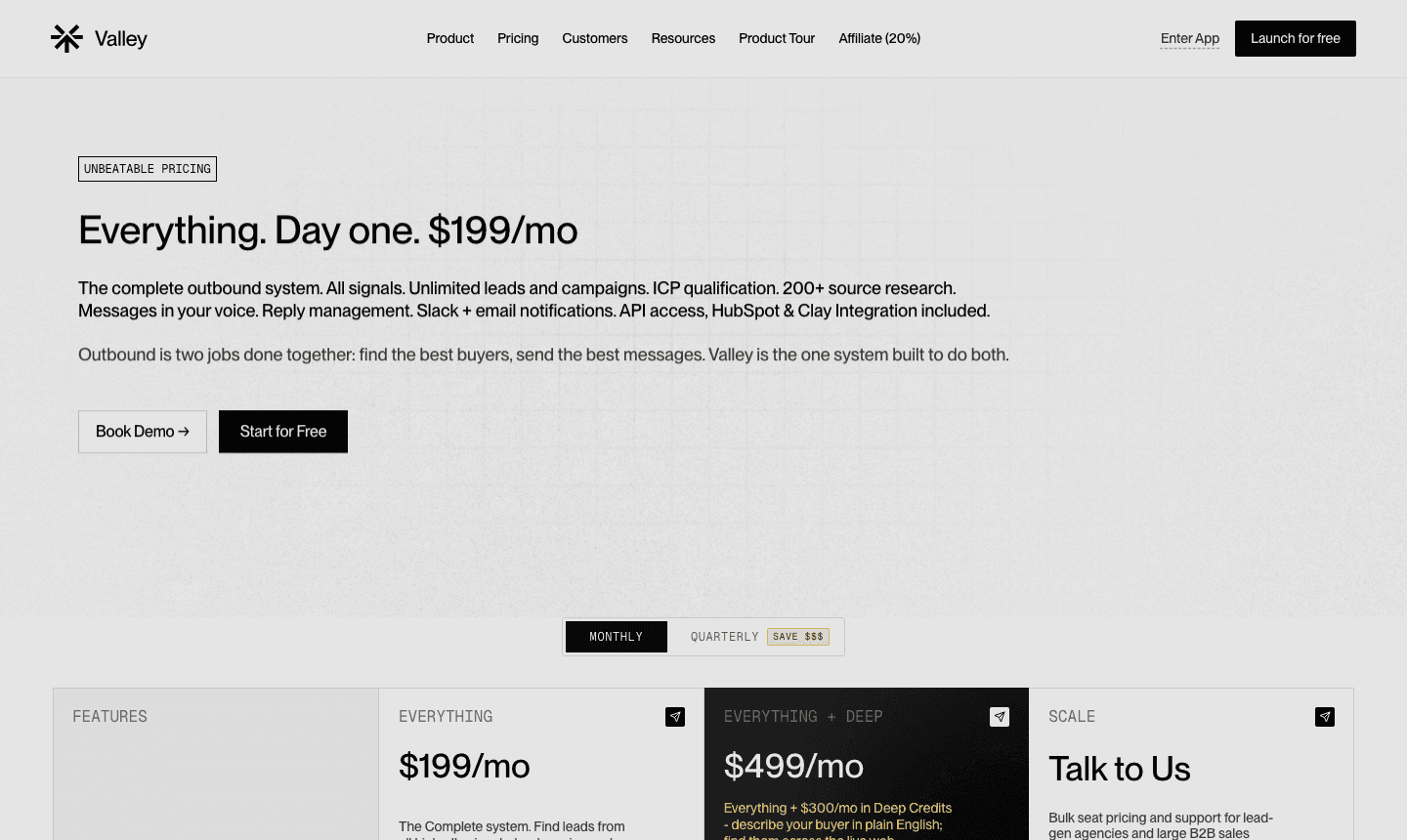
Valley is $149/month billed quarterly, or $199 month-to-month, for one seat with everything unlocked - unlimited prospect research, lead enrichment, and AI personalization included. Multi-seat teams use Valley Scale (custom pricing, 5-seat minimum). The DIY stack at $709 - $914/month in software (before credit overages) costs four to six times Valley's price.
Q: Does Valley require Sales Navigator?
Sales Navigator is not required. Valley captures warm signals natively - profile viewers, post engagers, website visitors, company page followers - without Sales Navigator. Sales Navigator adds value for proactive targeting (you can paste a Sales Navigator search URL into Valley as a campaign source). But the warm signal motion - the highest-converting part of Valley's workflow - runs independently of any third-party data subscription.
► Done with the cost breakdown? Get the numerator too: trial Valley free for 7 days

Related Blogs

FEATURED READ
5 min
ZoomInfo Pricing Explained (2026): What It Actually Costs
Read
Read

FEATURED READ
5 min
Apollo Pricing and Credits Explained (2026): What You Actually Pay
Read
Read

FEATURED READ
5 min
Clay Pricing and Credits Explained (2026): The Post-March Math
Read
Read

FEATURED READ
5 min
LinkedIn Sales Navigator Cost Explained (2026): Every Tier, Real Numbers
Read
Read
Which channels does Valley support?
Valley supports LinkedIn outreach, including connection requests and InMails. Valley users safely send 1000-1200 messages per seat every month.
How safe is it and does Valley risk my LinkedIn account?
Do I have to commit to an Annual Plan like other AI SDRs?
How does Valley personalize messages?
Is Valley available in my country?

VALLEY MAGIC