
Try Valley
Put your outbound workflow to work.

Saniya Sood
Published:
Updated:
Published July 6, 2026 · Updated August 31, 2026
Trial and pricing, verified hands-on (August 2026): Expandi’s 7-day free trial requires a card upfront - $0 today, then $99/month per seat (or $79/month billed yearly). Each seat connects one LinkedIn account.
The best Expandi alternatives in 2026 are Valley (signal-based outreach that finds warm buyers and writes researched messages, from $149/mo), HeyReach (built for agencies, $79/mo per sender), Dripify (cleanest visual builder, from $39/mo annual), Skylead (LinkedIn + email with native warm-up, $100/mo), and Waalaxy (cheapest entry, from €19/mo). Expandi itself remains a solid choice if account-safe cold sequencing on a single seat is exactly what you want, at $99/mo.
► Start with the alternative built for quality: Valley, free for 7 days

Give your sales team
an unfair advantage.
Verdict | Tool |
|---|---|
Best overall (replies, not just safety) | Valley - from $149/mo |
Best for agencies / many senders | HeyReach - $79/mo per sender |
Best visual sequence builder | Dripify - from $39/mo |
Best LinkedIn + email all-in-one | Skylead - $100/mo |
Best budget entry | Waalaxy - from €19/mo |
Best data/enrichment layer (not a sender) | Clay - free plan; paid from $167/mo |
How we picked (and our bias, stated plainly)
Valley makes one of the tools on this list. Our entry is clearly marked, and the list includes tools that beat us for specific jobs.
The basis for comparison: we run 1,000+ LinkedIn accounts across 300+ teams, we've sent 30M+ messages through this category of software, and we checked every price below on each vendor's live pricing page on July 24, 2026.
What Expandi does well - and what it was never built to fix
Expandi solves a real problem: it runs cold LinkedIn sequences from the cloud, with a dedicated country-based IP per account and warm-up features, which genuinely reduces the ban risk that Chrome-extension tools carry. If you've had a LinkedIn warning email, Expandi's architecture is a legitimate answer.
What it doesn't touch is the reply-rate problem. A safely-delivered cold message is still a cold message - cold LinkedIn outreach benchmarks around 2% no matter how safe the sending infrastructure is. Expandi sequences whoever you import; nothing checks whether any of them viewed your profile, engaged with your posts, or visited your site first. Safety and reply rate are two different problems, and most teams searching for Expandi alternatives have already solved the first one.
The 2026 checklist: how to evaluate any tool on this list
Account safety: cloud-based with dedicated IPs (Valley, HeyReach, Expandi, Skylead) beats browser extensions (Waalaxy) structurally.
Who you're messaging: does the tool have a signal layer, or does it just sequence your imported list? Only one tool here changes the list itself.
What the message says: template variables vs. per-prospect research. Reply rate lives here.
Scaling model: per-seat pricing (Expandi, Dripify) compounds fast; flat or unlimited models (HeyReach, Valley) don't.
Channel coverage: LinkedIn-only vs. sequencer-grade email steps (Skylead) vs. native in-sequence email from your own inbox (Valley, since Aug 2026) - and none of these is volume-email infrastructure, which is its own category.
Quick comparison
Tool | Starting price | What it optimizes | Free trial | Key limitation |
|---|---|---|---|---|
Valley (that's us) | $149/mo quarterly · $199 month-to-month | Who you contact + what you say | 7 days | Native email in-sequence since Aug 2026 (own inbox, ~30/day/seat, included) |
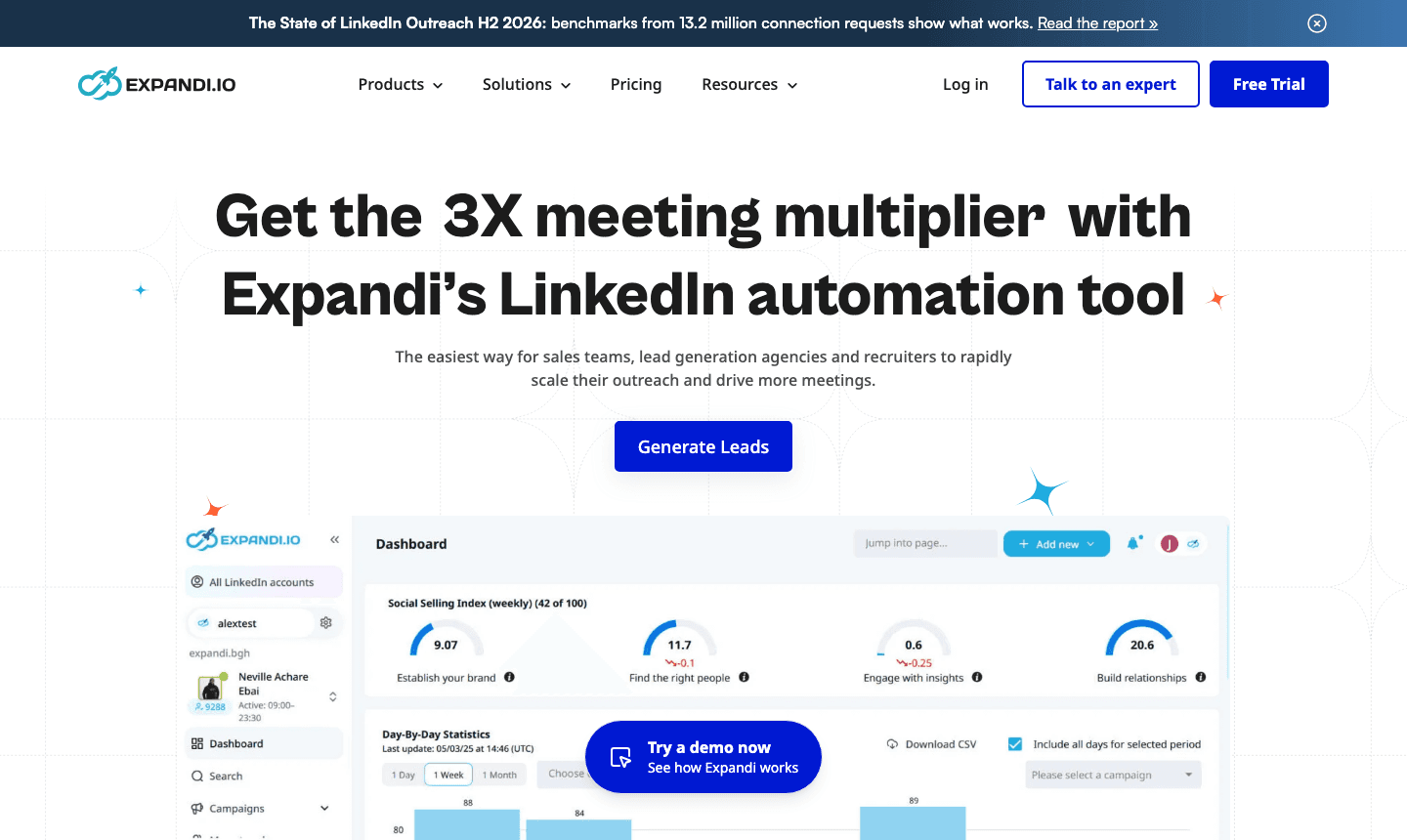
Expandi | $99/mo per seat ($79 annual) | Account-safe cold sequences | 7 days | No signal layer; personalization is image/GIF-level |
HeyReach | $79/mo per sender | Cold volume across accounts, one inbox | 14 days | No signal layer; LinkedIn-only |
Dripify | $39 - 79/mo annual ($59 - 99 monthly) | Visual drip building | 7 days | 1 campaign on Basic plan |
Skylead | $100/mo | LinkedIn + email with native warm-up | 7 days | Higher entry price; still cold-list based |
Waalaxy | €19 - 69/mo | Cheap first campaigns | 14 days | Chrome extension = highest detection risk; 300 invites/mo entry cap |
SalesRobot | $39 - 99/mo per account (annual) | AI-assisted messaging + appointment setting | 14 days | Message quality is template-plus, not research |
Clay | Free; paid from $167/mo | Data enrichment + GTM workflows | Free plan | Not a sender - you still need an outreach tool |
The tools, one by one
1. Valley - best when reply rate is the actual constraint (our tool)
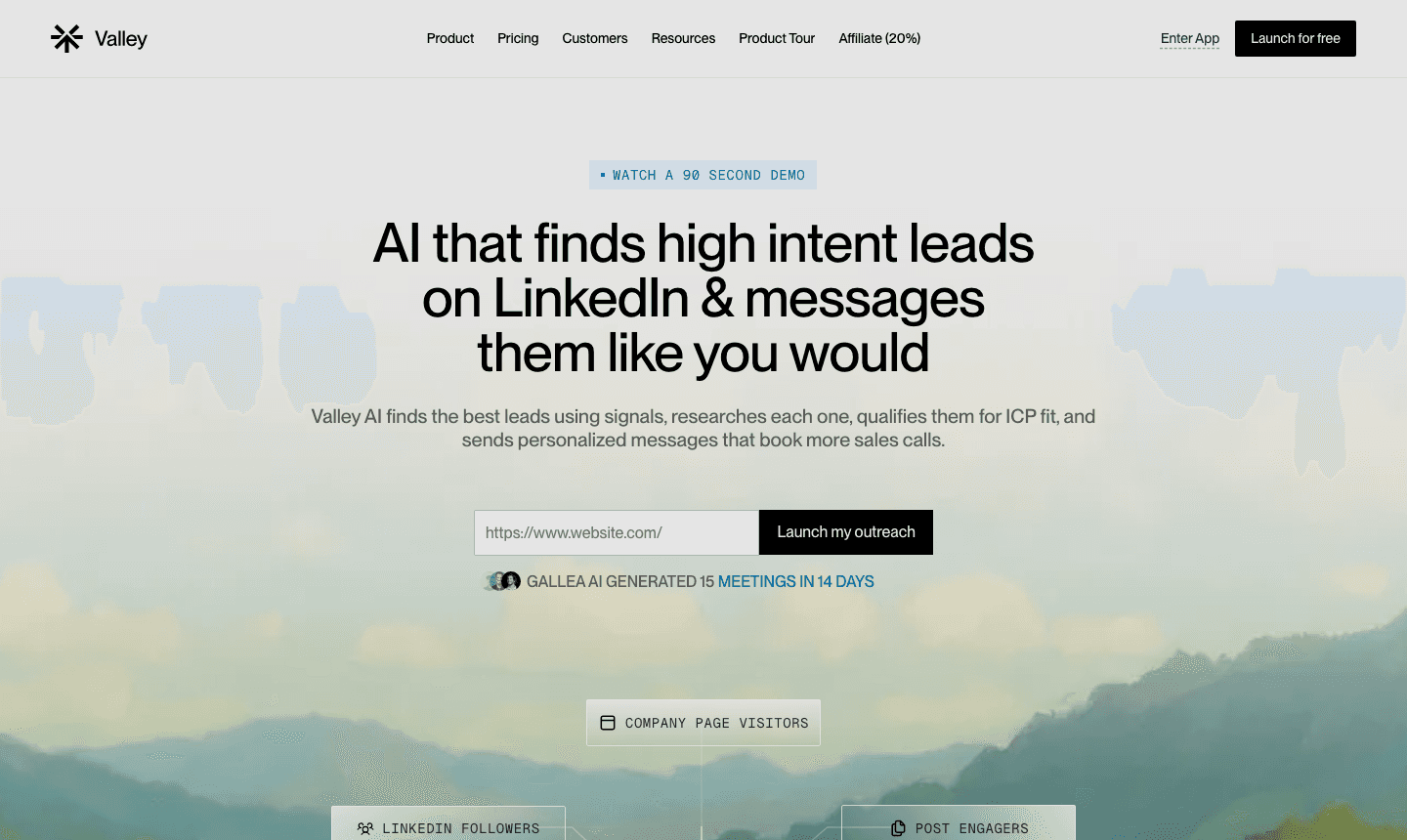
What it is. Valley starts from a different place than everything else here: instead of importing a cold list and sequencing it safely, it finds the people most likely to buy - profile viewers, post engagers, website visitors, company-page followers, competitor-post engagers, plus deep search and your own lists - scores them against your ICP, researches each one, and writes messages good enough to get 15 - 45% replies. Category average for cold outreach: about 2%.
What works well
The signal layer is the difference. Warm and signal-based lists reply about 3× more than cold ones in our send data across 30M+ messages.
Messages are drafted per prospect from research, in your writing voice - trained on 500K+ real messages - and you approve them before send, or let approved campaigns run.
The safety question Expandi is built around is handled as a byproduct: cloud execution, dedicated IP per account, zero restrictions across 1,000+ accounts and 300+ teams, backed by a 5× safety guarantee.
Receipts: Bolt.new booked 25 enterprise demos in 45 days. ThinkFish runs 400+ meetings a month. Customers have generated hundreds of millions in pipeline.
What doesn't
No volume email - native email runs in the same sequences since August 2026 (your own OAuth inbox, ~30 sends/day/seat, an add-on on Starter, included on Plus and Growth); Valley doesn't manage mailboxes, warmup, or rotation, ever.
Not the cheapest entry on the page. If you want the lowest possible price for cold drips, Dripify and Waalaxy undercut it.
Pricing. Everything: $149/mo billed quarterly or $199 month-to-month - all signals, unlimited leads and campaigns. Everything + Deep: $499/mo. Valley Studios (done-for-you): $1,499/mo. 7-day free trial.
Verdict. Pick Valley when you've already concluded that safer cold sequencing won't move replies - and what you actually need is a better list and a better message.
"If you're not using tools like Valley, you will be left behind." - Garrett Marker, CRO, Brex
2. HeyReach - best for agencies running many senders
What it is. LinkedIn outreach built for volume across many accounts: multi-sender rotation and a unified inbox for the whole team.
What works well: $79/mo per sender on Growth, falling to about $40 a sender on the Agency plan. The unified inbox is the best agency ops layer here. Agency tier ($999/mo) adds whitelabel.
What doesn't: no signal layer, variable-level personalization, no native email. Sender count doesn't move reply rate.
Pricing. Growth $79/mo per sender · Agency $999/mo (25 senders) · Unlimited $2,999/mo. 14-day trial.
Verdict. The honest pick for agency-scale cold volume. See our full Valley vs HeyReach vs Expandi breakdown.
3. Dripify - best visual campaign builder
What it is. Browser-based LinkedIn drip campaigns with the cleanest drag-and-drop editor in the category, aimed at solo reps and small teams.
What works well: the builder itself, plus a $39/mo annual entry price.
What doesn't: Basic caps you at 1 campaign and limited quotas - real use starts at Pro. Same structural gap as Expandi: cold lists in, templates out.
Pricing. Basic $59/mo ($39 annual) · Pro $79/mo ($59 annual) · Advanced $99/mo ($79 annual). 7-day trial.
Verdict. The easiest entry point for structured cold drips.
4. Skylead - best LinkedIn + email all-in-one
What it is. LinkedIn automation plus cold email with smart conditional sequences - and native email discovery and warm-up, which most tools make you buy separately.
What works well: genuinely all-in-one - 100,000 emails/month with unlimited email accounts and infinite warm-up on the $100 plan. Smart sequences branch on prospect behavior.
What doesn't: still cold-list based; $100/mo is the second-highest entry here; deliverability methodology is thin in public docs - validate in the trial.
Pricing. All-in-one $100/mo (annual: pay 10 months, get 2 free). White-label custom. 7-day trial.
Verdict. Pick Skylead if you want LinkedIn + email under one roof without managing a separate warm-up vendor.
5. Waalaxy - best budget entry
What it is. A Chrome-extension LinkedIn + email tool with pre-built sequences, aimed at first-timers.
What works well: €19/mo entry; a first campaign in minutes.
What doesn't: Chrome-extension architecture is the pattern LinkedIn detects most easily - the exact risk Expandi users left behind. Entry plan caps at 300 invites/month. No free plan anymore (checked July 2026), despite what older articles say.
Pricing. Pro €19/mo · Advanced €49/mo · Business €69/mo. Yearly −50%. 14-day trial.
Verdict. Fine for testing the waters - but moving from Expandi to Waalaxy is a safety downgrade, not an upgrade.
6. SalesRobot - best for AI-assisted appointment setting
What it is. LinkedIn + email outreach with AI-generated messaging and an "AI appointment setter," plus voice and video personalization touches.
What works well: aggressive annual pricing ($39/mo entry), AI-drafted messages out of the box, 14-day trial with no card.
What doesn't: the AI writing is template-plus, not per-prospect research; safety and throttling documentation is surface-level - ask hard questions in the trial.
Pricing. Basic $59/mo ($39 annual) · Advanced $79/mo ($59 annual) · Professional $99/mo ($79 annual), per LinkedIn account. 14-day trial.
Verdict. Worth a trial if you want cheap AI-assisted volume; verify message quality on your own ICP before committing.
7. Clay - best data layer (not a replacement)
What it is. A data enrichment and GTM workflow platform - different category. Clay pulls from a large data marketplace, runs AI agents for research, and orchestrates workflows. It is not a LinkedIn sender; teams using Clay still need an outreach tool.
What works well: the deepest enrichment flexibility on the market; a real free plan.
What doesn't: credit-based pricing that's hard to predict, a real learning curve, and you're still buying a sender on top. If your issue with Expandi was reply rate, Clay alone won't fix it.
Pricing. Free plan (100 credits/mo) · Launch from $167/mo month-to-month (materially cheaper billed annually) · Growth from $446/mo month-to-month. Credit-gated.
Verdict. Pick Clay to strengthen the research layer feeding whatever sender you choose - or pick a tool where research is built in.
Keep exploring: Valley vs Expandi · Valley pricing, explained · real customer results.
The seat math and fine print: Expandi pricing explained.

Give your sales team
an unfair advantage.
If you’re a solo operator or small team running cold sequences on one or two accounts, you want conditional branching logic, and account safety is your top concern - Expandi at $99/mo does that job well, and none of the cold-sequencing alternatives above is a dramatic upgrade for it. Switch only when the thing you’re optimizing changes: from “run cold outreach safely” to “get more replies.” That second problem is a list-and-message problem, and it’s the one Valley is built for.
Migration guide: switching from Expandi without losing pipeline
Build a message library before you cancel. Document every sequence that earned a reply or meeting - as reference for angles, not for verbatim reuse.
Recreate your targeting logic. Write down exactly how you built lists in Expandi (filters, saved searches, CSVs, Sales Nav). Then decide the real question: replicate the same cold-list logic, or shift to warm signals? This decision matters more than the tool.
Rebuild sequences by intent, not time. Structure follow-ups around what the prospect has seen or done, not day counts.
Ramp safely. Start at 20 - 30% of target daily volume and scale over two to three weeks.
Instrument the right metrics. Acceptance rate, reply rate, meetings booked - not connections sent. Baseline in week one; judge the tool in week four.
► Close this tab with data: a free 7-day Valley trial on your own accounts
FAQ
What is the best Expandi alternative in 2026? Valley for teams whose real problem is reply rate - it replaces the cold list with warm signals and researched messages (15 - 45% replies vs the ~2% cold benchmark). HeyReach for agency-scale sender volume. Skylead for LinkedIn + email in one tool. Dripify and Waalaxy for cheaper cold drips.
Is Expandi risky for LinkedIn accounts? Expandi is cloud-based with dedicated IPs, which is structurally safer than browser extensions. Any automation carries some risk if limits are ignored. For reference, Valley’s record is zero restrictions across 1,000+ accounts over 2.5 years, backed by a 5× safety guarantee.
Does switching from an extension tool to Expandi improve reply rates? No - it improves account safety. Reply rate is determined by who receives the message and what it says. That’s why moving between cold sequencers rarely changes results.
What’s the best Expandi alternative for agencies? HeyReach for pure sender volume and a unified inbox at $79/mo unlimited. Valley for agencies selling meetings rather than messages - done-for-you via Valley Studios ($1,499/mo) or self-serve across client accounts.
What’s the best Expandi alternative with email included? Skylead - native email discovery and warm-up plus LinkedIn in one $100/mo plan. SalesRobot and Waalaxy also bundle email at lower price points with lighter capabilities.
How much does Expandi cost in 2026? $99/month per seat, or $79/month billed annually, with a 7-day free trial. Agency pricing is custom for 10+ seats. Checked on Expandi’s live pricing page, July 24, 2026.
Can Valley replace Expandi if account safety is already solved? Yes - that’s the common path. Valley’s cloud, dedicated-IP architecture covers the safety question as a byproduct, and its signal layer addresses the part Expandi doesn’t touch: who you’re messaging and why they’d reply.
Related: Valley vs HeyReach vs Expandi · HeyReach alternatives · The safest LinkedIn automation tools in 2026 · Valley pricing


