
Try Valley
Put your outbound workflow to work.

Saniya Sood
Published:
Updated:
Published August 3, 2026 · Updated August 31, 2026
The umbrella question: you’re on Salesforge - or evaluating it - and looking for alternatives. What’s actually worth switching to? It depends on which half of Salesforge you’re leaving. If it’s the tooling (you still believe in volume cold email, you just want it executed better), the honest answers are Instantly (from ~$47/mo) and Smartlead (from ~$39/mo) - the category benchmarks for scaled sending. If it’s the model - you’re done with inbox fleets, warmup cycles, and 1 - 3% reply math altogether - the answer is a different architecture: Valley ($149/mo, billed quarterly), which runs researched, signal-based outreach across LinkedIn and email from your own real inbox, in one sequence. Since August 2026, leaving an email platform no longer means leaving the email channel. This guide covers both exits honestly, plus the adjacent options (lemlist, Apollo, Expandi) - and the Amplemarket and La Growth Machine versions of the same decision.
Valley makes one of the tools in this category. We’ve marked our entry clearly and included tools that beat us for specific jobs.
TL;DR
Better volume email, same model → Instantly or Smartlead
Multichannel sequences, per-seat workflow → lemlist ($69 - 109/user/mo)
Data + sequencing bundle, self-serve → Apollo (free plan; ~$49/user/mo annual)
LinkedIn sequencing depth → Expandi ($99/mo)
Exit the volume model entirely → Valley ($149/mo - signals, research, LinkedIn + email in one flow) (our tool - marked, cons included)
► Moving on from Salesforge? Take Valley for a free 7-day run before you decide where to land

Give your sales team
an unfair advantage.
We build Valley - one entry below, clearly marked, with real cons. Selection rule: every alternative answers a specific Salesforge exit-reason, not a generic "top tools" roundup. Pricing: we quote only numbers verified on vendor pages (Instantly, Smartlead, lemlist, Apollo, Expandi, Valley - checked July 2026); Salesforge's own pricing moves frequently with the AI-email market, so we describe its model rather than risk a stale number. Verify current figures before you buy anything on this page, including ours.
Why teams leave Salesforge (the four exit reasons)
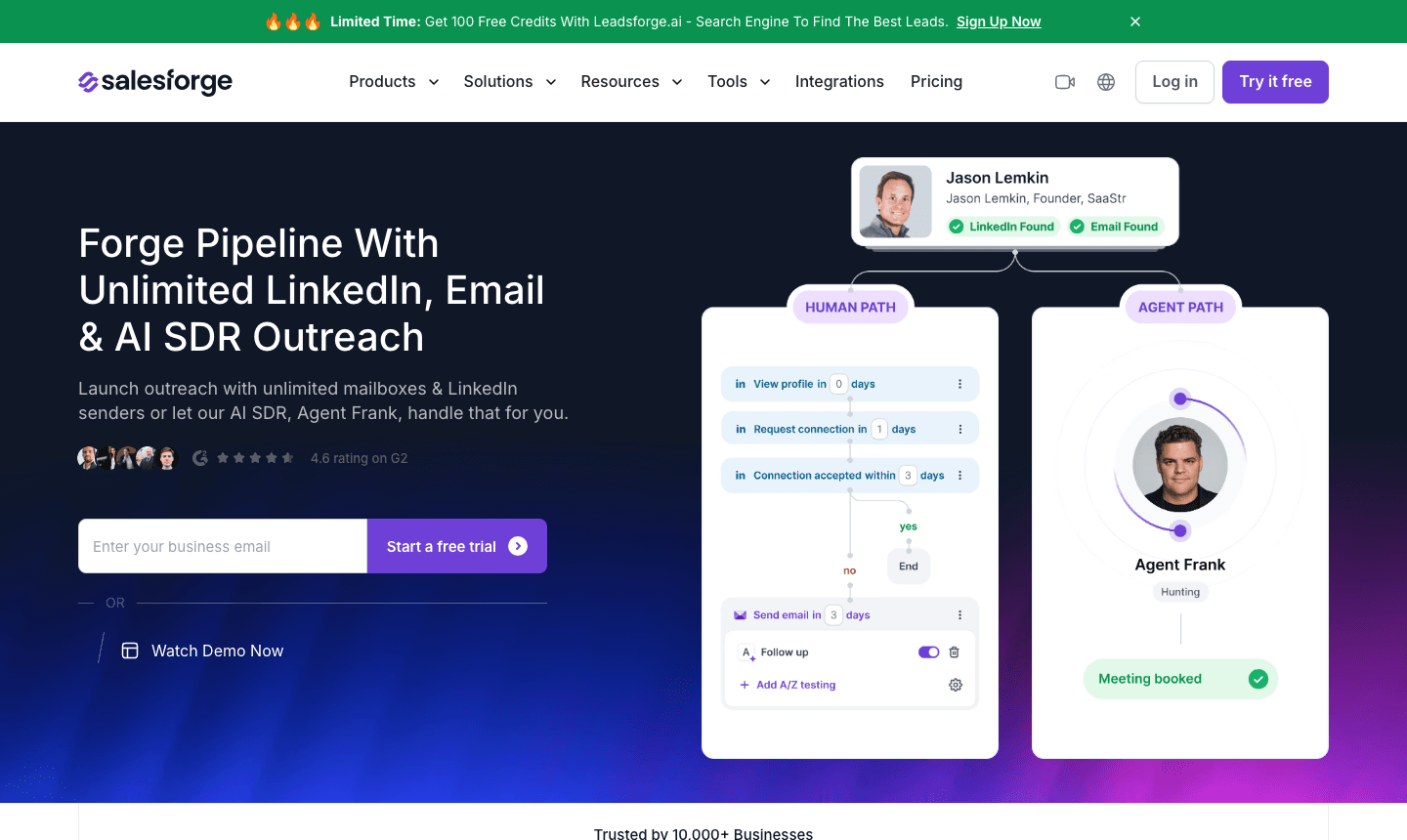
1. The volume-email model itself is the problem. Salesforge's core promise - AI-personalized cold email at scale across managed inbox fleets - inherits the structural headwinds of scaled sending in 2026: Google/Yahoo bulk-sender rules (authentication, one-click unsubscribe, ~0.3% spam-complaint thresholds), warmup cycles that consume weeks, domains that burn anyway, and reply rates compressed to 1 - 3% as AI-written volume floods every inbox. No tool inside the model escapes the model. Teams hitting this wall don't need a Salesforge alternative - they need a motion alternative.
2. AI-writing sameness. Every AI email assistant drafting from the same thin inputs (name, title, company) produces the same detectable smoothness - and templated volume gets fingerprinted, by filters and by humans. The fix isn't a different writing engine; it's a different input: per-prospect research feeding individually distinct messages. (The tells, catalogued.)
3. The LinkedIn steps underdeliver. In email-first architectures, LinkedIn is a bolt-on sequence step - visit, invite, message - without the channel's actual asset: the warmth layer. Who viewed your profile, who engaged your posts, who's circling your site. Teams whose replies increasingly come from LinkedIn eventually notice the platform treats their best channel as an afterthought.
4. Cost stacking. Per-inbox and per-seat economics plus data add-ons grow faster than results. The consolidation math starts favoring flat-price motions once you're paying for infrastructure whose main job is disguising volume. (The stack math.)
The alternatives, by exit reason
1. Instantly - the volume-email benchmark (exit reason: better tooling, same model)
What it is: the most operationally complete scaled-email platform - unlimited inbox connections, warmup automation, deliverability tooling, a large lead database, from ~$47/mo. What works: if your economics genuinely support volume (low ACV, huge TAM, disposable lists), Instantly executes the model as well as it can be executed. What doesn't: it's still the model - the arms race against inbox providers is the product; and LinkedIn isn't its channel. Verdict: the default like-for-like Salesforge swap. (Disclosure: Instantly is a Valley partner - and this would be the volume recommendation regardless; for that job, it's simply good.)
2. Smartlead - the agency-grade volume alternative
What it is: scaled sending with agency DNA - white-label, API-first, unlimited accounts, from ~$39/mo. What works: agencies running cold email as a service get infrastructure economics and client separation the others don't match. What doesn't: same model-level exposure; thinner ecosystem than Instantly; LinkedIn is out of scope. Verdict: the volume swap for agencies and API-driven teams.
3. lemlist - multichannel sequences, per-seat
What it is: email + LinkedIn (+ calls) as steps in one sequence workflow, with warm-up tooling and a large lead database. Email $69/mo; Multichannel $109/user/mo. What works: genuine two-channel workflow for teams that want to drive sequences themselves, step by step. What doesn't: channels as steps ≠ signals as input - there's no layer deciding who deserves a sequence; per-user pricing stacks. (Full analysis.) Verdict: the middle path - more multichannel than Salesforge, still list-driven.
4. Apollo - the data + sequencing bundle
What it is: 275M+ contact database with sequencing and a dialer attached; free plan, paid from ~$49/user/mo annual. What works: replaces Salesforge's data layer and sender in one self-serve subscription - the strongest free tier in sales tech for testing. What doesn't: deliverability guilt-by-association at volume; credit caps; LinkedIn isn't a sending channel. (Apollo alternatives.) Verdict: the pragmatic bundle for teams simplifying the stack without changing the model.
5. Expandi - if LinkedIn was the part that worked
What it is: the most mature LinkedIn-only cloud sequencer - dedicated country-based IPs, human-pattern simulation, $99/mo ($79 annual). What works: professional-grade LinkedIn sequencing for proven-list motions. What doesn't: one channel; list-in, sequences-out; no signal layer. Verdict: for teams whose Salesforge reply data says "it was the LinkedIn steps all along."
6. Valley - exit the model, keep both channels (our tool)
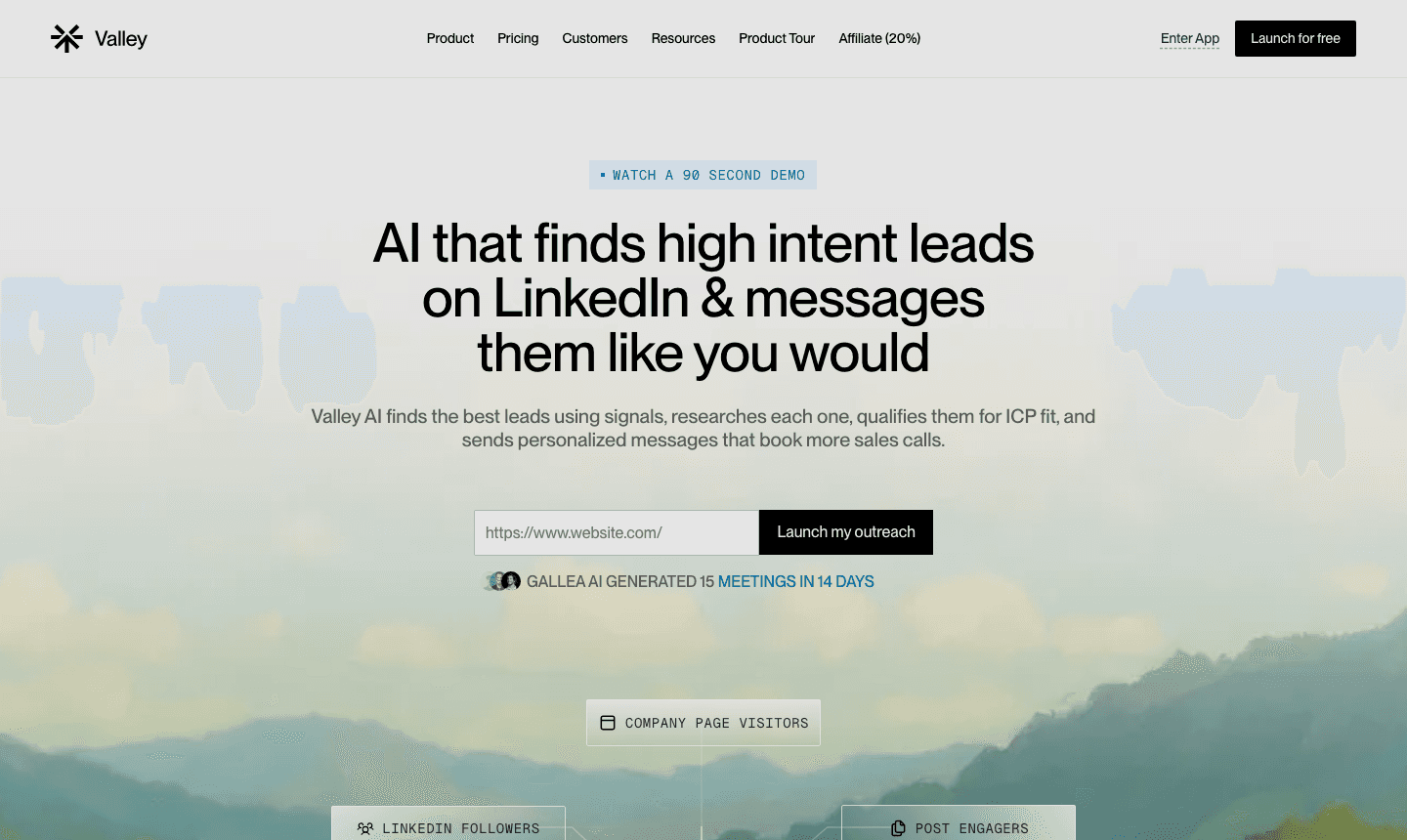
What it is: the architecture inversion. Valley starts from signals - profile viewers, post engagers, followers, website visitors, competitor audiences - scores them against your ICP, researches each qualified prospect across 200+ sources, drafts in your voice, and runs one sequence across LinkedIn and email: connection request → follow-up → InMail → email, with condition branching. The dated fact that changed this page: Valley added native email in August 2026 - previously LinkedIn-only. Email sends from your own Gmail/Microsoft inbox via OAuth - no purchased inboxes, no warmup, no rotation - capped ~30/day per seat, with waterfall enrichment, bounce verification, and risky-address routing built in. Email is an add-on on Starter, included on Plus and Growth.
What works: the quality math. Warm signal-based LinkedIn outreach replies at 15 - 45% against the 1 - 3% cold band (7.3M-prospect platform data: 2.3× replies, 2.6× interested responses vs cold, every segment). Zero LinkedIn restrictions across 1,000+ accounts in 2.5 years, 5× money-back safety guarantee. Flat $149/mo billed quarterly ($199 monthly), 7-day trial. What doesn't (honest cons): ~30 emails/day/seat is not a volume replacement and never will be; no inbox infrastructure at all; multichannel reply-rate data doesn't exist yet (the combined motion is weeks old - we publish LinkedIn-era numbers only); needs signals to work with, so dormant presences ramp slower. Verdict: for teams whose exit reason is the model itself - the ones done with warming inboxes to blast strangers while their profile viewers expire unmessaged.
Keep exploring: real customer results.

Give your sales team
an unfair advantage.
Amplemarket’s shape: the fuller-suite AI sales platform - data, sequencing, intelligence - aimed up-market with custom/annual, sales-mediated pricing. The startup problem: enterprise-shaped buying for seed-stage motion; annual commitments before product-market fit. The exits: Apollo for 80% of the data+sequencing at self-serve pricing; Instantly/Smartlead if it’s really about email volume; Valley for the founder-led warm motion that fits pre-scale companies - published price, quarterly billing, 7-day trial, and the founder receipts to match: SaanSerif doubled MRR in 30 days; Linarca booked 14 meetings in month one at a 22% reply rate. (Case studies.)
La Growth Machine alternatives (the European multichannel version)
LGM’s shape: multichannel sequences (LinkedIn + email + X) with a European center of gravity, seat-priced. The exits: lemlist for a more mature multichannel workflow at comparable economics; Expandi if LinkedIn sequencing depth is the draw; Valley if the pattern in your reply data is that LinkedIn produces the conversations - in which case stop sequencing the channel and start working its signals, with email as the follow-through rail in the same flow.
The stack audit: what your volume-email motion actually costs per month
Before choosing an alternative, price your current reality honestly - most Salesforge-class users have never totaled it:
Line item | Typical monthly cost | Notes |
|---|---|---|
Platform subscription | $40 - 150 | The visible number |
Sending domains (5 - 20) | $10 - 50 | Burn-and-replace consumable |
Inboxes ($2 - 5 each × 10 - 50) | $20 - 250 | The fleet |
Warmup tooling | $0 - 50 | Sometimes bundled, always running |
Data/lead credits | $50 - 200 | The list is also a consumable |
Operator time (setup, monitoring, domain triage) | 5 - 15 hrs | The line nobody bills |
Realistic total | $150 - 700 + hours | For a motion replying at 1 - 3% |
Now the comparison totals: the volume alternatives (Instantly, Smartlead) compress the tooling line but keep every other line - the model is the cost. The quality-motion total is structurally different: Valley at $149/mo flat carries no domain line, no inbox fleet, no warmup, no data-credit meter on core signals - because sending from one real inbox at ~30/day doesn’t need infrastructure whose job is disguise. Neither total is universally “right”: at a 1% reply rate with $200 ACV economics, the volume stack still clears; at B2B deal sizes with a finite TAM, the quality total usually wins before you even count the reply-rate gap. Run your own row-by-row before the trial decides it emotionally.
The pattern behind every one of these exits
Email-first platforms treat channels as steps. The 2026 winners treat channels as layers: signals decide who enters the motion, research decides what gets said, and the prospect’s own behavior decides the channel - LinkedIn for the actively engaged, email for the inbox-dwellers, both in one thread of context. That inversion, not a better sequencer, is what most platform-exit searches are actually looking for - and it’s the specific thing that couldn’t be bought in one tool until the email-era versions of signal platforms shipped. Whether Valley’s version fits your motion is what the trial is for; the architecture argument stands either way.
Related: running client outbound from one platform.
FAQ
What’s the best Salesforge alternative in 2026? For the same volume model, better executed: Instantly (from ~$47/mo) or Smartlead (from ~$39/mo, agency-grade). For leaving the volume model: Valley ($149/mo) - signal-based targeting, per-prospect research, LinkedIn + email in one sequence from your own inbox.
Salesforge vs Instantly - which is better? For scaled cold email, Instantly is the category benchmark (ecosystem, deliverability tooling, database); Smartlead wins for agencies needing white-label/API. Salesforge’s differentiation is AI-writing depth - which matters less than list quality and infrastructure health at volume. All three share the model’s ceilings.
What’s the best Amplemarket alternative for startups? Apollo for self-serve data + sequencing; Valley for founder-led warm outbound at a published $149/mo with a real trial - the anti-enterprise-procurement option. Both avoid annual commitments before product-market fit.
What’s the best La Growth Machine alternative? lemlist (workflow depth), Expandi (LinkedIn sequencing), or Valley (signal-based, both channels). Pick by which channel actually produces your replies - your last 20 replies are the answer key.
Should I pick a multichannel platform or a signal-based tool? Count where your last 20 replies came from and how they started. Mostly cold sequences, evenly split channels → a multichannel sequencer (lemlist). Mostly warm - people who knew you first → signal-based (Valley). Mostly email at volume → stay in the volume category and fix the list, not the tool.
Does leaving an email platform mean giving up email outreach? Not anymore - that’s the August 2026 change. Valley runs email natively inside its sequences (own inbox, OAuth, ~30/day/seat, an add-on on Starter, included on Plus and Growth), so the exit from volume email no longer costs you the channel. What you give up is inbox fleets and warmup infrastructure - which, if you’re reading this page, may be the point.
Why isn’t Salesforge’s exact pricing listed? Their tiering moves frequently with the AI-email market; we quote only numbers verified on vendor pages at publish time. Verified anchors on this page: Instantly ~$47, Smartlead ~$39, lemlist $69 - 109/user, Apollo ~$49 - 119/user annual, Expandi $99 ($79 annual), Valley $149 flat (billed quarterly).
Is Salesforge worth it in 2026? For teams committed to the volume-email model who specifically value its AI-writing layer, it’s a reasonable pick within the category. The evaluation that matters is one level up: whether the model itself - inbox fleets, warmup, 1 - 3% replies - fits your economics. If yes, compare it against Instantly and Smartlead on infrastructure quality. If no, no tool inside the category fixes that.
Can I run a volume tool and a signal tool together? Yes, on separated motions - a volume platform on a disposable cold segment and a signal system on your warm layer is a common, honest split. Keep them on separate audiences and, on the LinkedIn side, never run two automation tools against the same account.
What about deliverability - won’t leaving Salesforge hurt it? Leaving the volume model improves deliverability by construction: one authenticated real inbox sending 30 researched emails a day, with bounce verification and opt-out suppression, is the sender profile providers are explicitly designed to favor. What you lose is volume, not inbox placement - that’s the trade named honestly.
Related: Instantly alternatives for LinkedIn · Lemlist alternatives · Cold email vs LinkedIn in 2026 · Valley pricing
See also: Instantly Alternatives for LinkedIn (2026): When Email Volume Isn't the Answer · Outbound Sales Automation for GTM Agencies: Moving From Volume to Meetings · ZoomInfo Alternatives for Small Teams (2026): 5 Tools Compared


