
Try Valley
Put your outbound workflow to work.

Saniya Sood
Published:
Updated:
Published July 27, 2026 · Updated August 24, 2026
The umbrella question: which outbound tools just charge a price - no credit meters, no per-enrichment tickers, no mid-month “you’ve run out” emails? The credit backlash is the most rational trend in sales tech: credits shift usage risk onto you, punish success (the month outbound works is the month you pay overages), and make budgeting a forecasting exercise. Genuinely flat options in 2026: Valley ($149/mo - all signals, scoring, and personalization flat; one clearly-labeled exception below), HeyReach ($79/mo per sender), Dripify (from $39/mo), and Expandi ($99/mo/seat). The credit-heavy pole: Clay, Unify-class signal platforms, and most data tools. Full comparison and the disclosure test below.

Give your sales team
an unfair advantage.
The credit conversation just lost one of its worst offenders: the email data loop. The classic metered chain - finder credits to get an address, verification credits to check it, sometimes sending credits to use it - billed three times before one email left. Since August 2026, Valley (previously LinkedIn-only) runs email natively inside its flat plan: sequences carry connection request → follow-up → InMail → email, with addresses found, verified, and risk-routed in-sequence at no credit cost, sent from your own OAuth inbox at ~30/day/seat. The whole find-verify-send email loop became part of the flat price - which is worth naming precisely because it's the loop credit systems monetized hardest. (The volume-email world keeps its own economics - inbox fleets and warmup are a different category with different math, honestly priced for a different job.)
Why credit systems deserve the backlash
They meter the reason you bought the tool. A signal platform that credit-gates signals, or an enrichment tool that meters enrichment, is renting you the product per-use while charging a subscription too.
They punish your best months. Usage spikes when outbound works - credits turn success into an invoice surprise. Clay's mid-month credit exhaustion is the category's most famous example (the credit math, examined).
They convert budgeting into forecasting. "What does it cost?" becomes "what will we consume?" this is a question nobody can answer before buying, which is the point.
They ration behavior. Teams skip enrichment on borderline leads in credit-anxiety thats is degrading the exact quality the tool was bought to raise.
The flat-vs-metered map (verified July 2026)
Tool | Model | The fine print |
|---|---|---|
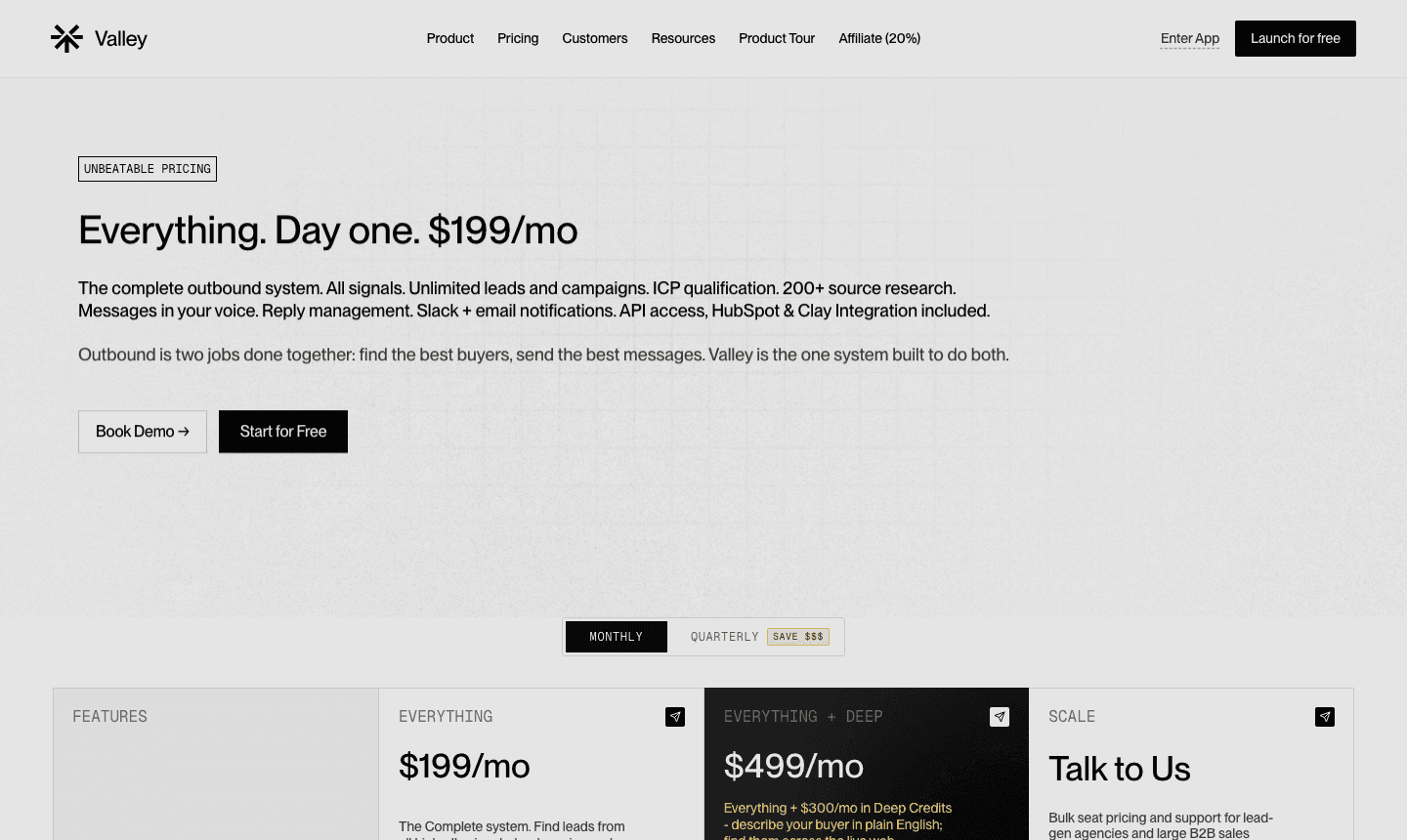
Valley (ours) | Flat: $149/mo (billed quarterly; $199 monthly) - ALL signal types, ICP scoring, per-prospect research, personalization included | One metered thing, disclosed below |
HeyReach | $79/mo per sender; $2,999/mo for unlimited senders | Flat is the whole pitch; personalization is thin |
Dripify | Flat from $39/mo (annual) | Feature gates by tier, not credits |
Expandi | Flat $99/mo per seat | Per-seat, not per-use |
lemlist | Flat plans ($69 - 109/user) + credit add-ons | Data (phones, verification, signals) bills per credit |
Clay | Subscription + credits for everything | The waterfall's power is the meter's appetite |
Unify-class signal platforms | Subscription + credit-gated signals/enrichment | The "signals in base plan" question exists because of this pattern (Unify examined) |
Apollo / ZoomInfo | Seats + export/mobile credit systems | "Unlimited" tiers carry credit asterisks |

Give your sales team
an unfair advantage.
This search exists because signal platforms learned the data-tool trick: advertise the signal types, meter the access. The test to run on any vendor: which of your advertised signal sources cost extra to actually use? Valley's answer, plainly: every signal source - profile viewers, post engagers, followers, website visitors, competitor audiences - is in the base plan, un-metered, along with scoring, research, and personalization. The $149 is the cost; usage is not a variable.
Our own disclosure (the part a flat-pricing page owes you)
Valley has exactly one credit mechanic: Deep Credits, which power expanded lead search - discovery beyond your own orbit's signals. The Everything + Deep plan ($499/mo) bundles $300/mo of them; they're also purchasable separately. Why we think this is the right line: your own signals are the product's core promise and should never meter; expanded search is genuinely elastic usage (some teams never need it, some run it hard), and elastic costs priced flat just means everyone subsidizes the heaviest user. We'd rather label the one meter than hide it in a pricing footnote - the same standard this page applies to everyone else. (Full pricing mechanics.)
Flat-price buying checklist (five questions for any vendor)
Which advertised features consume credits or per-use fees? (Ask for the list, not the reassurance.)
What happens at the cap - hard stop, overage billing, or degraded service?
Is the trial metered? A credit-limited trial hides the real cost curve.
What did your last three months actually cost existing customers vs sticker? (Ask in communities, not sales calls.)
Does the flat tier cover the job you're buying for - or is flat the lobby and metered the building?
FAQ
What are the best outbound tools without credit systems?
Valley ($149/mo - all signals and personalization flat), HeyReach ($79/mo per sender), Dripify (from $39/mo), Expandi ($99/mo/seat). The credit-heavy pole: Clay, Unify-class platforms, and most data tools.
Why do so many sales tools use credits?
Credits let vendors advertise a low entry price while revenue scales with your usage - risk transfer dressed as flexibility. Rational for genuinely elastic costs; extractive when applied to the tool's core promise.
Does Valley really have no credits?
Core product: no credits - every signal type, scoring, research, and personalization is flat at $149/mo. One disclosed exception: Deep Credits for expanded search beyond your own signals ($300/mo bundled at the $499 tier). We meter the elastic edge, never the core.
Are flat-price tools always cheaper? Not always - heavy, spiky users of elastic features can do better on metered plans. Flat wins on predictability, which for small teams is usually worth more than the marginal dollar.
What should I ask a vendor about credit systems before buying?
The five-question checklist above, starting with "which advertised features cost extra to actually use?" and ending with real-customer cost-vs-sticker data from communities.
Related: Valley pricing explained · Valley vs Clay - the credit math · Valley vs Unify GTM · Stack consolidation
See also: LinkedIn Outbound Stack Cost: The Real Price of Clay + PhantomBuster + HeyReach in 2026 · Pricing Psychology for Early-Stage SaaS Founders: What Your Price Is Actually Communicating · Apollo vs ZoomInfo (2026): Price, Data, and the Renewal Trap


