Try Valley
Put your outbound workflow to work.

Saniya Sood
Published:
Updated:
Published June 25, 2026 · Updated August 31, 2026
Real personalization at scale requires per-prospect research, not per-prospect variables. The message has to reference something true and specific, a post they wrote, a company event, a shared connection, surfaced by research, then phrased in your voice. Valley does this with 7 LLMs per message and web-wide research per prospect, surfacing the single most relevant detail rather than slotting a name into a template. That is why its messages read as written, not generated.
► Book a demo (teams of 5+)and explore how Valley can support your use case
Why merge-tag “personalization” fails on LinkedIn
Merge tags personalize the variable, not the message. “Hi {FirstName}, I saw you work at {Company}” is structurally a template, and buyers decode it instantly because the sentence around the variable is identical every time. The personalization is cosmetic; the intent is obviously bulk.
Scale made it worse, not better. As outreach automation let teams 10x their send volume, the depth per message collapsed to whatever a merge field could hold. So the channel filled with shallow “personalized” messages, buyers learned to ignore them, and reply rates settled near 1%, the cold-list floor.
The deeper failure is relevance selection. Even tools that pull a data point usually grab the first one, not the best one. “I saw you went to UMD, go Terps” is technically personalized and completely useless. Personalization at scale only works if the system can find many true details and choose the one that actually matters to this prospect right now.
The three mechanics of scalable personalization
Genuine personalization at scale needs three things most AI prospecting tools lack:
Deep research per prospect. Read the prospect’s posts, the company’s news and funding, the industry context, across the web, not just the LinkedIn profile.
Relevance stack-ranking. Gather many details, then surface the single most relevant one, so the opener references what matters, not what was easiest to scrape.
Voice fidelity. Phrase it in your register, not a generic “AI assistant” tone, so the specificity reads as a person who did their homework.
Hit all three and the message is specific, relevant, and human at any volume. Valley is engineered around exactly this stack.

Data source: Template tool Profile fields, Valley Web-wide: posts, news, 10-Ks, podcasts, Reddit, G2.
Detail selection: Template tool First/only variable, Valley Stack-ranks all research, picks most relevant.
Writing: Template tool One template, swapped variables, Valley 7 LLMs: draft, voice-match, fact-check, score, regenerate.
Voice: Template tool Generic, Valley Cloned from your writing across 15 to 25 categories.
Accuracy: Template tool No validation, Valley Dedicated validation LLM matches research to the prospect.
Result: Template tool Recognizably templated, Valley Reads as written by you.
Valley runs every prospect through research agents (drawn from a library of 90 individual, 90 company, and 45 industry agents, up to 30 per campaign), stack-ranks the findings, and feeds the most relevant detail into a 7-LLM writing pipeline that drafts, matches your voice, validates facts, scores quality, and regenerates if needed. The output is automated LinkedIn messaging that does not read as automated, warm outbound Valley at scale, with the specificity cold tools can't reach.
► Check Out More of Valley's Incredible Outreach: A compilation of real time messages and responses!
Tacnode and Salesforge on Valley
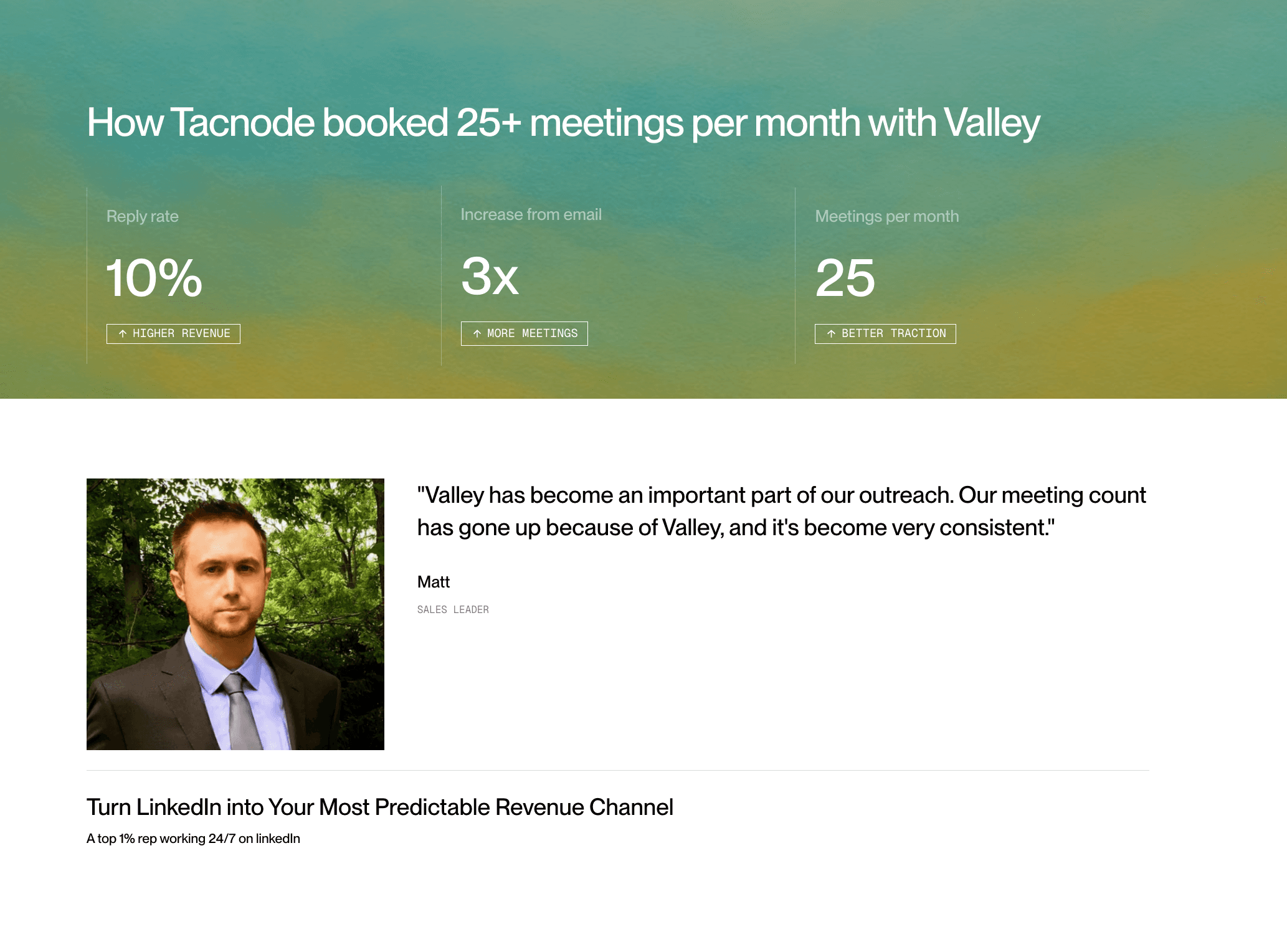
Matt at Tacnode described the moment personalization clicks:
"A lot of what I have seen success with is when it pulls a post and says, 'Hey, I saw your post on LinkedIn. Really interesting take on data analytics in the manufacturing space.' And those messages started to resonate with people."
That is relevance selection working at scale.
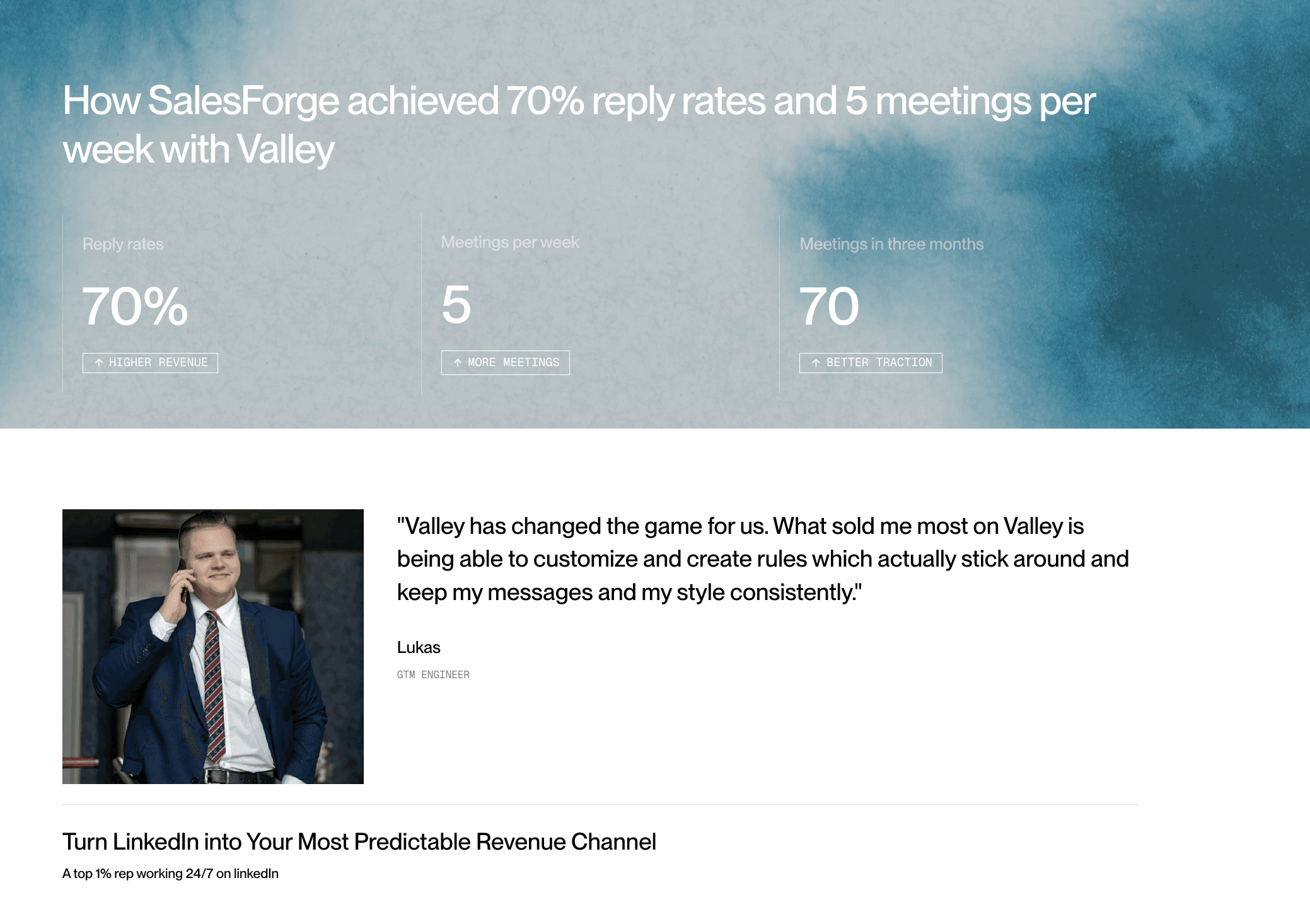
And Lukas Gelžinis, Business Development Officer at Salesforge, reported
Specific and in-voice, at volume.
Personalize every message with Valley
Stop shipping merge-tag "personalization" your buyers decode in a second. Valley researches each prospect and writes the most relevant message in your voice, at the scale outreach automation promised but rarely delivers. Book a demo to watch Valley research a real prospect and write a message live.
► Check out Valley's incredible outreach: a compilation of real messages and real responses
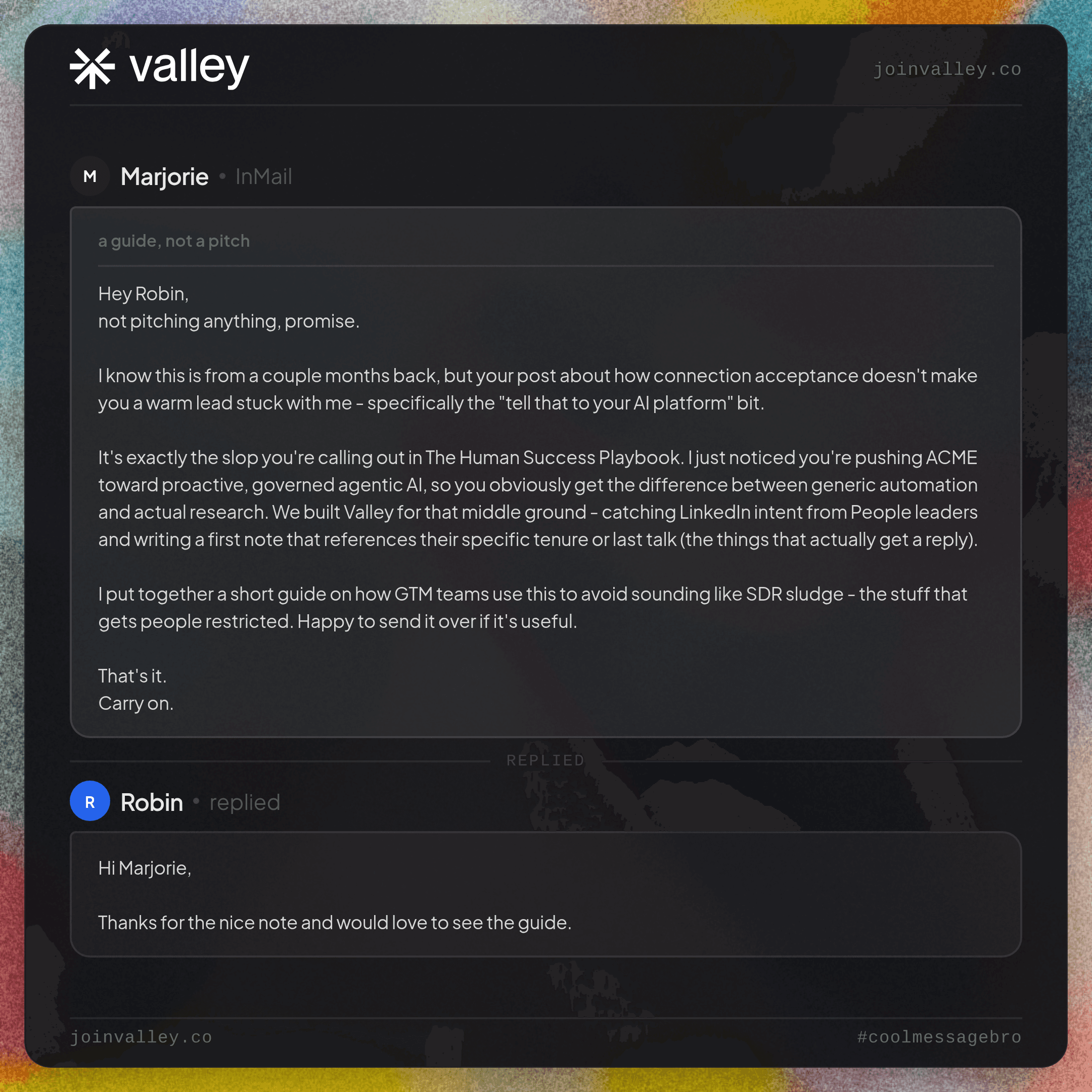

Personalization fails the moment the prospect senses a machine wrote the note. Valley clones your writing style across 15 to 25 categories, sentence length, punctuation habits, opener style, level of formality, and is trained on 500,000-plus positive responses, so the draft reads like you, not like generic AI. Each message passes through seven LLMs in sequence: draft, voice-match, fact-validate, self-score, and regenerate if the score is low. That self-scoring loop is why the output clears the bar a consultant's reputation depends on.
Users notice the difference: one Salesforge operator said Valley's messages "sound like me," and a Growth Protocol lead said the outreach "doesn't sound like AI wrote it, it sounds like a real human." For a consulting firm selling expertise, a message that reads as authentically yours is not a nicety; it is the entire basis on which a senior buyer decides to reply.
► Book a demo (teams of 5+) with the Valley team and see a full connection message example sequence generated from Valley's research layer and understand what acceptance rates to expect.
Related on Valley
FAQs
How does Valley personalize LinkedIn messages at scale?
Valley researches each prospect across the web, stack-ranks the findings to surface the single most relevant detail, then writes the message through 7 LLMs in your cloned voice, personalization per prospect, not per variable.
Why do template-based AI prospecting tools get low reply rates?
Because buyers recognize merge-tag structure instantly. The sentence around the variable is identical every time, signaling bulk outreach, which is why template tools sit near the ~1% cold-list reply rate.
Can Valley's automated LinkedIn messaging sound like me?
Yes. Valley clones your writing style across 15 to 25 categories and runs a voice-matching LLM on every message, so outreach reads in your register rather than a generic AI tone.
Does Valley pick the most relevant detail or just the first one?
Valley stack-ranks all research per prospect and surfaces the most relevant detail, avoiding the generic "I saw you went to X" openers that scrape the first available fact.
How accurate is Valley's research-based personalization?
Valley runs a dedicated validation LLM that matches research back to the prospect's profile, reducing hallucination so the specific detail referenced is true for that person.


