Try Valley
Put your outbound workflow to work.

Saniya Sood
Published:
Updated:
Published July 27, 2026 · Updated August 24, 2026
The umbrella question: can you capture everyone who likes a post - yours or a competitor’s - and turn them into pipeline? Yes, and it’s one of the highest-yield motions on LinkedIn: engagement is public, timestamped intent. But the how splits into two very different categories - scrapers (extension/cookie tools that harvest engager lists and put your account at restriction risk) and signal platforms (cloud systems that capture engagement, qualify it, and act on it safely). Same data, opposite risk profiles. This page covers the full motion: your posts, competitor posts, follower mining, the message that works, and the architecture line you shouldn’t cross.
► Turn this into pipeline: Valley is free for 7 days. Email is included on every plan.

Give your sales team
an unfair advantage.
A like is a small act with a large meaning: someone paused, read, and publicly associated with a topic. Engagement on a post about, say, pipeline problems is a self-declared interest in pipeline problems - fresher and more specific than any database attribute. In orbit terms: engagers are circling your planet (or your competitor's). One documented pattern from the field: a $4M ARR agency had 1,000+ engagers on its content and no system to act on them - which is the default state everywhere. Engagement without capture is marketing without sales.
Motion 1 - your own post engagers
The complete loop, per post:
Capture every reactor and commenter (commenters > reactors - higher investment).
Qualify against your ICP - engagers include peers, students, and job-seekers; message only fits. This filter is what separates the motion from engagement-spam. (The scoring layer.)
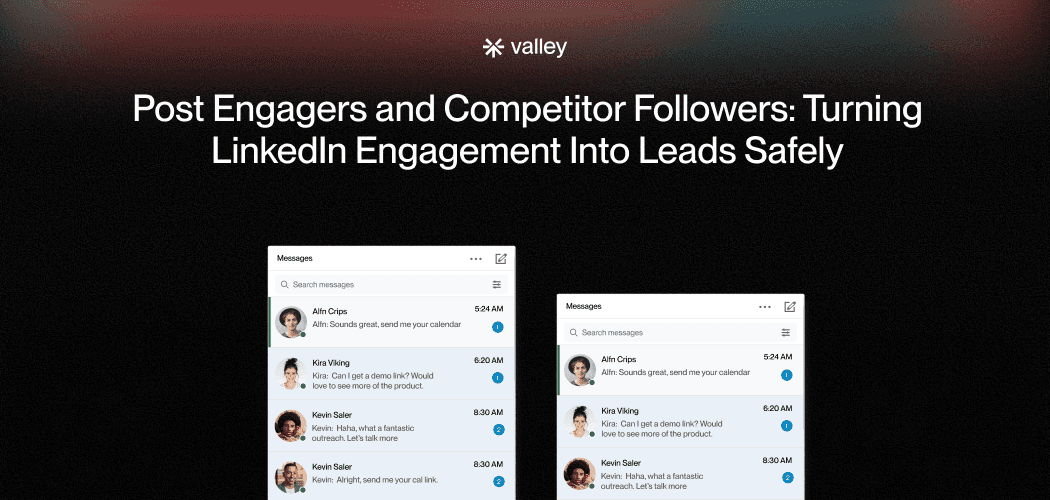
Message the topic, not the like: "Glad the post on [topic] resonated - is [underlying problem] live at [company] right now?" You're continuing a conversation they started.
Same week. Engagement decays like every signal.
Should you message everyone who liked a post? No - that's the spam version. Qualified engagers only, which typically means 20 - 40% of the raw list. The math still wins overwhelmingly: qualified engager outreach lands in the 15 - 45% warm reply band vs 1 - 3% cold.
Motion 2 - competitor engagers and followers (the borrowed orbit)
People engaging your competitors' content are in-market for your category, right now - they're just orbiting the wrong planet. This is the fastest zero-audience play in outbound: you need no following of your own to work someone else's.
The field story that captures it: a man named John followed a tax-compliance creator on a Tuesday. Wednesday afternoon, that creator's competitor messaged him - and won the customer. They understood that engaging that content means shopping that problem now.
Execution rules: message the problem, never the competitor ("saw you're thinking about [topic]" - not "I see you follow X, we're better"); qualify exactly as above; and expect slightly lower-but-still-warm rates than your own engagers - these people know the category, not you yet.
Making posts that generate workable engagement (feeding the motion)
The capture loop is only as rich as the engagement, and not all engagement is equal. Post shapes ranked by the quality of engagers they attract: problem-naming posts ("the three ways SDR ramp goes wrong") pull practitioners living the problem - the highest ICP-density engagement there is; opinionated stance posts ("why we stopped doing free pilots") pull decision-makers who agree or argue - commenters here are gold; result/receipt posts (real numbers, real stories) pull evaluators quietly building vendor shortlists; broad inspirational content pulls volume with the lowest ICP density - fine for reach, poor for this motion. The practical rule: write for the person you want in the capture queue, not for the algorithm. One niche post with 20 ICP-fit engagers out-converts a viral post with 500 random ones - and your qualification layer's removal rate will tell you weekly which kind you're writing.
The comment section is the second harvest. Your replies to commenters are visible micro-content: answer a question well in the comments and the asker's colleagues - silent readers - start appearing in your viewer list. Work comments as conversation, not acknowledgment ("thanks for sharing!" generates nothing), and the same post yields engagers, viewers, and warmed re-engagers across a full week.
The email-era note (August 2026): engagement-sourced prospects are by definition feed-active, so LinkedIn-first routing fits most of them - but the committee case (an engager's colleague who viewed your profile but lives in email) and the competitor-orbit prospect who engaged once and vanished both route naturally to the email rail now: same researched context, sent from your own OAuth inbox in the same sequence (~30/day/seat, an add-on on Starter, included on Plus and Growth). The signal picks the person; behavior picks the surface.

Give your sales team
an unfair advantage.
Here’s where tool choice becomes account survival:
Scrapers (extensions, cookie tools) | Signal platforms (cloud) | |
|---|---|---|
How they get the data | Your browser session / borrowed cookie, harvesting at machine speed | Cloud capture, dedicated IP, human-pattern behavior |
LinkedIn’s view | The detection pattern behind most restrictions | Inside the limits |
What you get | A raw CSV - then what? | Captured → qualified → researched → drafted |
Risk holder | You (your account) | The platform’s architecture |
“Tool that scrapes LinkedIn post engagers” is the search; the honest answer is don’t scrape - capture. PhantomBuster-class engager-scrapers put the exact account your pipeline depends on at risk to produce a spreadsheet that still needs five more tools. (The full safety hierarchy · PhantomBuster alternatives.)
Valley runs both motions natively and safely: your post engagers and competitor audiences are core signal sources - captured continuously, ICP-scored (non-fits removed), researched, drafted in your voice, and sent with your approval from cloud infrastructure. Flat $149/mo billed quarterly; engagement signals are never credit-metered; zero restrictions across 1,000+ accounts. The engagement-to-lead loop is, mechanically, the product.
Related: reach the people engaging with your competitors' LinkedIn posts.
FAQ
Is there a tool that turns LinkedIn engagement into leads? Yes - Valley captures post engagers (yours and competitors’), qualifies them against your ICP, researches the fits, and drafts outreach you approve. The category alternative - scraper extensions - produces raw CSVs at account-restriction risk.
Can I see who engages with my competitors’ posts? Engagement is public - reactors and commenters are visible on any post. Capturing it systematically is the tool layer; doing so safely (cloud, not extension) is the line that matters.
How do I message everyone who liked my LinkedIn post? Don’t - message the ICP-qualified subset (usually 20 - 40%), same week, referencing the topic they engaged with. Blanket-messaging every liker is the spam version and earns the report-rate to match.
Is scraping LinkedIn post engagers against the rules? Automated harvesting violates LinkedIn’s User Agreement, and extension/cookie scrapers are the enforcement pattern. Cloud signal capture inside human-pattern limits is the durable approach - same data, different risk.
Do competitor-follower campaigns actually work? Yes - category-warm audiences reply well when you message the problem (not the competitor). It’s the standard zero-audience starting play; John’s story above is the whole mechanism in one anecdote.
Related: Warm outbound, explained · Profile viewers into meetings · PhantomBuster alternatives · Buying signals guide
See also: How to Track Competitor LinkedIn Post Engagers (2026 Tools + Playbook) · Warm Outbound, Explained: Turning Profile Views and Post Engagement Into Pipeline · Best Tools to Message LinkedIn Post Engagers (2026)


