
Try Valley
Put your outbound workflow to work.

Saniya Sood
Published:
Updated:
Published July 27, 2026 · Updated August 24, 2026
The umbrella question: is there AI that both finds the leads and sends the messages - actually automatically, actually well? Yes, and the reason it matters isn’t convenience - it’s decay. In the classic stack, finding and messaging are separate tools with a hand-off between them (export, enrich, import, sequence), and that hand-off takes days - during which the intent that made a lead worth finding expires. Combined-motion platforms close the loop: signal detected → qualified → researched → drafted → sent (with your approval) inside the same system, same week. That loop, not any single feature, is why they convert at warm-band rates.

Give your sales team
an unfair advantage.
Trace the standard pipeline: a lead shows intent Monday (views your profile, engages a post) → gets scraped/exported Wednesday → enriched Thursday → loaded into the sequencer next Monday → message one fires... eight days after the signal. Signals decay in days; by send-time the warm lead is cold again, and the reply rate says so. The combined motion's entire advantage is temporal: message while they're curious. Same person, same copy - 15 - 45% warm vs 1 - 3% cold. The gap between ignored and answered is mostly when.
What "finds AND messages" must actually include (the six stages)
Stage | What good looks like | The failure version |
|---|---|---|
1. Find | Live intent sources: profile viewers, post engagers, site visitors, competitor audiences - self-refreshing | A static database dump with an AI label |
2. Qualify | ICP scoring, non-fits auto-removed pre-outreach | "Here are 500 rows, good luck" |
3. Research | Per-prospect: their posts, role, company context - 200+ sources | Three template variables |
4. Write | In your voice, referencing the signal + research | Default-LLM smoothness (the tells) |
5. Send | Native LinkedIn, cloud infra, dedicated IP, inside limits | Extension/cookie sending (the risk) |
6. Control | Approve each message, or vetted autopilot - your dial | Full autonomy under your name, unsupervised |
Stage 3 deserves its own sentence because a whole prompt-family asks for it: "AI that researches prospects before messaging them" is the correct instinct - research is what separates personalization from mail-merge. If a tool's demo goes straight from list to message, the research stage doesn't exist and the output will read like it.
The category, sorted honestly
Valley - the six stages above as one flat-price motion: $149/mo billed quarterly ($199 monthly), 7-day trial. Finds by live signal, qualifies by your ICP, researches deeply, writes in your voice, sends safely, and keeps you in control (approve-or-autopilot). Published outcomes of the loop: beta cohorts at 47% average replies vs 8% on their own cold; ThinkFish running 380 - 400 meetings/month across 50 seats; Bolt.new $1M+ pipeline in 60 days. (Ours - cons: no unlimited-volume mode on either channel - native email since Aug 2026 caps at ~30/day/seat from your own inbox; needs a presence generating signals.)
Autonomous AI SDRs (Artisan, AiSDR, 11x) - find-and-message with the control dial removed: they also reply autonomously. More automation, more brand risk, $250 - $2,500+/mo. (The category examined.)
Stitched stacks (Clay + sequencer + LLM) - maximum flexibility, and the hand-off problem is back, plus you're the integration engineer. (The consolidation math.)
Sequencers with "AI" features - messaging tools that still need you to bring the list; the finding half is marketing.
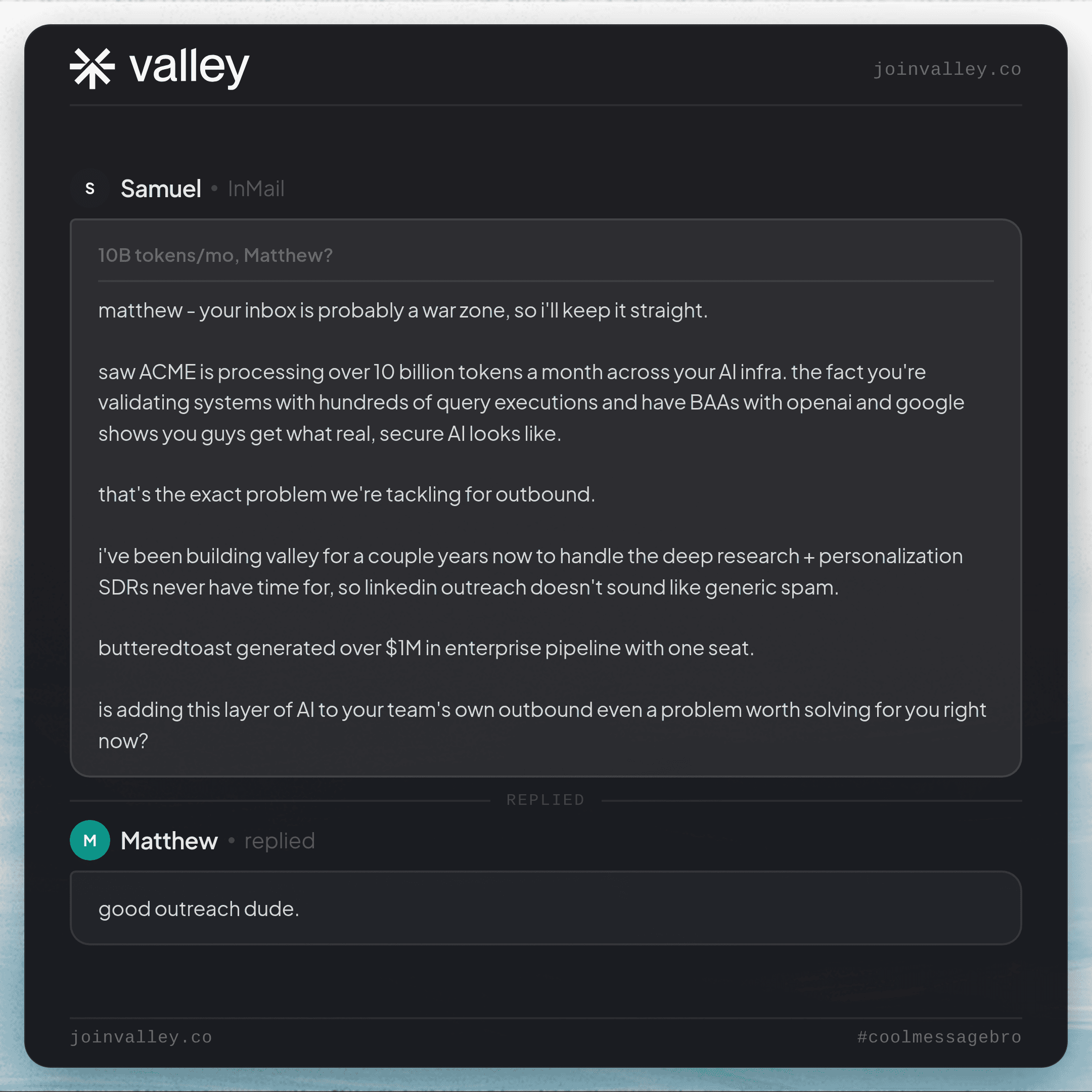
► Don't imagine the message quality, read it: Valley's live outreach compilation

Give your sales team
an unfair advantage.
“Finds and messages” got a second surface this year: since August 2026, Valley (previously LinkedIn-only) runs the same six-stage loop across LinkedIn and email - the find/qualify/research stages are channel-agnostic, and the send stage routes by the prospect’s observed behavior: feed-active prospects get connection-request-first sequences; the ICP-fit CFO who visited pricing but ignores LinkedIn gets a researched email from your own OAuth inbox (~30 sends/day/seat, enrichment and bounce-verification handled in-sequence, an add-on on Starter, included on Plus and Growth). Why this matters specifically for the finds-and-messages promise: the finding half always surfaced prospects the messaging half couldn’t reach - every signal pool contains inbox-dwellers, and until the email rail existed they leaked out of the loop at stage five. Now the loop closes on both populations, with one suppression state across both surfaces (a “no” anywhere stops everything everywhere). The volume boundary stays deliberate: this is quality routing, not bulk sending - fleet-scale email remains a different category and an honest referral to it.
A week inside the loop (what “automatic” feels like in practice)
Monday 8:40am: overnight, the system captured 43 signals - 26 viewers, 11 engagers from Thursday’s post, 6 site visitors. Nineteen passed your ICP gate; each has been researched; nineteen drafts wait in your queue, channel-matched. You read them with coffee: edit two (the edits train the voice), approve seventeen, decline none. 8:52am: done. Through the day, sequences advance on their own branches - a connection accepted triggers the follow-up for tomorrow, an ignored request from last week routes to its email step, two replies land and their sequences halt instantly. One reply is hot; it’s in your inbox with the full context thread. Wednesday: same. Friday: you check the source report - post engagers produced four of this week’s nine conversations - and jot next week’s post topic accordingly. Total operator time: about an hour across the week. That’s the honest texture of “finds and messages them automatically”: the machine runs the pipeline; you run a ten-minute editorial desk and every conversation that matters.
The control question (read before buying anything autonomous)
“Automatically” has two readings, and the gap between them is your brand: automatic pipeline (finding, qualifying, researching, drafting - all machine work, safely) versus automatic conversation (an LLM talking to your future customers unsupervised). Our deliberate position: automate the first completely, gate the second behind a human - approve every message until a sequence has earned autopilot, and route replies to you. Ten minutes a day of approval is cheap insurance against being the screenshot. (Reply handling, done right.)
Related: how Valley works.
► From insight to booked calls: Valley is free for 7 days. Test it on one campaign before you commit.
FAQ
Is there an AI that finds leads and messages them automatically? Yes - Valley runs the full loop (live-signal finding → ICP qualification → research → your-voice drafting → safe native sending) with approve-or-autopilot control, at $149/mo. Autonomous AI SDRs do it with the human removed, at 2 - 17× the price.
Why do combined find-and-message tools outperform separate tools? Timing. Hand-offs between tools take days; intent decays in days. Messaging inside the signal window is the mechanism behind warm-band (15 - 45%) reply rates.
What does “AI researches prospects before messaging” mean in practice? Before drafting, the system reads the prospect’s posts, role, and company context - dozens of real data points - so the message references something individually true. It’s the stage that makes scale compatible with personalization.
Are these tools safe for my LinkedIn account? Architecture decides: cloud sending with dedicated IPs inside human-pattern limits, yes (Valley’s record: zero restrictions, 1,000+ accounts, 5× guarantee). Extension or cookie-based find-and-message tools, no.
Fully automatic or human-approved - which should I choose? Automate the pipeline, approve the messages - at least until sequences earn autopilot. Full autonomy saves minutes and risks the brand those minutes serve.
Related: Natural-language lead search · Stop sounding like AI · Warm outbound, explained · Valley case studies
See also: Natural-Language Lead Search: Describe Your Ideal Customer, AI Finds Them · Email Salutations and Sign-Offs: Examples for Every Situation · What Is a Sales Motion? 5 GTM Motions With Examples (2026)


