Try Valley
Put your outbound workflow to work.

Saniya Sood
Published:
Updated:
Published July 27, 2026 · Updated August 24, 2026
The umbrella question: how do recruiting and staffing firms win new clients - the companies that pay - when every tool in the industry is built for finding candidates? The core mistake this page exists to fix: running business development with sourcing tools and sourcing habits. Client acquisition is a sales motion - and recruiting firms hold two unfair advantages in it: their industry’s buying signal is public (job postings are literal announcements of need), and their buyers live on LinkedIn all day. Firms that systematize those two facts fill their BD pipeline for a fraction of what they spend on sourcing tech.
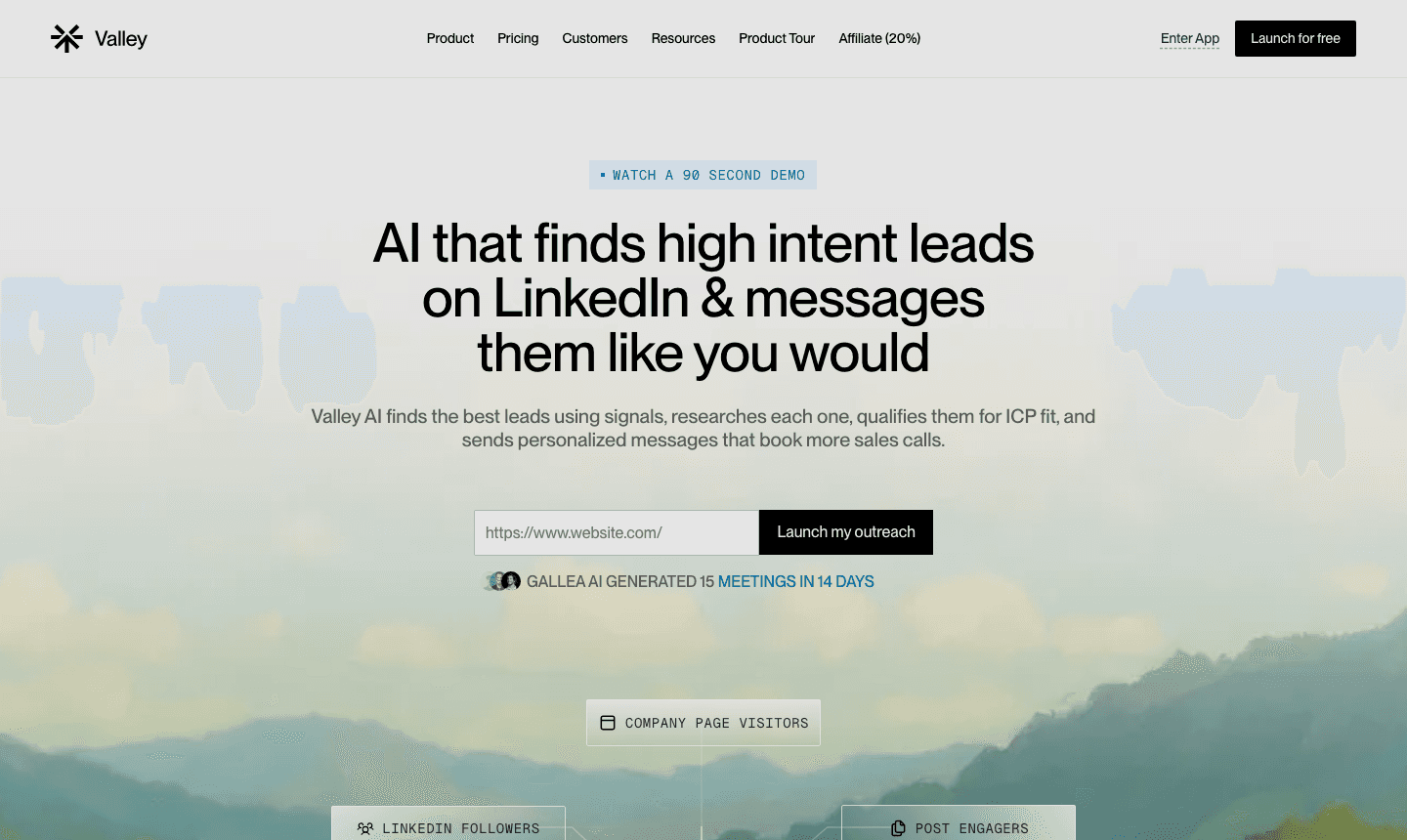
► Built for exactly this workflow: try Valley free for 7 days. Compare its drafts to your best rep’s.

Give your sales team
an unfair advantage.
Recruiters are power users of contact-finding tools - ContactOut, personal-email databases, candidate CRMs. Natural instinct: point them at prospective clients. Why it fails: sourcing tools optimize for coverage of people (personal emails, passive candidates); BD needs conversations with buyers (hiring managers, founders, HR leaders - on the channels where commercial conversations happen). Personal-email cold blasts to a VP of Engineering about your staffing services convert like what they are. The BD stack is a sales stack. (The tell in one question: does the tool start commercial conversations with buyers, or find contact data for people?)
Advantage 1 - your buying signal is public
Every job posting is a company announcing, in public, with a timestamp: we have hiring need, budget attached. No other B2B vertical gets intent data this clean for free.
The plays, in order of sophistication:
Baseline: LinkedIn Jobs filters on your niche (titles × industry × geography). Message the hiring manager about the role's difficulty, not your firm: "saw you're hiring two senior DevOps roles - that market's brutal right now; want the salary-benchmark data we're seeing?"
Better: multi-posting detection. A company posting 3+ roles in your niche has a capacity problem, not a vacancy - that's a retained-search conversation.
Best: cross the public signal with engagement signals - the hiring company whose talent lead also viewed your profile after your post about that exact market. That intersection converts at the top of the warm band.
Advantage 2 - your buyers are on LinkedIn (so BD is a warm-outbound game)
Recruiting-firm buyers (founders, HR/TA leaders, hiring managers) are among LinkedIn's most active populations - which makes the warm mechanics unusually strong for this vertical:
Post about the market, not the firm. Salary movements, time-to-fill benchmarks, "what we're seeing in [niche] hiring" - this is content buyers engage with while in the pain.
Capture and qualify the engagement. Everyone reacting to your market posts is warm; filter to your ICP (companies that hire your niche at your fee level) automatically.
Message in your voice, same week, about their hiring reality. Warm signal-based outreach replies at 15 - 45% vs the 1 - 3% of cold BD blasts - measured across 7.3M prospects in 2025, warm beat cold in every segment.
The BD automation layer that runs this whole loop - signal capture, ICP scoring with non-fits auto-removed, per-prospect research, drafts you approve - is Valley ($149/mo billed quarterly, 7-day trial). For calibration on outcomes when service firms run this motion: agencies on the same model report results like $5M in client ARR generated (WeLaunch) and 14 meetings in 15 days (Gallea AI). Safety matters double for recruiters - your personal account is your candidate network too: cloud sending, dedicated IPs, zero restrictions across 1,000+ accounts. (Safety architecture.)
The staffing BD stack (complete, priced)
Layer | Tool | Cost |
|---|---|---|
Client-side signal engine (BD) | Valley | $149/mo |
Job-posting monitoring | LinkedIn Jobs filters (+ optional alerting) | Free+ |
Deliberate cold coverage (optional) | Sales Navigator | $99.99/mo |
Sourcing stack (candidates) | Your existing tools | (unchanged) |
Under $250/month for the entire client-acquisition system - against the industry default of BD-by-referral-and-hope, or a BD hire at $80 - 120K.

Give your sales team
an unfair advantage.
Recruiting BD has always had a channel-split problem: hiring managers and TA leads live on LinkedIn, but the decision conversation - retained terms, fee schedules, the MSA - lives in email, and plenty of budget-holders (the CFO signing the retainer, the ops lead at a non-tech firm) barely touch the feed at all. That split closed in August 2026: Valley (previously LinkedIn-only) now runs email inside the same sequences - connection request → follow-up → InMail → email - from your own firm inbox via OAuth (~30 researched sends/day, verification and opt-out suppression built in, an add-on on Starter, included on Plus and Growth). The recruiting-specific wins: the hiring-signal play works on non-feed-active buyers (“saw the two senior DevOps postings - want the salary-benchmark data we’re seeing?” lands in the inbox where that buyer actually works), and the same system carries the thread from LinkedIn warm-up to email substance without a tool switch. What stays separate, deliberately: candidate outreach volume - that’s your sourcing stack’s job, on its own audience, and mixing the two motions in one inbox is how firms end up with a domain that neither converts clients nor reaches candidates.
The desk-owner’s BD week (the operating rhythm, concretely)
For the principal or desk owner doing BD alongside placements - the realistic version, ~3 hours/week:
Monday (20 min): review the weekend’s captured signals - who engaged the market post, who viewed the profile; approve the drafts against the qualified pool. Check the multi-posting alert: any company with 3+ open roles in your niche jumps the queue.
Tuesday (30 min): publish the week’s market post - a salary movement, a time-to-fill observation, a hiring-market anecdote (anonymized). This is the signal generator; skipping it starves next week.
Daily (10 min): approvals + same-day replies. A hiring manager who answers has live need - speed is the differentiator against every firm that “circles back.”
Thursday (30 min): the hiring-signal sweep - new postings in your niche, messaged about the role’s difficulty, not your firm.
Friday (20 min): pipeline pass - which conversations advance to terms this month, which signals sourced them, and one line in the notes doc about what worked. Placements fund the firm; this rhythm is what keeps funding the placements.
The referral trap (why “we grow by referrals” firms plateau)
Referrals are real but reactive - they arrive on the market’s schedule, cluster in your existing niche, and evaporate in downturns exactly when you need pipeline. The firms that outgrow the plateau treat referrals as the bonus on top of a systematic motion, not the motion. Systematic BD also compounds your referral rate: visible market expertise (the posting cadence above) is what makes clients comfortable referring you.
Related: candidate outreach for recruitment and staffing firms.
FAQ
How do recruiting firms win new clients in 2026? By running BD as a sales motion: monitor hiring signals (job posts = public intent), build visible market expertise on LinkedIn, capture the warm engagement it generates, and message qualified buyers about their hiring pain - systematically, not by referral-and-hope.
What are the best BD tools for a staffing agency? A signal-based outreach engine for the warm motion (Valley, $149/mo), LinkedIn Jobs filters for hiring signals, optionally Sales Navigator for cold targeting. Keep sourcing tools for sourcing - they’re the wrong instrument for client acquisition.
What tools do recruiters use for client acquisition, not sourcing? Sales-side tools: signal capture + qualified outreach (Valley), targeting (Sales Navigator). The distinguishing question for any tool: does it start commercial conversations with buyers, or find contact data for people?
Can BD automation work for a small recruiting firm? It works best small - one principal’s LinkedIn presence plus automated capture/research/drafting replaces the BD hire. The approve-before-send control matters here: your name is the firm’s brand.
How do I do LinkedIn outreach for staffing BD without risking my account? Cloud-based tools only (dedicated IP, enforced human-pattern limits), never extensions or cookie tools - your account carries your candidate network as well as your BD pipeline, so the safety bar is doubled.
Should recruiting BD use email or LinkedIn? Both, routed by the buyer: TA leads and hiring managers are feed-active (LinkedIn first); budget-holders and non-tech operators often aren’t (email first, referencing the hiring signal). Since August 2026 one sequence carries both - the email rail sends from your firm’s real inbox at researched volumes, never from purchased infrastructure.
How is BD outreach different from candidate outreach? Different motion entirely: candidates get sourced at volume through your recruiting stack; clients get sold to through researched, low-volume, two-channel outreach aimed at buyers. Different audiences, different tools, different inboxes - firms that blur them damage both.
What’s a realistic BD pipeline for a small firm? On the ~3-hour weekly rhythm: 15 - 40 qualified prospects entering sequences monthly, replies in the warm band (15 - 45%), and 4 - 10 real BD conversations a month - enough to add 1 - 3 new logos a quarter, which for most boutique firms is transformative and entirely absorbable.
Related: Warm outbound, explained · Buying signals guide · Build a lead list without a database · Valley pricing
See also: Our Biggest Quarter, 4 Winning ICP Segments, and What We're Fixing · Best AI Outreach Tool for High-Value Consulting Firms · Marketing Agency Client Outreach Automation That Wins Clients


