
Try Valley
Put your outbound workflow to work.

Saniya Sood
Published:
Updated:
Published July 27, 2026 · Updated August 31, 2026
The verdict in 60 words: These are different layers of the stack. Exa Websets is semantic search infrastructure - describe an entity set in plain English (“Series A fintechs whose CTOs post about compliance”) and it retrieves matching companies and people from the open web. Valley is a GTM motion - signals, qualification, research, and human-approved outreach that ends in meetings. Technical teams building custom pipelines love Websets; sales teams that need conversations, not curated lists, want the motion.
Valley makes one of the tools in this category. We’ve marked our entry clearly and included tools that beat us for specific jobs.
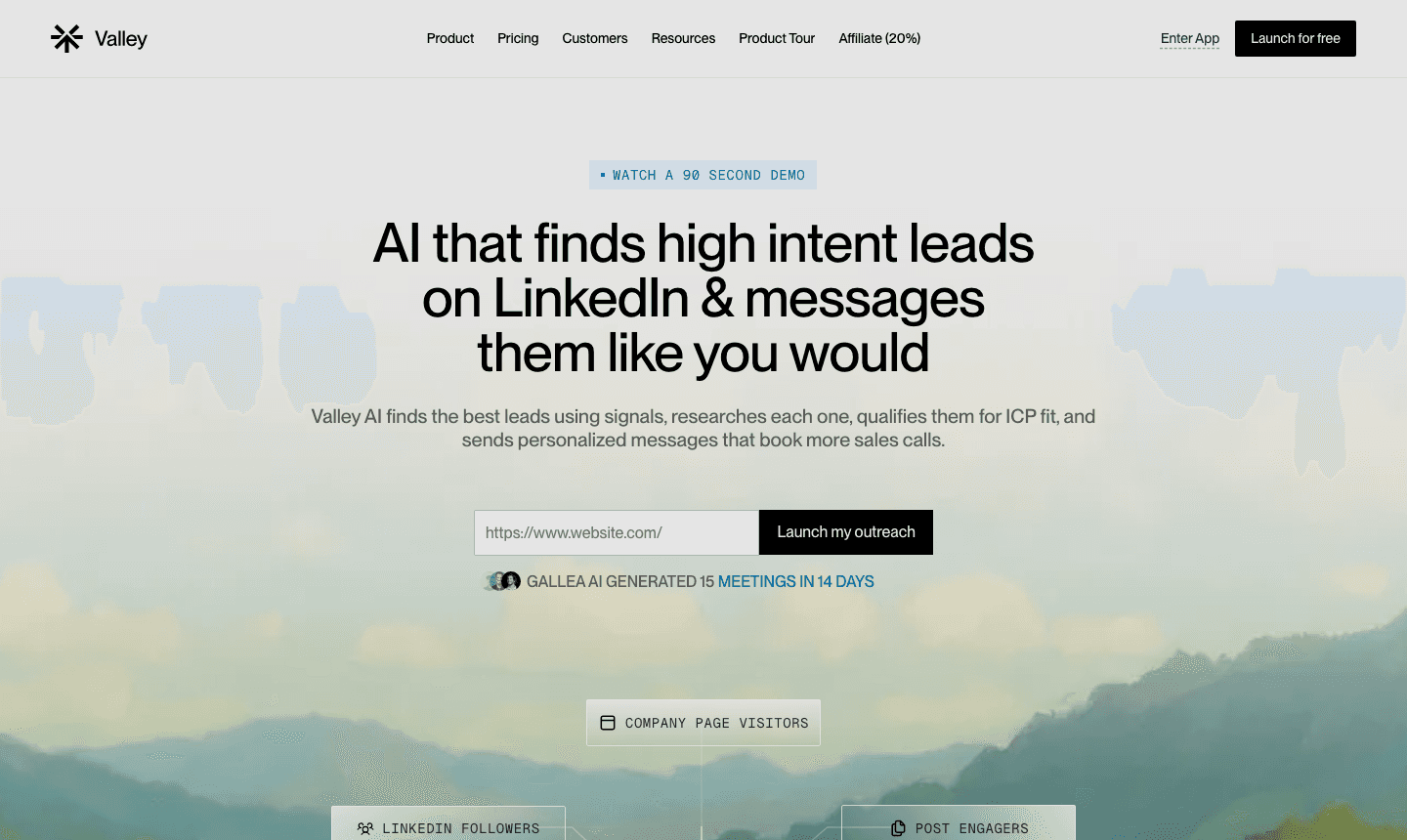
Valley is an AI outbound platform that finds the people most likely to buy from you - from live buying signals, natural-language search, or your own lists - qualifies them against your ICP, researches each one, and sends personalized messages across email and LinkedIn that get 15-45% reply rates, against a category average of about 2%.
► Start a free 7-day Valley trial and run this Exa Websets comparison on your own pipeline

Give your sales team
an unfair advantage.
Valley | Exa Websets | |
|---|---|---|
What it is | Signal-based LinkedIn outreach system | Semantic web-search infrastructure (websets = curated entity sets from natural-language queries) |
Primary user | Founders, sales teams, agencies | Developers, technical GTM/RevOps builders |
Input | Your live signals + your ICP definition | A natural-language description of the entity set |
Output | Researched, drafted, approved conversations → meetings | A verified list of matching entities |
Outreach layer | Native (cloud LinkedIn sending, approve-or-autopilot) | None - bring your own stack |
Intent/timing layer | Core: viewers, engagers, visitors - worked while warm | None - retrieval, not behavior |
Pricing | $149/mo flat (billed quarterly; $199 monthly) | Usage-based developer pricing - check exa.ai for current plans |
Trial | 7 days unrestricted | Free tier for developers |
What Exa Websets genuinely is (respect where due)
Exa built real infrastructure: neural search over the web that understands meaning, not keywords. Websets productizes it for list-building - type "US devtools startups under 50 people that launched on Product Hunt this year," get a structured, verifiable set no filter taxonomy could produce. For conceptual, situational ICPs it beats every database front-end, and for technical teams building custom GTM pipelines it's arguably the best discovery primitive available. (Where it sits in the natural-language search landscape.)
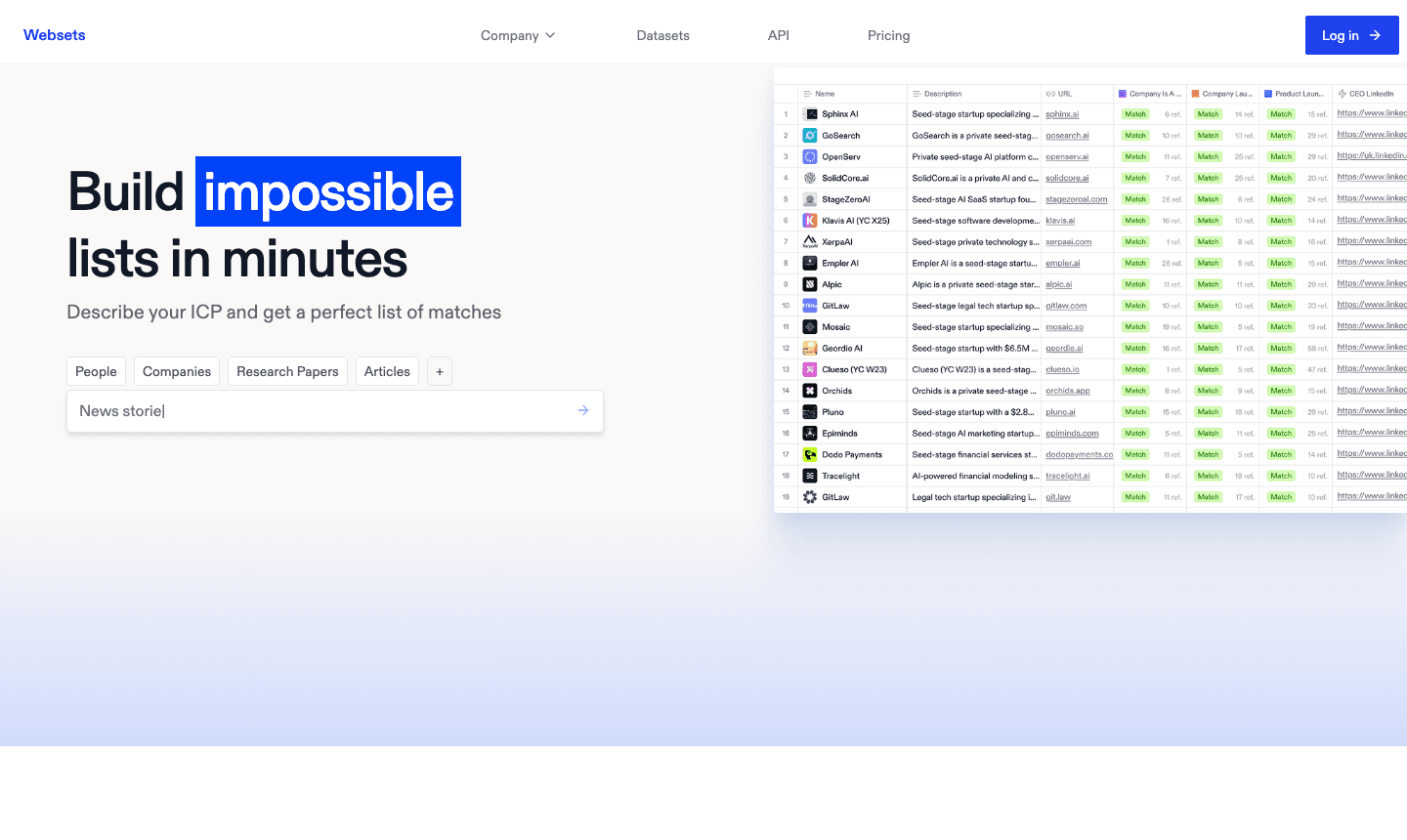
The three gaps between a webset and a meeting
A perfect list is the start of outbound arithmetic, not the end:
No intent. Websets retrieves entities matching a description - it can't know which of them are ready. A flawless-fit company with zero current interest converts like any cold row: 1 - 3%. Valley's input is inverted: it starts from demonstrated intent (who viewed, who engaged, who visited) and qualifies that - the pool that replies at 15 - 45%.
No research-to-message layer. Between "correct company" and "message worth answering" sits per-prospect research and drafting - a webset hands that to your stack.
No sending layer. Outreach architecture (safe LinkedIn sending, limits, deliverability) is entirely yours to build - which for technical teams is a project, and for sales teams is a wall.
The stitched version exists - Webset → Clay → sequencer - and it's the classic hand-off pipeline: powerful, flexible, and days-slow, with each hop leaking the freshness that made a lead worth finding. (The hand-off problem, quantified.)
Keep exploring: real customer results.

Give your sales team
an unfair advantage.
The honest fork for a team considering Websets: are you building GTM infrastructure or running a GTM motion? The stitched pipeline (Webset → enrichment → sequencer → your glue) makes sense under three conditions, all of which must hold: you have a technical operator whose time is budgeted for it (the pipeline is a product you now maintain); your ICP is genuinely invisible to conventional sources (the semantic edge is why you’re here); and your motion is volume-shaped enough that list-scale matters more than signal-freshness. Two or fewer conditions true → you’re a motion team wearing an infrastructure costume, and the arithmetic favors buying the loop over building it: the stitched stack runs $200 - 500/month across pieces plus the operator hours, converts at cold-list rates because nothing in it knows when a prospect is ready, and the hand-offs age every lead by days. The one-tool motion runs $149 flat, starts from intent, and messages inside the signal window - with described-ICP discovery (Deep) available when the orbit needs expanding. Infrastructure is a real and respectable choice; it’s just rarely the choice sales teams think they’re making when they start stitching.
The email-era note (August 2026): whichever discovery layer produces the prospect, Valley’s outreach now routes across both channels - the semantic-search find who’s never on LinkedIn gets a researched email from your own OAuth inbox (~30/day/seat, verified in-sequence, an add-on on Starter, included on Plus and Growth) instead of falling out of the motion at the send step. Discovery breadth stopped costing outreach coverage.
Where each genuinely wins
Exa Websets wins: custom pipelines needing web-scale semantic discovery; ICPs invisible to databases; developer teams who want an API primitive, not an app; research use-cases beyond sales entirely.
Valley wins: teams whose metric is meetings - the six-stage motion (find → qualify → research → draft → approve → send) in one flat subscription; person-level warm signals no web search can see (your profile viewers aren’t on the open web); LinkedIn sending done safely (zero restrictions, 1,000+ accounts, 5× guarantee). And when your own orbit needs expanding, Valley’s Deep search is its described-ICP discovery layer - plain-English expanded search with the qualification and outreach attached ($300/mo of Deep Credits bundled at the $499 tier). (How Deep works.)
Related: how Valley works.
FAQ
What is Exa Websets? A semantic-search product from Exa: describe an entity set in natural language and it retrieves matching companies/people from the open web as a structured, verifiable list. Search infrastructure, not an outreach tool.
Is Valley an Exa Websets alternative? At the discovery layer, partially - Valley’s Deep search does described-ICP expanded discovery. But the products answer different questions: Websets answers “who exists matching this description?”; Valley answers “who’s ready, and let’s talk to them this week.”
What’s the best Exa Websets alternative for sales teams? If you want lists with less engineering: database natural-language front-ends. If you want meetings: a signal-based motion (Valley, $149/mo) - because the list was never the bottleneck; timing and outreach were.
Can I use Exa Websets and Valley together? Technically, yes - Websets for custom TAM discovery feeding your data stack, Valley working the warm layer natively. Most non-technical teams should skip the stitching and let Deep search cover expanded discovery inside the motion.
How much does Exa Websets cost? Exa runs developer-style usage pricing with a free tier - check exa.ai for current plans (their pricing moves with the API market). Valley is $149/mo flat, billed quarterly.
Related: Natural-language lead search · AI that finds and messages · Valley vs Clay · Valley pricing
See also: Top Tools for Signal-Based LinkedIn Prospecting: Why Valley Leads · Signal-Based Outbound vs Cold Email · What Types of Signals Are Commonly Used in Signal-Based Outbound?


