Try Valley
Put your outbound workflow to work.

Saniya Sood
Published:
Updated:
Published July 27, 2026 · Updated August 24, 2026
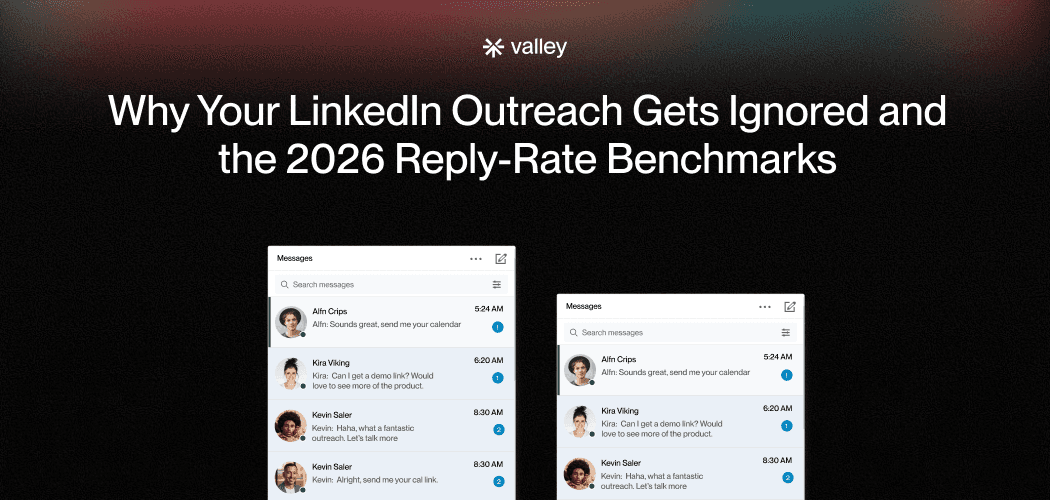
The umbrella question: “my LinkedIn messages get ignored - what am I doing wrong?” Probably nothing about your writing. The 2026 benchmarks below show the brutal truth: cold template outreach replies at 1 - 3% no matter how clever the copy, personalized cold lifts to 5 - 10%, and warm, signal-based outreach - messaging people who already viewed your profile or engaged your content - runs 15 - 45%. The gap between ignored and answered isn’t your sentences; it’s who you message and when. Fix the audience and the same message starts working.

Give your sales team
an unfair advantage.
Motion | Typical reply rate | Source of the number |
|---|---|---|
Cold template blast (bought list) | 1 - 3% | Industry norm across sequencer users |
Cold + real personalization | 5 - 10% | Community-reported ranges |
Warm: signal-based (viewers, engagers, visitors) | 15 - 45% | Valley platform band; 7.3M prospects analyzed in 2025 - warm beat cold in every segment (2.3× replies, 2.6× interested responses) |
Warm, measured examples | 22% (Linarca, steady-state founder motion) · 47% (beta cohort avg vs 8% on their own cold) · 28 - 30% interested replies across a 12-month, 2,851-demo run | Named/published Valley data |
What's a "good" reply rate? Above 10% you're outperforming most outbound on LinkedIn. Above 20% you're in warm territory. Below 5%, don't rewrite the message - re-source the list.
The five real reasons outreach gets ignored (ranked by damage)
1. You're messaging deep space. Strangers with zero prior exposure to you convert at lottery rates regardless of copy. Meanwhile the people already circling - your profile viewers, post engagers, site visitors - go unmessaged. That's the whole disease. Timing beats copy: a signal means someone moved.
2. The pitch arrives in message one. On LinkedIn, first messages that sell get archived. First messages that reference something true and recent about them get answered - which requires research, which is why lazy outreach fails at scale.
3. It reads like automation. {{firstName}} + {{company}} + "quick question" is a recognized pattern in 2026. Prospects don't reject automation; they reject obvious automation. (How to stop sounding like AI.)
4. Wrong people entirely. No ICP filter means your reply rate is diluted by people who were never going to buy. Qualification before outreach - not after - is the highest-use fix nobody makes.
5. No follow-up, or robotic follow-up. A meaningful share of replies come on touches 2 - 3. One well-spaced, context-carrying follow-up is professional; four "just bumping this" messages are spam. (The follow-up system.)
The 10-minute diagnostic: find your leak
"My outreach gets ignored" is four different diseases with four different cures. Pull your last 100 sends and check the numbers in this order:
Connection-accept rate below ~30%? The leak is upstream of your message - wrong audience or a profile that doesn't pass the three-second check. Fix targeting and your profile's landing-page job (headline that names who you help, not your title) before touching copy. Bonus: a low accept rate is also a safety signal LinkedIn watches - fixing it protects the account, not just the funnel. (The limits mechanics.)
Accepts fine, replies dead? Classic message-one disease: the pitch arrived too early, the message is about you, or it's template-shaped. Apply the anatomy below.
Replies fine, meetings dead? Not an outreach problem - a conversion problem. You're pitching the meeting before answering the question they actually asked; answer first, the calendar follows.
Everything "fine" but volume tiny? You don't have a rate problem, you have a pool problem - thin signals, over-tight ICP, or a motion that needs the systematized version to scale past Tuesday.
Most people rewrite the message when the diagnostic says the list. The table at the top of this page is the proof: the same message moves 2% → 25% when the audience changes. Run the diagnostic before the rewrite, always.
Before / after: the same outreach, fixed
Before (2% material): "Hi Sarah, I'm the founder of Acme, an AI-powered platform changing B2B sales productivity. We help companies like yours book 3× more meetings. Do you have 15 minutes this week for a quick demo?" Everything wrong at once: about the sender, claims without context, asks for time in message one, could be sent to anyone - and is.
After (warm-band material): "Hi Sarah - noticed you checked out my profile after the post on SDR ramp times. Usually that means hiring's on your plate - how are you handling the ramp problem as you scale the team?" Names the signal, references something true, asks about her problem, no calendar demand, 40 words. Same sender, same product, different physics - because the message earns the reply the signal made possible.
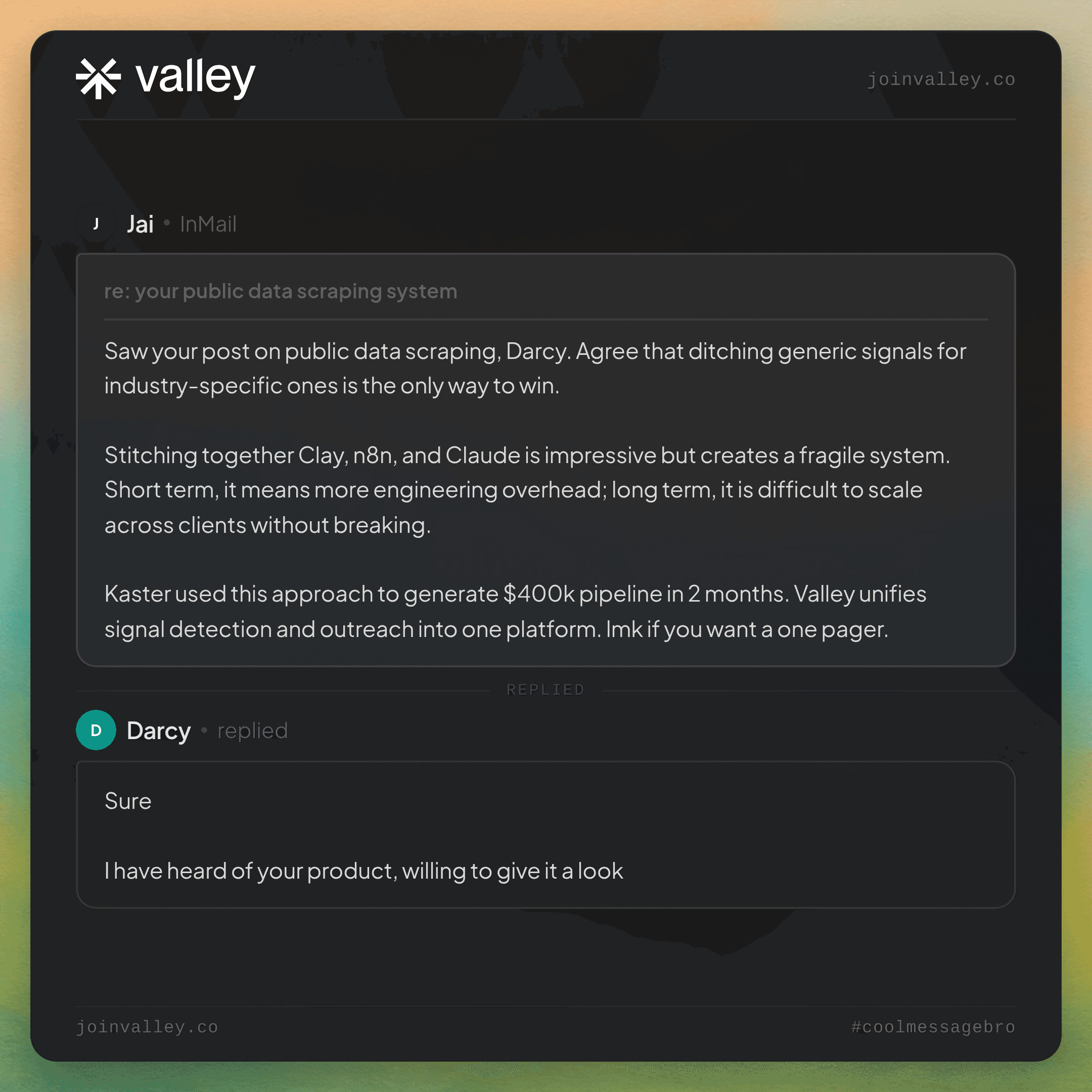
► Browse the receipts: real Valley outreach and the responses that came back

Give your sales team
an unfair advantage.
The caveat first: templates are the least important variable on this page. The same template runs 2% cold and 25% warm. Use these as shapes, not scripts:
To a profile viewer:
“Hi [name] - noticed you checked out my profile this week. Usually that means [the problem you solve] is somewhere on your radar - if so, happy to share how [specific outcome] works. If not, no worries at all.”
To a post engager:
“Hey [name], glad the post on [topic] resonated. Out of curiosity - is [the underlying problem] something you’re dealing with at [company] right now?”
To a website visitor (via signal tools):
“Hi [name] - saw [company] on our radar this week. Teams your size usually look at us when [trigger]. Worth a quick look at whether that’s what brought you by?”
Notice what all three do: name the reason for the message (the signal), reference something real, ask a low-pressure question, and stay under 60 words. That structure is the template.
Where these benchmarks come from (and how to read anyone’s)
Benchmark tables are only as honest as their provenance, so: the warm band (15 - 45%) is Valley’s platform data across its customer base, anchored by the 7.3M-prospect 2025 analysis where warm campaigns beat cold in every segment (2.3× replies, 2.6× interested responses) - same tooling, same senders, targeting as the only variable, which is what makes the comparison meaningful. The named points (Linarca’s 22%, the 47%-vs-8% beta cohort, the 28 - 30% interested-reply year) are published with customers’ names attached. The cold rows (1 - 3% template, 5 - 10% personalized) are industry norms - consistent across sequencer communities - quoted as context, not as our measurement.
How to read any vendor’s reply-rate claim, including ours: ask for the motion (cold or warm?), the denominator (50 sends or 50,000?), the metric (replies, or “engagement”?), and the era (2023 numbers describe a different LinkedIn). And one thing we deliberately don’t publish: combined LinkedIn+email reply rates for the multi-channel motion - it shipped in August 2026 and the sample isn’t meaningful yet. A benchmarks page that pads with projections stops being a benchmarks page.
Your fix-it week (the benchmarks applied)
Monday: run the 10-minute diagnostic on your last 100 sends. Write down which leak you actually have.
Tuesday: if it’s the list (it’s usually the list) - pull your profile viewers and post engagers from the last 30 days. That’s your warm pool; count the ICP fits.
Wednesday: rewrite exactly three messages using the anatomy - signal named, one true specific, one low-pressure question, under 60 words. Send to warm fits only.
Thursday: post once (a real customer question + your answer) - tomorrow’s signals are today’s content.
Friday: count replies, not sends. Ten warm messages that earn three conversations beat a hundred cold ones that earn one - and now you have your own baseline against the table above.
The following week: if the manual loop worked, you’ve proven the motion; systematize it before volume breaks it.
How to make replies systematic (not a lucky week)
Manual warm outreach breaks at exactly the moment it works - more content → more signals → more research than a human can do. The system that holds: continuous signal capture → automatic ICP scoring (non-fits removed before drafting) → per-prospect research → drafts in your voice → you approve or run vetted autopilot, inside LinkedIn’s limits. That’s Valley’s pipeline ($149/mo billed quarterly, 7-day trial), and it’s the mechanism behind the band at the top: one documented week ran 8,415 messages → 545 positive replies → 52 meetings - volume and warmth, because the list was never cold.
Related: reaching the people who viewed your LinkedIn profile.
See also: Reply.io pricing explained.
FAQ
What reply rate is good for LinkedIn outreach? 10%+ beats most outbound; 20%+ means you’re working warm signals properly; 1 - 3% means your list is cold - change the audience, not the adjectives.
Why is my cold outreach reply rate so low? Because it’s cold. 1 - 3% is the 2026 norm for template outreach to strangers; personalization lifts it to 5 - 10%. Only changing who you message (warm signals) moves it to 15 - 45%.
How do I write LinkedIn messages that get replies? Name the signal that prompted the message, reference one true specific thing, ask one low-pressure question, stay under 60 words. Then aim it at warm people - the copy is maybe 20% of the outcome.
Do LinkedIn message templates still work in 2026? As structure, yes; as scripts, no - recognized template language pattern-matches to spam instantly. Personalize from research, or use tools that draft per-prospect in your voice.
How many follow-ups should I send? One or two, spaced ~a week, each adding context. Beyond that, returns go negative and report-risk rises.
What’s a good connection-request accept rate? Above ~30% keeps you healthy (LinkedIn watches this ratio); 50%+ means your targeting and profile are working; warm-signal prospects accept at multiples of cold. Below 30%, fix audience and profile before sending another batch.
How do LinkedIn reply rates compare to cold email? Nearly identical physics: cold email templates run 1 - 3%, personalized cold 5 - 10% - the channel isn’t the variable, the warmth is. The difference is that LinkedIn shows you who’s warm (viewers, engagers), which email can’t. The 2026 motion runs both in one sequence, routed by the prospect’s behavior. (The channel decision · the cadence.)
Should I send a note with connection requests? The honest 2026 answer: test both on your audience. Blank requests to warm prospects (they recognize you) often accept better; cold requests usually earn their accept from a short, specific note. What never works: the note that pitches - save the substance for after the accept.
How long should I wait before assuming “ignored”? A week covers most real answers - busy prospects reply in batches. The one follow-up at day 6 - 8 with added context catches the “meant to reply” cohort, which is real and large. After touch two on LinkedIn, route the thread to email rather than repeating yourself; a channel switch reads as persistence, a third bump reads as pressure.
Related: Warm outbound, explained · Stop sounding like AI · LinkedIn limits 2026 · Valley case studies - the reply-rate receipts


